
MA2-MR-01 is the Stage 2 outcome in the NSW Mathematics K–10 syllabus covering multiplicative relations to 10 × 10. In plain terms: by the end of Stage 2 a student should understand the structure of multiplication and division well enough to use it to solve problems, with the facts to 10 × 10 available to them.
Most people read that outcome as “learn the times tables” and go straight to drill. That is why so many Year 4 students can chant the sixes and still cannot tell you whether 24 biscuits shared into 4 boxes is a multiplication or a division problem. This is a working guide to the outcome: what NESA is actually asking for, why structure has to come before recall, the order the facts should be built in, and what to do when a student stalls.
How to read an NSW outcome code
NSW codes are short and decode cleanly, which makes curriculum.nsw.edu.au much faster to search:
- MA - the learning area, Mathematics. (EN for English.)
- 2 - the Stage, not the year. Stage 2 is Years 3 and 4.
- MR - the focus area, Multiplicative relations. (AR is Additive relations, RN Representing numbers, PF Partitioned fractions, GM Geometric measure, and so on.)
- 01 - the outcome number within that focus area.
The stage structure is the part that trips up teachers and parents arriving from other states. NSW deliberately writes outcomes across two years, which means a Year 3 and a Year 4 student can both be working on MA2-MR-01 and both be exactly where they should be. Our guide to the NSW syllabuses covers the wider structure.
Focus areas A and B, and why the distinction matters
Inside Stage 2, NESA organises the content into Multiplicative relations A and Multiplicative relations B. A generally sits earlier in the stage and B later, and the split is roughly where Year 3 and Year 4 work fall in most schools. A is where equal groups become arrays and the smaller fact families are built; B is where the full range to 10 × 10 gets consolidated and applied to larger problems.
This matters because “the student is working on MA2-MR-01” is not precise enough to plan from or to report on. Naming the focus area tells a colleague, a parent or a NESA home-education reviewer where in the stage the student actually is, which is the difference between a useful record and a tick.
Structure before recall
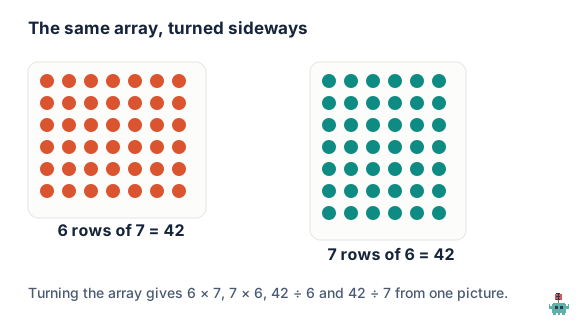
The word doing the heavy lifting in this outcome is structure. A student who has memorised 6 × 7 = 42 without structure has one isolated fact. A student who understands the structure has, from the same fact: 7 × 6, 42 ÷ 6, 42 ÷ 7, the fact that 6 × 7 is double 3 × 7, and a way to reconstruct it if they blank.
Two structural ideas carry most of the outcome:
- The array. Six rows of seven and seven rows of six are the same array turned sideways. This is not a picture that helps some students, it is the concept. It also halves the workload: because of commutativity there are not 100 facts to 10 × 10, there are 55 distinct ones, and once the easy families are in, far fewer than that remain.
- The inverse. Multiplication and division are one relationship, not two topics. Teaching them in the same lesson from the same array is faster than teaching them in separate terms and then trying to connect them, which is a job most students never finish.
The order to build the facts in
Teaching the tables in numerical order (twos, then threes, then fours) wastes the structure. Build them in the order that lets each new family lean on an old one:
- 2s, 4s, 8s. One doubling chain. Fours are double twos, eights are double fours. Three families for the price of one relationship.
- 10s, then 5s. Fives are half of tens, and students already have the skip-counting.
- 3s, then 6s. Sixes are double threes, which is the same move they used for fours.
- 9s. Ten of something minus one of something. The digit-sum pattern is a nice check but a poor explanation, so teach the reasoning first.
- The leftovers. After all of that, a very small set of genuinely hard facts remains, clustered around 6, 7 and 8. Naming that set out loud (“there are about six hard ones left, that is all”) does more for a discouraged student than another full round of the tables.
Only once a family is understood does recall practice earn its place, and then it should be short and daily rather than long and weekly. Ten minutes five times a week beats an hour on Sunday, for the reasons covered in helping with maths at home without a tutor.
The partner outcome: MA2-MR-02
MA2-MR-02 covers completing number sentences involving multiplication and division by finding missing values. It is the outcome that catches students who can compute but do not understand the relationship. A student who confidently answers 6 × 7 but freezes at 6 × ? = 42 has recall without structure, which is precisely the gap MA2-MR-01 is written to close.
Use missing-value sentences as your diagnostic, not as an end-of-unit extension. They surface the problem in about ninety seconds.
When a student stalls, go back to MA1-FG-01
The Stage 1 outcome underneath this one is MA1-FG-01, which covers using the structure of equal groups to solve multiplication problems and sharing or grouping to solve division problems. If a Stage 2 student cannot build 4 × 3 as four equal groups of three with counters, more table drill will not help. The fix is a week of equal groups and arrays with physical materials, and it is almost always faster than the months of drilling it replaces.
Ahead of MA2-MR-01 sits MA3-MR-01, selecting and applying appropriate strategies to solve multiplication and division problems in Stage 3. The word there is selects: Stage 3 assumes the Stage 2 facts and structure are in place and moves the difficulty to strategy choice and larger numbers. A student who arrives in Stage 3 without MA2-MR-01 spends the year doing Stage 2 work under Stage 3 pressure, which is the single most common cause of “suddenly bad at maths” in Year 5.
Three tasks pitched at this outcome
- The array hunt. Find real arrays: egg cartons, seating plans, tiles, an app icon grid, muffin trays. For each one, write four number sentences (two multiplications, two divisions). This is MA2-MR-01 and MA2-MR-02 in one task.
- The equal-groups story. Give the answer and ask for the problem. “The answer is 8 ÷ 4 = 2. Write a story about your soccer team that this solves.” Reversing the task exposes whether the structure is understood.
- Scale a recipe or a roster. Doubling and tripling something real gives multiplication a reason to exist, and the leftover-and-remainder conversations that come out of it lead naturally into Stage 3.
Recording the alignment
Whether you are programming for a class or building evidence for a NESA home-education review, record the outcome code and the focus area on the task itself. “Times tables practice” tells a reviewer nothing; “MA2-MR-01, Multiplicative relations B, arrays and inverse relationships, 12 May” answers the question before it is asked. Our guide to the state-by-state registration requirements covers what NSW reviewers ask for, and which curriculum your state uses covers which code set applies if you have moved states.
Sprout Lessons turns an outcome like this one into a complete interactive lesson at the stage you choose, wrapped in whatever your student is into, with worked examples, self-checking practice that hints rather than just marking wrong, and the exact NSW outcome code recorded in the lesson footer. Try it free and generate a Stage 2 multiplication lesson in about a minute.
Outcome codes reference NSW syllabuses © NSW Education Standards Authority (NESA) for and on behalf of the Crown in right of the State of New South Wales, accessed via curriculum.nsw.edu.au. NESA does not endorse this product. Always verify against the current syllabus outcomes and content.
FAQ
What is MA2-MR-01?
MA2-MR-01 is the NSW Mathematics K–10 syllabus outcome for Stage 2 covering multiplicative relations to 10 by 10: representing and using the structure of multiplication and division to solve problems. It is the outcome most people think of as "the times tables", but the emphasis on structure means understanding arrays and the inverse relationship matters as much as recall.
How do you read an NSW syllabus outcome code?
MA is the learning area (Mathematics; EN is English), the digit is the Stage rather than the year (Stage 2 is Years 3 and 4), the letters are the focus area (MR Multiplicative relations, AR Additive relations, RN Representing numbers, PF Partitioned fractions, GM Geometric measure), and the final digits are the outcome number. So MA2-MR-01 is the first Multiplicative relations outcome in Stage 2.
What years does Stage 2 cover in NSW?
Stage 2 covers Years 3 and 4. NSW deliberately writes outcomes across two years, so a Year 3 and a Year 4 student can both be working on MA2-MR-01 and both be exactly where they should be. Within the stage, NESA splits the content into Multiplicative relations A (generally earlier) and B (generally later), which is the detail worth naming when you plan or report.
What order should times tables be taught in?
Not numerical order, because that wastes the structure. Build the 2s, 4s and 8s together as one doubling chain, then 10s followed by 5s as half of tens, then 3s followed by 6s as double threes, then 9s as ten of something minus one of something. That leaves a small cluster of genuinely hard facts around 6, 7 and 8, and telling a discouraged student that only a handful remain does more than another full round of drilling.
What do you do if a Stage 2 student cannot learn their tables?
Go back to MA1-FG-01, the Stage 1 outcome on using equal groups to solve multiplication problems and sharing or grouping to solve division problems. If the student cannot build 4 x 3 as four equal groups of three with counters, more drill will not help. A week of equal groups and arrays with physical materials is almost always faster than the months of drilling it replaces.