
Wait a day, then give them one problem of the same kind with nothing on the screen. That is the whole test. If your child can do it cold, the tool taught them. If they cannot, the tool did it for them, and every session since has been producing evidence of learning rather than learning.
This is the question parents actually have about AI tutors, and it is a good question, because the honest answer is that some of them do exactly that, and the research says it is worse than not using one.
The finding worth knowing
In a 2025 study published in PNAS, Bastani and colleagues compared students practicing with no AI, with a standard chatbot, and with a version deliberately constrained to withhold answers. The constrained version helped. The unconstrained one did not just fail to help.
That is the important shape of the result, and it is the opposite of the intuition that any help is better than none. Practice where the answer is available on demand can leave a student worse off than practice with no support at all, because the effort that produces the learning is exactly the effort the tool removes.
The wider evidence base, including what the effective versions have in common, is in does AI tutoring actually work. This page is narrower: how to tell which kind you have, and what to do about it.
What should happen when a child gets stuck
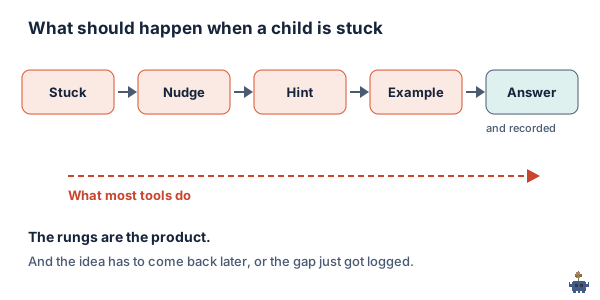
A tool that teaches has rungs between being stuck and being told. A tool that does not have one step: ask, receive.
- A nudge that is not information. “What is the question actually asking for?” This alone resolves a surprising share of stuck moments, because most of them are comprehension rather than method.
- A hint that narrows without solving. Name the operation, or the first step, or the thing to notice. Your child still has to do the work.
- A worked example of a different problem. Not this one. The same kind, fully worked, so the method is visible and the transfer is still theirs to make.
- The answer, and only then. With the method, not just the number.
- The same idea again later. If a child needed the answer on Tuesday and never meets that idea again, the tool has recorded a gap and done nothing about it.
The fifth rung is the one almost everything is missing, and it is the one that separates a tutor from a help desk. Being told the answer is not a failure if the idea comes back on Thursday. It is a failure if it does not.
Three ways to find out what you have
- The cold retest. A day later, one problem of the same type, no device. This is the only test that matters and it takes two minutes. Do it on a Saturday so it does not feel like an ambush.
- Ask them to talk you through one step. Not the whole thing. One step, and why. A child who was handed answers can usually reproduce the shape of a method and cannot say why any step follows the last.
- Watch one session over their shoulder. Count the seconds between your child being stuck and something useful appearing. Under about three seconds, with no question asked of them in between, and you have your answer.
What to ask of any product
These are answerable by looking, and they work on every tool including ours.
- Is there a hint before there is an answer, and more than one level of it?
- Is asking for the answer recorded? Not punished, recorded. A reveal is information about what your child found hard, and a tool that does not keep it has thrown away its most useful signal.
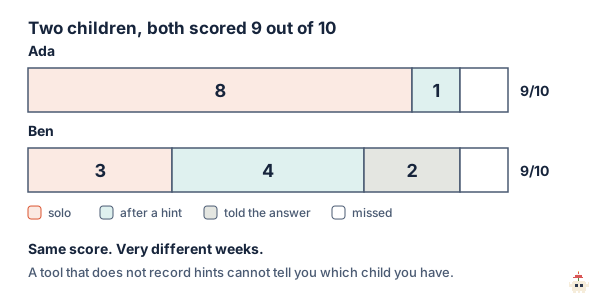
- Can you see how often hints and reveals were used? If the only number you get is a percentage correct, that percentage includes everything they were told.
- Does the same idea come back? Ask what happens to a topic your child got wrong. “It adapts” is not an answer; ask when they will see it again.
- Can your child type anything they like into it? If yes, there is no ladder, because there is always a way to phrase “just tell me”.
If it is already happening
Do not start by taking the tool away, because that frames it as a punishment for something your child was not told was wrong.
- Say the quiet part out loud. “The point is not the finished page, it is whether you can do it tomorrow.” A surprising number of children have genuinely never been told this, and some are relieved, because producing correct pages they do not understand is its own kind of stress.
- Make the retest routine and low stakes. One cold problem a day, no grading, no consequence. It reframes the goal from output to recall without anyone having a row about it.
- Put a delay in. If the tool has no hint ladder, you are the hint ladder: they have to ask you before they ask it, and you give a nudge rather than a method.
- Separate the homework from the practice. Using a tool to understand something is different from using it to finish something. The second is where this goes wrong, and it is usually a deadline problem rather than a character problem.
Where we sit, declared
We are building a tutor, so weigh that. Sprout Tutor is in development and not for sale: the tool asks the question rather than waiting to be asked, there is no open text box to talk it into giving an answer, and hint and reveal use is tracked per student alongside accuracy so an adult can see how much help a score contained. It is deliberately a narrower thing than a chatbot, which is a real cost as well as the point.
None of that exempts it from the cold retest. Run it on ours too.
The short version
The question is not whether a tool can give answers, it is whether it does so before it has tried anything else, and whether it comes back to the idea afterwards.
Wait a day and give one problem of the same kind, cold, with no device. That single test beats every feature list, and two minutes on a Saturday tells you more than a term of dashboards.
If it turns out answers were being handed over, the fix is not confiscation. Say out loud that the point is tomorrow rather than the finished page, make a cold problem a daily habit, and put yourself between your child and the tool as the first hint. And if you are choosing something new, ask the five questions above, starting with whether a reveal is recorded at all.
Sprout Lessons builds standards-aligned lessons for grades K–12, around whatever your child is actually into. Start free.
Checked 16 September 2026. The three-condition practice experiment is Bastani et al., PNAS, 2025; the fuller treatment of the evidence, including studies pointing the other way, is on our does AI tutoring actually work page. Publisher sites including pnas.org block automated fetches, so the DOI link is canonical and opens normally in a browser. This is a fast-moving field: treat the evidence position as of this date rather than as settled.
FAQ
How do I know if an AI tutor is actually teaching my child?
The cold retest. Wait a day, then give one problem of the same kind with nothing on the screen. If they can do it, the tool taught them; if they cannot, it did the work and every session since has produced evidence of learning rather than learning. Two supporting checks: ask them to talk you through one step and say why it follows from the last, and watch one session counting the seconds between being stuck and something useful appearing.
Is it actually harmful if the tool gives answers?
It can be, which is the counter-intuitive part. A 2025 PNAS study by Bastani and colleagues compared practice with no AI, with a standard chatbot, and with a version deliberately constrained to withhold answers. The constrained version helped, and the unconstrained one did not simply fail to help. Practice where the answer is available on demand can leave a student worse off than practice with no support at all, because the effort that produces the learning is the effort the tool removes.
What should a good AI tutor do when a child is stuck?
Put rungs between stuck and told. First a nudge that is not information, such as asking what the question is actually looking for, which resolves a surprising share of stuck moments because most are comprehension rather than method. Then a hint that narrows without solving. Then a worked example of a different problem of the same kind. Then the answer, with the method rather than just the number. And then the same idea again later, which is the rung almost everything is missing.
Should a tutor ever just tell my child the answer?
Yes, eventually, and the mistake is treating that as the failure. Being told is fine if the idea comes back later in the week; it is a failure if it never returns. What matters more is whether the reveal was recorded. A request for the answer is information about what your child found hard, and a tool that does not keep it has thrown away its most useful signal, as well as inflating whatever accuracy figure it shows you.
What if my child is already using it to finish homework?
Do not start by taking it away, because that frames it as punishment for something nobody told them was wrong. Say the quiet part out loud, that the point is whether they can do it tomorrow rather than the finished page; some children are relieved, because producing correct work they do not understand is its own stress. Make a cold problem a daily low-stakes habit, and separate using a tool to understand something from using it to finish something, since the second is usually a deadline problem rather than a character problem.
Can my child talk any tool into giving the answer?
If there is an open text box, yes, because there is always a way to phrase just tell me. That is the practical reason a narrower tool behaves differently from a general assistant: not better intentions, but no surface to negotiate with. It is also a real cost, since a bounded tool cannot help with the specific worksheet in front of them or answer a question outside its curriculum.