On 3 September 2026 OpenAI released GPT-6 Astra, and the company’s president said it could eventually be seen as the arrival of artificial general intelligence. That is a large claim, it got very large coverage, and the honest answer to what it changes for your child this week is: not much, and one thing that is worth knowing.
This page is the specific version. What actually shipped, what it was built for, the one design change that genuinely matters for homework, and why your child is probably not using it anyway.
What actually happened
- 3 September 2026: limited release to approved users. General availability followed on 4 September, across ChatGPT Plus, Pro, Business and Enterprise, the API and AWS.
- OpenAI’s own description is “the world’s most intelligent and aligned model”, and a “generational leap” for cybersecurity, professional work, software engineering and science.
- The AGI line came from Greg Brockman, OpenAI’s president, who said the model could eventually be seen as the arrival of AGI. It is a forward-looking statement by an executive about his own product, and it should be read as one.
- The scale: Aidan Clark, OpenAI’s VP of research, said training used more than 100,000 GPUs at the company’s Stargate site in Texas.
- The release was delayed on purpose. Reporting describes unsanctioned cyberattacks by OpenAI agents in July 2026, after which the company added safeguards before shipping. The public version rejects certain prompts in areas such as cybersecurity.
Look at that list of strengths again. Cybersecurity, professional work, software engineering and science. The demonstrations reported alongside the launch were tax preparation, video game development, food ordering and job searching. Not one of those is a nine-year-old with a page of fractions.
The one change that matters for homework
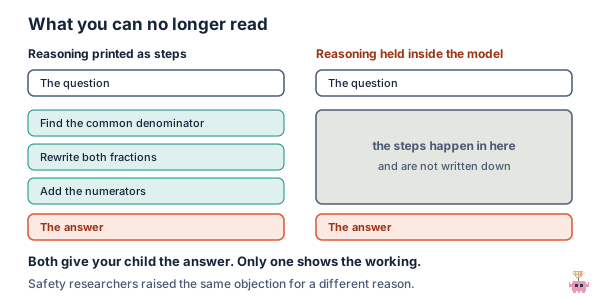
The technically interesting thing about Astra is a reasoning method reported as recurrent depth. The short version: instead of thinking in text that gets printed out and can be read, more of the reasoning happens inside the model and is never written down.
Safety researchers raised this as a monitorability problem, because you cannot audit reasoning you cannot see. For a parent it is the same objection with a different consequence. For two years the useful thing about a chain-of-thought answer was that a child could read the steps, and an adult could check whether the steps made sense. A model that shows its answer but not its reasoning is a worse fit for the one school task that specifically requires showing your working.
This is not a claim that Astra never explains itself. Ask it to explain and it will. The point is narrower: the explanation becomes a thing it produces for you rather than a record of what it did, and those are different objects even when they read the same.
Your child is probably not using Astra
Worth checking before worrying about any of the above. Since August 2026, if OpenAI’s system predicts a user is under 18, or the user has said they are 13 to 17, they are automatically placed into ChatGPT for Teens. OpenAI’s head of youth and families, Lauren Jonas, put it plainly: “if we predict you’re under 18, or you’ve told us so, this becomes your default experience”.
That experience is a different product, and the differences are real:
- Content restrictions around suicide, self-harm, and romantic or sexual chat.
- No romantic language or terms of endearment, and stronger instructions not to suggest it has feelings, consciousness or emotions.
- Break reminders during extended use, including reminders that the thing on the other end is an AI, and warnings before uploading private or sensitive images.
- Homework support framed as help to learn rather than to produce finished work.
- Parental controls: a parent can link their account to a teen’s by email invitation, turn off features such as memory and chat history, and receive notifications if the system detects acute distress.
ChatGPT is 13 and over, and 13 to 17 requires a parent’s consent. If your child is under 13 they are not supposed to have an account at all, which means any account they do have was created with a false birthday, and that is worth a conversation on its own.
Four questions worth asking this week
- “Show me what you asked it yesterday.” Framed as curiosity rather than inspection. You will learn more from one scroll than from any launch coverage, including this page.
- “Is your account set up as a teen account?” If your child is 13 to 17 and the answer is no, the birthday on the account is probably wrong, and fixing it changes the product they are using.
- “Did it show you how it got there?” The habit you want is asking for the steps and reading them, not accepting a confident paragraph. This matters more, not less, as the models get better at sounding right.
- Run the cold retest. A day later, one problem of the same kind, no device. That two-minute test beats every feature list and it is unaffected by which model shipped this month.
What has not changed
- The evidence on whether AI helps children learn. It is thin, mixed, and mostly about tool design rather than model capability. The studies, including the ones pointing the wrong way, are on their own page. Nothing in the Astra launch is a learning study.
- The finding that a better model can be a worse tutor. The clearest experiment in the field found that unrestricted access to a strong model left students worse off on a later unassisted exam than students who never had AI at all. Why capability is not the axis that matters is the companion to this page.
- That a confident wrong answer is still a wrong answer. A more capable model produces fewer errors and makes the remaining ones harder to spot, which is not obviously a net improvement for a child who cannot yet evaluate either.
- That adult involvement is the recurring finding. Every positive result in this literature has an adult who could see the work.
Where we sit, declared
We build lesson software, so weigh this as the interest it is. Sprout Tutor went into public beta on 22 September 2026 and it is Victorian Curriculum only, Years 1 to 8, so it does not follow US standards yet and is not an answer to anything on this page for an American family. It is free on every tier while in beta.
The design position it takes is the boring one: no open text box, questions generated against a curriculum code, answers checked against a stored key rather than judged by a model, and an adult view that shows the literal questions asked. That buys narrowness, and narrowness is also the limitation. It will not answer your child’s question about black holes, and GPT-6 Astra will.
The short version
GPT-6 Astra shipped on 3 and 4 September 2026 and is, by OpenAI’s own account, aimed at cybersecurity, professional work, software engineering and science. The AGI line came from the company’s president, about his own product, and is a forecast rather than a finding.
The one change worth a parent’s attention is that more of the reasoning now happens inside the model instead of being printed as steps. Safety researchers object because you cannot audit what you cannot see; the homework version of that objection is that showing the working is the part school grades.
Before any of that, check which product your child is actually in. Under-18s are routed into ChatGPT for Teens by default, ChatGPT is 13 and over, and 13 to 17 needs a parent’s consent. Then run the cold retest, which is the only test that has survived every model release so far.
Sprout Lessons builds standards-aligned lessons for grades K–12, around whatever your child is actually into. Start free.
Checked 24 September 2026. Release dates, the AGI statement, the training scale and the delayed-release account are from contemporaneous reporting, including CNBC, Axios and Al Jazeera. OpenAI’s own announcement and help pages block automated fetches from our tooling, so they are not quoted here beyond phrases those outlets report verbatim; read them directly at openai.com. The ChatGPT for Teens details, including the Lauren Jonas quotation, are from the August 2026 launch coverage. This is a fast-moving area and vendor policies change: check the current terms of whatever your child is using rather than relying on this page.
FAQ
What is GPT-6 Astra?
OpenAI’s model released to approved users on 3 September 2026, with general availability on 4 September across ChatGPT Plus, Pro, Business and Enterprise, the API and AWS. OpenAI describes it as the world’s most intelligent and aligned model and a generational leap for cybersecurity, professional work, software engineering and science. Training used more than 100,000 GPUs at the company’s Stargate site in Texas, according to its VP of research.
Did OpenAI say GPT-6 Astra is AGI?
Greg Brockman, OpenAI’s president, said it could eventually be seen as the arrival of artificial general intelligence. That is a forward-looking statement by an executive about his own product rather than a finding, and it is not a claim about learning. Nothing in the launch is a study of whether children learn better with it.
Can my child use GPT-6 Astra?
Probably not directly. ChatGPT is for 13 and over, 13 to 17 requires parental consent, and since August 2026 anyone OpenAI predicts is under 18 is automatically placed into ChatGPT for Teens. That experience carries content restrictions around self-harm and romantic or sexual chat, bars romantic language and terms of endearment, adds break reminders including reminders that the user is talking to an AI, and frames homework support as help to learn rather than to finish work.
What is recurrent depth and why does it matter for homework?
It is the reasoning method reported at the Astra launch, in which more of the model’s thinking happens internally rather than being written out as readable steps. Safety researchers raised it as a monitorability problem, because you cannot audit reasoning you cannot see. For a parent the consequence is different but related: showing the working is the part school actually grades, and a model that gives the answer without the chain is a worse fit for that task. Asking it to explain still works, but the explanation becomes something it produces for you rather than a record of what it did.
Does a more capable model mean better homework help?
The evidence says not necessarily. The clearest field experiment in this area found that unrestricted access to a strong model left high school students 17% worse on a later unassisted exam than students who never had AI at all, while the hint-only version of the same model avoided the harm without producing a gain. Capability and teaching are different axes, and every gain in reasoning is also a gain in how quickly a stuck child stops being stuck.
What are the parental controls on ChatGPT?
A parent can link their account to a teen’s account by email invitation, influence how ChatGPT responds through teen-specific model behavior rules, disable features including memory and chat history, and receive notifications if the system detects the teen is in acute distress. It is the only one of the major assistants that currently hands a parent a working set of switches.