
Two of the three answer themselves. Claude does not allow anyone under 18 to have an account at all, and school Gemini is not your decision to make. That leaves a much smaller question than the one most comparison pages spend two thousand words on, and it is answerable in an afternoon.
September 2026 was a heavy month for launches. Anthropic shipped Claude Fable 5.1 on the 1st, OpenAI shipped GPT-6 Astra on the 3rd, and both were described by their makers in superlatives. Neither announcement is about children. The age rules and the design choices decide this, not the benchmarks.
Start with who is allowed to use what
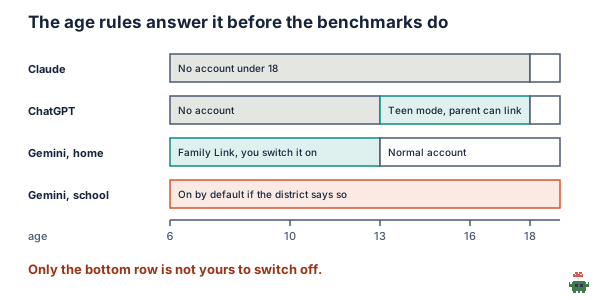
Claude: 18 and over, no exceptions
Anthropic’s own support page is unambiguous: “We require all users to be at least 18 years old to create and use a Claude account.” Enforcement is being rolled out in stages by US state as age-verification laws take effect, using age signals the app stores pass to developers.
So whatever Claude Fable 5.1 scores on anything, it is not a product your child is permitted to use, and that is Anthropic’s position rather than an oversight. If a child in your house has a Claude account, it was created with a false age, and it may stop working without warning when enforcement reaches your state.
ChatGPT: 13 and over, with a parent, and a separate teen product
ChatGPT is not for under-13s, and 13 to 17 requires parental consent. Since August 2026 there is also a distinct experience: if OpenAI’s system predicts a user is under 18, or they have said they are 13 to 17, they are placed into ChatGPT for Teens automatically. Content restrictions around self-harm and romantic or sexual chat, no terms of endearment, stronger instructions not to claim feelings, break reminders, and homework support framed as help to learn rather than to finish.
The parental controls are real and worth five minutes. Link your account to your teen’s by email invitation, turn off memory and chat history if you want to, and receive a notification if the system detects acute distress. This is the only one of the three where a parent gets a switch that is actually theirs.
Gemini: depends entirely on whose account it is
On a personal account, a child under 13 can only use it on a supervised account that a parent enables through Family Link. On a school account it is a different story. Since August 2026 it is on by default at any age wherever the district had Gemini enabled, and there is no parent switch. The controls sit with the administrator. The full account of what changed and what to ask the school is its own page.
What these products are actually for
Read the launch announcements and the answer is obvious, which is why it is odd that so few comparison pages mention it.
- Claude Fable 5.1 is described by Anthropic as one of “the world’s most advanced models for coding and knowledge work”. The evidence offered is molecular design, a high-resolution elevation map of Venus, and scores on Terminal-Bench-Science and CursorBench. The restricted sibling, Mythos 5.1, is available only to a set of US organizations working in cybersecurity and life sciences.
- GPT-6 Astra is pitched by OpenAI as a “generational leap” for cybersecurity, professional work, software engineering and science, and the demonstrations reported at launch were tax preparation, video game development, food ordering and job searching.
- Gemini in Classroom is the one of the three actually aimed at students, which is precisely why it is the one that arrived without asking you.
Nobody at the frontier is racing to teach your ten-year-old fractions. That is not a criticism of these companies. It is the single most useful fact for deciding how much of this news is about you.
The comparison that actually matters
If your child is over 13 and you are choosing, these are the questions worth the time, in this order.
- Does it hand over answers? This is the only one with hard evidence behind it. A large field experiment found that unrestricted access to a strong model left students 17% worse on a later unassisted exam than students who never had AI at all. Capability is not the axis that matters.
- Can you see what happened? Chat history, and whether the product lets you read it. ChatGPT’s teen linking gives you a lever here; a school Gemini account does not.
- Does it show its working? Increasingly the answer is less than it used to be. Astra moves more of its reasoning inside the model, which is a real change for a child who is supposed to be learning from the steps.
- What happens when it is confidently wrong? All three produce errors, and a fluent register makes them hard to spot. A child cannot evaluate a confident wrong explanation, because evaluating it requires the knowledge they came to get.
- Who can switch it off? For school-issued tools, usually not you.
What we would actually do
- Under 13: none of them, and mean it. Two of the three forbid it outright and the third needs a supervised account you set up deliberately. There is no version of this where a false birthday is the good option.
- 13 to 17: ChatGPT with the teen account and the parent link switched on, if you are picking one. Not because the model is better, but because it is the only one of the three that hands a parent a working set of controls.
- Check what the school has already decided. For a lot of families the real answer is Gemini, because it is already on, and nobody asked.
- Use it in the same room for the first two weeks. Not supervision, proximity. You will learn more in two sessions than from any comparison table, ours included.
- Agree out loud what it is not for. Finishing work that gets graded is the line most worth drawing, and the cold retest tells you whether it is holding.
Where we sit, declared
We make lesson software and we use several of these models to build it, so weigh this accordingly. Sprout Tutor entered public beta on 22 September 2026 and covers the Victorian Curriculum only, Years 1 to 8, so it does not follow US standards yet and is not a candidate for an American family today. It is free on every tier while in beta.
It also is not the same kind of thing as the three above. There is no open text box, questions are generated against a curriculum code and checked against a stored answer, and the adult view shows the literal questions asked. That is a narrower product on purpose, and the cost of the narrowness is that it cannot do the thing a general assistant does well.
The short version
Claude is 18 and over by Anthropic’s own rule, so for a child it is not a choice. ChatGPT is 13 and over with parental consent, routes under-18s into a separate teen product by default, and is the only one of the three that gives a parent real controls. Gemini depends on whose account it is: Family Link at home, and the district at school, where it is on by default and there is no parent switch.
Neither September launch was built for children. Fable 5.1 is sold on protein design and coding benchmarks; Astra is sold on cybersecurity and professional work. The only one of the three aimed at students is the one that turned up without asking.
So skip the benchmark table. Ask whether it hands over answers, whether you can see what happened, whether it shows its working, and who can switch it off. Then sit in the same room for two weeks.
Sprout Lessons builds standards-aligned lessons for grades K–12, around whatever your child is actually into. Start free.
Checked 24 September 2026. The Claude minimum age is quoted from Anthropic’s own support page. Claude Fable 5.1 and Mythos 5.1 capabilities and availability are from Anthropic’s announcement. The GPT-6 Astra and ChatGPT for Teens details are from contemporaneous reporting of OpenAI’s September and August 2026 announcements, because openai.com and its help center block automated fetches from our tooling; read them directly at openai.com. The Gemini position is as set out on our own Gemini for students page, sourced there from Google’s Workspace and Family Link documentation. This is a fast-moving area and vendor terms change: check the current policy of whatever your child is using rather than relying on this page.
FAQ
Can my child use Claude?
No. Anthropic’s support page states that it requires all users to be at least 18 years old to create and use a Claude account, and enforcement is being rolled out in stages by US state using age signals that app stores pass to developers. That applies regardless of how Claude Fable 5.1 scores on anything. If a child in your house has a Claude account it was created with a false age and may stop working without warning.
How old do you have to be to use ChatGPT?
Thirteen, and 13 to 17 requires parental consent. Since August 2026 anyone OpenAI predicts is under 18, or who has said they are 13 to 17, is automatically placed into ChatGPT for Teens, which adds content restrictions, bars romantic language and terms of endearment, adds break reminders, and frames homework support as help to learn rather than to finish work. Parents can link their account to a teen’s, disable memory and chat history, and receive distress notifications.
Which AI is best for kids doing homework?
Of the three, ChatGPT with a teen account and the parent link switched on, if your child is 13 to 17. Not because the model is better but because it is the only one of the three that gives a parent working controls. Under 13 the answer is none of them: two forbid it outright and the third needs a Family Link supervised account you set up deliberately.
Were Claude Fable 5.1 and GPT-6 Astra built for students?
No. Anthropic describes Fable 5.1 and Mythos 5.1 as the world’s most advanced models for coding and knowledge work, evidencing it with molecular design, a high-resolution Venus elevation map and scores on Terminal-Bench-Science and CursorBench, with Mythos restricted to a set of US organizations in cybersecurity and life sciences. OpenAI pitches Astra as a generational leap for cybersecurity, professional work, software engineering and science. The only one of the three actually aimed at students is Gemini in Classroom, which is why it is the one that arrived without asking parents.
Who controls Gemini on my child’s school account?
The district administrator, not you. Since August 2026 it has been on by default at any age wherever the school’s administrator had Gemini enabled, and there is no parent switch. On a personal account the picture is different: a child under 13 can only use it on a supervised account that a parent enables through Family Link.
What should I ask before picking one?
Five things, in order. Does it hand over answers, or is there a hint ladder. Can you see what happened. Does it show its working, which is becoming less true as models move reasoning inside themselves. What happens when it is confidently wrong. And who can switch it off, which for school-issued tools is usually not you.