
Year 1 Maths in the Australian Curriculum Version 9 is 15 content descriptions, AC9M1A01 through AC9M1ST02. The number is smaller than Foundation’s 12 might suggest, because Year 1 is where the curriculum stops asking children to act things out with materials and starts asking them to structure numbers. The biggest single descriptor in the whole primary sequence, tens and ones, lands this year.
This is a working guide to all 15 codes: what changes from Foundation, the three descriptors that decide whether Year 2 goes well, a term-by-term order, and the checks that tell you whether a child is ready to move on.
What changes this year
Foundation is entirely oral and material: no symbols, no recorded equations, everything acted out with counters and talk. Year 1 introduces structure. AC9M1N02 asks students to partition two-digit numbers into tens and ones, which is the first time the curriculum asks a child to see a number as ten groups of something rather than a pile of individual units. Numbers also stretch from “at least 20” to “at least 120”, which is not a bigger version of the same skill, it is a different skill: nobody subitises 120, so a child has to trust the structure of the number system instead of counting everything one at a time.
Measurement makes a parallel move. Foundation compares things directly, side by side. Year 1 introduces informal units (AC9M1M02), where a length gets measured by laying paperclips or blocks end to end and counting them. It is the same conceptual leap as tens and ones: from a whole compared to another whole, to a whole built out of countable, uniform parts.
The year at a glance
| Strand | Codes | What it covers |
|---|---|---|
| Number | 6 (AC9M1N01–06) | Numbers to at least 120, partitioning into tens and ones, skip counting, adding and subtracting within 20, and modelling money and sharing situations |
| Algebra | 2 (AC9M1A01–02) | Skip-counting pattern sequences, and repeating patterns with an identified unit |
| Measurement | 3 (AC9M1M01–03) | Direct and indirect comparison, measuring length with informal units, and describing duration using calendar units and hours |
| Space | 2 (AC9M1SP01–02) | Making, comparing and classifying shapes, and giving and following directions |
| Statistics | 2 (AC9M1ST01–02) | Acquiring and recording categorical data, and representing and comparing it |
There is still no Probability strand. It starts at Year 3 with AC9M3P01. Number remains the largest strand at six of fifteen codes, and it is the strand carrying the year’s conceptual weight.
Reading the codes
From Year 1 the pattern is AC9 + M + year + strand + number, so AC9M1N01 is Year 1 Number, position 1. Foundation is the exception, where the year is written as F rather than a digit. The strand letters are N Number, A Algebra, M Measurement, SP Space, ST Statistics, and from Year 3, P Probability.
Strand by strand
Number (AC9M1N01 to AC9M1N06)
AC9M1N01 and AC9M1N03 extend Foundation’s counting pair to at least 120: recognising, representing and ordering numbers, then quantifying sets by partitioning into equal groups and skip counting rather than counting one by one. AC9M1N02 is the new arrival, partitioning one- and two-digit numbers in different ways, explicitly including tens and ones. It is the single most load-bearing descriptor in the year.
AC9M1N04 extends Foundation’s part-part-whole work into adding and subtracting within 20, using part-part-whole knowledge to 10 and a variety of calculation strategies. AC9M1N05 and AC9M1N06 are the applied pair: mathematical modelling of additive situations including simple money transactions, and of equal sharing and grouping. Symbols and diagrams are expected here in a way Foundation never asked for.
Algebra (AC9M1A01 to AC9M1A02)
AC9M1A01 is skip-counting pattern sequences, initially by twos, fives and tens, which ties Algebra directly to the counting work in Number. AC9M1A02 is repeating patterns with the repeating unit identified, extending Foundation’s AC9MFA01 by requiring the student to name the unit rather than just continue the pattern.
Measurement (AC9M1M01 to AC9M1M03)
AC9M1M01 adds indirect comparison to Foundation’s direct comparison: using a third object to compare two things that cannot be placed side by side. AC9M1M02 is the informal-units descriptor discussed above. AC9M1M03 extends Foundation’s calendar language to include hours, which is the first appearance of clock-adjacent vocabulary, though reading a clock face is not required until later years in the Australian Curriculum.
Space (AC9M1SP01 to AC9M1SP02)
AC9M1SP01 extends shape work from naming to making, comparing and classifying, with an explicit similarities-and-differences requirement. AC9M1SP02 turns Foundation’s positional vocabulary active: giving and following directions to move people and objects, which is where positional language becomes something a child does rather than just says.
Statistics (AC9M1ST01 to AC9M1ST02)
AC9M1ST01 is acquiring and recording data for categorical variables, including with digital tools, which is new: Foundation’s AC9MFST01 only asked for objects and images. AC9M1ST02 is representing that data with one-to-one displays and comparing using frequencies. Together they turn Foundation’s informal object-lines into something closer to a real graph, still built from countable, physical units.
The three codes that decide Year 2
AC9M1N02: tens and ones
The misconception: that a two-digit number is a pile of ones that happens to be written with two digits. A child can read and write “34” correctly while believing it names 34 separate, unstructured units.
What you will see: asked to show 34 with materials, the child counts out 34 individual counters one at a time instead of building three groups of ten and four ones. Asked which digit is worth more in 34, they may say the 4 because “it’s the last one you say”, revealing that the positions carry no value for them yet.
The fix: bundle and unbundle physically, every day, with the same materials (icy pole sticks in rubber bands, or bundling straws). Build a number as loose ones first, then bundle into tens and see the count shrink to a manageable size. The moment worth protecting is watching a child choose to bundle into tens without being told, because that is the structure landing rather than being performed.
AC9M1N04: adding and subtracting within 20
The misconception: that every addition problem is solved by counting from one. A child who can correctly answer 7 + 5 by counting “1, 2, 3…12” on fingers looks successful, but has not built the part-part-whole knowledge to 10 the descriptor names, and will hit a wall the moment numbers exceed finger count.
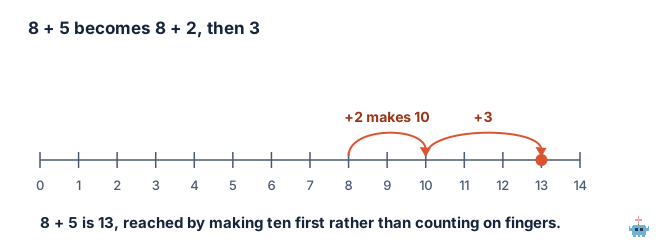
What you will see: a long pause and finger movement for facts that should be near-instant, especially any pair that bridges through ten (8 + 5, 9 + 6). Ask the child to solve 8 + 5 without fingers and watch whether they reach for 8 + 2 + 3, or simply stall.
The fix: make bridging to ten the explicit strategy, not an incidental one. 8 + 5 becomes 8 + 2 (makes 10) + 3. This only works if part-part-whole to 10 from Foundation (AC9MFN04) is actually secure, which is why a Year 1 student stuck here often needs a week revisiting number bonds to 10 rather than more addition worksheets.
AC9M1M02: units must be uniform and end-to-end
The misconception: that measuring means laying objects roughly along a length and counting however many fit. Gaps between units, overlaps, and mixing different sized units all produce a number that feels like a measurement without being one.
What you will see: a child measures the same desk twice with the same unit and gets two different answers, and is not troubled by the discrepancy. Or they measure with a mix of large and small blocks and report the total count as if the unit size did not matter.
The fix: deliberately measure with a unit too small to space out easily (small cubes), so gaps are visually obvious, then repeat with a unit that is prone to overlap. Comparing two students’ measurements of the same object using different units is the fastest way to surface why uniformity matters, because the disagreement becomes the lesson.
What students need to arrive with
Year 1 leans on three Foundation codes directly. AC9MFN04 (part-part-whole to 10) is the prerequisite for AC9M1N04. AC9MFN01 and AC9MFN03 (counting and quantifying to 20) are the prerequisite for extending to 120 in AC9M1N01 and AC9M1N03. AC9MFA01 (repeating patterns) is the prerequisite for AC9M1A02. A child who arrives without secure part-part-whole knowledge to 10 should not start bridging-to-ten strategies; the fix is a short return to Foundation part-part-whole work rather than pushing ahead into Year 1 addition.
What this year sets up
- AC9M1N02 (tens and ones) becomes Year 2’s extension into hundreds, tens and ones, the next layer of the same place value structure.
- AC9M1N04 (addition and subtraction within 20) becomes Year 2’s extension to larger numbers and more efficient mental strategies, building on the same bridging-to-ten approach.
- AC9M1A01 (skip counting) becomes the direct lead-in to multiplication, since skip counting by twos, fives and tens is repeated addition in disguise.
- AC9M1M02 (informal units) becomes Year 2’s introduction to formal units, metres and centimetres, once the idea that units must be uniform is secure.
Our guide to which curriculum your state uses is worth checking if you are unsure whether AC9, VC2 or a NSW syllabus applies to your child.
A term-by-term order
- Term 1: extend and consolidate. AC9M1N01 and AC9M1N03 counting and quantifying to 50, AC9M1SP01 and AC9M1SP02 shapes and directions, and AC9M1M01 direct and indirect comparison. This confirms Foundation held before adding new structure.
- Term 2: tens and ones. AC9M1N02 as the centrepiece, daily bundling and unbundling, alongside AC9M1A01 skip counting by tens, which reinforces the same structure from a different angle.
- Term 3: addition, subtraction and units. AC9M1N04 bridging to ten, AC9M1M02 measuring with informal units, and AC9M1A02 repeating patterns with the unit named.
- Term 4: apply and extend. AC9M1N05 and AC9M1N06 modelling money and sharing situations, numbers extended to 120, AC9M1M03 duration and hours, and AC9M1ST01 and AC9M1ST02 collecting and representing categorical data, which draws on the counting and comparing skills built all year.
Tens and ones sits in Term 2 rather than later because everything from Term 3 onward, bridging strategies, larger numbers, formal units, assumes it is already there.
Assessment checkpoints
- Number: show 34 with materials. Bundling into three tens and four ones confirms AC9M1N02; counting out 34 loose ones means reteach place value with bundle-and-unbundle before moving on.
- Algebra: ask the child to continue a skip-counting sequence by fives past 50 without a hundreds chart. Success confirms AC9M1A01; reliance on the chart means reteach skip counting with physical groups of five first.
- Measurement: have the child measure the same object twice with the same informal unit. Matching answers confirm AC9M1M02; mismatched answers mean reteach uniform, end-to-end placement with a unit that makes gaps obvious.
- Space: ask the child to give three directions to move an object to a target location. Following through in order confirms AC9M1SP02; stalling after one step means reteach positional language before adding sequence.
- Statistics: from a class survey the child helped collect, ask which category had the most and how they know. A frequency-based answer confirms AC9M1ST02; reteach comparing displays with a two-category question if the answer is guesswork.
Recording the alignment
Whether you are programming for a class or building evidence for a homeschool registration review, record the code on the activity as you go. “Maths games” tells a reviewer nothing; “AC9M1N02, tens and ones with bundling straws, 12 May” answers the question before it is asked. Our guide to state-by-state registration requirements covers what reviewers actually ask for, and teaching maths through interests covers how to wrap these codes around whatever your child is currently into.
Sprout Lessons builds a full interactive lesson from any of these codes, pitched at Year 1 and wrapped in whatever your student is into, with self-checking practice that hints rather than just marking wrong, and the exact AC9 code recorded in the lesson footer. Try it free and generate a Year 1 Maths lesson in about a minute. You can also browse ready-made Year 1 Maths lessons against these codes directly.
Australian Curriculum content descriptions are © ACARA and licensed under CC BY 4.0. Quoted here unmodified. ACARA does not endorse this product. Always verify against the current content descriptions and achievement standards at australiancurriculum.edu.au.
FAQ
How many maths codes are there in Year 1 of the Australian Curriculum?
Fifteen: six in Number (AC9M1N01 to AC9M1N06), two in Algebra (AC9M1A01 and AC9M1A02), three in Measurement (AC9M1M01 to AC9M1M03), two in Space (AC9M1SP01 and AC9M1SP02) and two in Statistics (AC9M1ST01 and AC9M1ST02). There is still no Probability strand; it starts at Year 3 with AC9M3P01.
What is the most important Year 1 maths code?
AC9M1N02, partitioning one- and two-digit numbers, including into tens and ones. It is the first time a child is asked to see a number as structured groups rather than a pile of individual units, and everything from Term 3 onward, bridging strategies, larger numbers, formal units, assumes it is already secure.
What changes between Foundation and Year 1 maths?
Foundation is entirely oral and material, with no symbols or recorded equations. Year 1 introduces structure: numbers extend from at least 20 to at least 120, place value arrives through partitioning into tens and ones, and measurement moves from direct comparison to counting informal units laid end to end.
Why do children keep getting decimals wrong in Year 1 addition problems?
Year 1 does not cover decimals. The equivalent stumbling block is bridging to ten in addition and subtraction within 20 (AC9M1N04). A child who counts from one on their fingers for every fact has not built part-part-whole knowledge to 10, and needs a short return to Foundation number bonds rather than more addition worksheets.
How do I check if my child is ready to move from Year 1 to Year 2 maths?
Ask them to show a two-digit number like 34 using materials. Bundling into three tens and four ones confirms tens-and-ones understanding (AC9M1N02); counting out 34 loose units means the place value structure has not landed and is worth reteaching before moving on.