
Year 1 Maths in the Victorian Curriculum F–10 Version 2.0, officially Level 1, is 15 content descriptions, VC2M1A01 through VC2M1ST02. Thirteen of them map straight onto the national Year 1 curriculum with no meaningful difference, but the two that differ, both in Algebra, point at something distinctly Victorian: numeracy tied to money from the first pattern-sequence lesson of the year, and problem solving named as its own goal rather than left implicit.
This guide covers all 15 codes, the two genuine points of difference from the Australian Curriculum, the three descriptors that decide whether Level 2 goes well, a term-by-term order, and five checks before moving on.
What Victoria does differently at Level 1
Swap the VC2 prefix for AC9 and, for thirteen of the fifteen codes, you land on a descriptor that says the same thing in the same words. That makes translation easy, and it makes the two exceptions easy to miss because nothing in the numbering flags them.
- VC2M1A01 names Australian coins as a context. Both curricula ask students to recognise, continue and create pattern sequences formed by skip counting in twos, fives and tens. Victoria explicitly lists Australian coins as material for this work, which is not decoration: five- and ten-cent groupings are skip counting by fives and tens with a real object attached, and it is the most natural bridge in the whole year between the Algebra strand and the money work students meet in Number.
- VC2M1A02 names problem solving as the point. The national descriptor asks students to recognise, continue and create repeating patterns and identify the repeating unit. Victoria adds that students should recognise why repetition matters for solving problems, which pushes the lesson past “spot the pattern” into using a known pattern to predict something you have not seen yet, such as which colour comes fifteenth in a sequence without counting there one step at a time.
A third point of continuity rather than difference: Victorian students met simple financial situations back at Foundation (VC2MFN05), a year before the national curriculum introduces money. By Level 1 a Victorian child has already handled the shop-corner version of money; VC2M1N05’s simple money transactions are a step up in formality, not a first encounter. For the wider comparison, see the Victorian Curriculum versus the Australian Curriculum.
The level at a glance
| Strand | Codes | What it covers |
|---|---|---|
| Number | 6 (VC2M1N01–06) | Numbers to at least 120, partitioning into tens and ones, skip counting, adding and subtracting within 20, and modelling money and sharing situations |
| Algebra | 2 (VC2M1A01–02) | Skip-counting pattern sequences including with Australian coins, and repeating patterns with the value of repetition made explicit |
| Measurement | 3 (VC2M1M01–03) | Direct and indirect comparison, measuring length with informal units, and describing duration using calendar units and hours |
| Space | 2 (VC2M1SP01–02) | Making, comparing and classifying shapes, and giving and following directions |
| Statistics | 2 (VC2M1ST01–02) | Acquiring and recording categorical data, and representing and comparing it |
No Probability strand yet, it begins at Level 3. Number carries six of fifteen codes and the year’s conceptual weight, exactly as it does nationally.
Reading the codes
Victorian Maths codes run VC2 + M + level + strand + number, so VC2M1N01 is Level 1 Number, position 1. At Foundation the level is written as F; from Level 1 it is a digit, and in primary school the level number matches the year number, so Level 1 is the same cohort as Year 1. That stops being true in secondary school, where Levels 9 and 10 cover the same two years as Years 9 and 10 combined for some subjects, but it does not affect primary Maths.
Strand by strand
Number (VC2M1N01 to VC2M1N06)
VC2M1N01 and VC2M1N03 extend the counting pair from Foundation to at least 120: recognising, representing and ordering numbers, then quantifying sets by partitioning into equal groups and skip counting rather than counting one by one. VC2M1N02 is the new arrival this level, partitioning one- and two-digit numbers in different ways, explicitly including tens and ones. It is the single most load-bearing descriptor of the year.
VC2M1N04 extends part-part-whole work into adding and subtracting within 20, using part-part-whole knowledge to 10 and a range of calculation strategies. VC2M1N05 and VC2M1N06 are the applied pair, modelling additive situations including simple money transactions, and equal sharing and grouping, with diagrams and calculation strategies now expected rather than acted out with materials alone.
Algebra (VC2M1A01 to VC2M1A02)
Covered above. Both descriptors extend Foundation’s single pattern code into two, one tied to skip counting and coins, one tied to repeating units and problem solving.
Measurement (VC2M1M01 to VC2M1M03)
VC2M1M01 adds indirect comparison to Foundation’s direct comparison, using a third object to compare two things that cannot sit side by side. VC2M1M02 is measuring length with informal units, laid uniformly and end to end. VC2M1M03 extends Foundation’s calendar language to hours, the first clock-adjacent vocabulary, though reading a clock face is not required at this level.
Space (VC2M1SP01 to VC2M1SP02)
VC2M1SP01 moves shape work from naming to making, comparing and classifying, with similarities and differences named explicitly. VC2M1SP02 turns Foundation’s positional vocabulary active: giving and following directions to move people and objects, where positional language becomes something a child does rather than only says.
Statistics (VC2M1ST01 to VC2M1ST02)
VC2M1ST01 is acquiring and recording data for categorical variables, including with digital tools, a step up from Foundation’s objects-and-images-only requirement. VC2M1ST02 is representing that data with one-to-one displays and comparing using frequencies, turning Foundation’s two-outcome object lines into something closer to a real graph.
The three codes that decide Level 2
VC2M1N02: tens and ones
The misconception: that a two-digit number is a pile of ones that happens to be written with two digits. A child can read and write “34” correctly while believing it names 34 separate, unstructured units.
What you will see: asked to show 34 with materials, the child counts out 34 individual counters rather than building three groups of ten and four ones. Asked which digit is worth more, they may point to the 4 because “it’s the last one you say”.
The fix: bundle and unbundle physically every day, with consistent materials such as icy pole sticks in rubber bands. Build a number as loose ones, then bundle into tens and watch the count shrink. A child who chooses to bundle without being told is showing you the structure has landed rather than being performed for you.
VC2M1N04: adding and subtracting within 20
The misconception: that every addition problem is solved by counting from one. A child who reaches 7 + 5 by counting “1, 2, 3…12” on fingers looks successful but has not built the part-part-whole knowledge to 10 the descriptor asks for, and hits a wall once numbers exceed finger count.
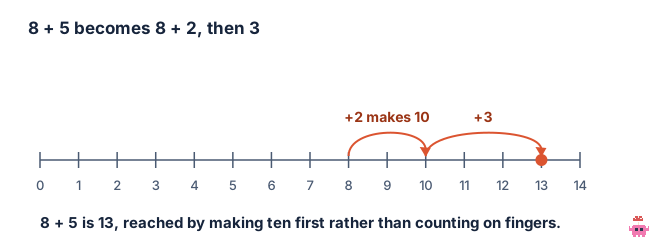
What you will see: a long pause and finger movement for facts that should be near instant, especially pairs that bridge through ten, 8 + 5 or 9 + 6. Ask for 8 + 5 without fingers and watch whether they reach for 8 + 2 + 3, or stall.
The fix: make bridging to ten the explicit, named strategy: 8 + 5 becomes 8 + 2 (makes 10) + 3. This depends on secure part-part-whole knowledge to 10 from Foundation, so a stuck Level 1 student usually needs a week back on number bonds rather than more addition worksheets.
VC2M1A02: naming why repetition matters
The misconception: that continuing a pattern correctly is the whole task. Victoria’s addition, explaining why repetition is useful for solving problems, is the part most easily skipped because a child can continue a pattern by rote without being able to use it.
What you will see: a child continues red-blue-red-blue accurately but, asked what colour would be fifteenth without counting the whole way there, has no strategy beyond starting from the beginning again.
The fix: once a pattern is secure, always ask a prediction question that rewards knowing the repeating unit rather than counting: what comes fifteenth, what comes after the pattern repeats three times, is position ten the same colour as position four. The predicting is the descriptor, not the continuing.
What students need to arrive with
Level 1 leans on three Foundation codes directly: VC2MFN04 (part-part-whole to 10) for VC2M1N04, VC2MFN01 and VC2MFN03 (counting and quantifying to 20) for the extension to 120 in VC2M1N01 and VC2M1N03, and VC2MFA01 (patterns and instructions) for both Algebra codes this level. A child without secure part-part-whole knowledge should not start bridging strategies; the fix is a short return to Foundation part-part-whole work rather than pushing ahead.
What this level sets up
- VC2M1N02 (tens and ones) becomes Level 2’s extension into hundreds, tens and ones, the next layer of the same structure.
- VC2M1N04 (addition and subtraction within 20) becomes Level 2’s extension to larger numbers and more efficient mental strategies, still built on bridging to ten.
- VC2M1A01 (skip counting, including coins) becomes the direct lead-in to multiplication, since skip counting by twos, fives and tens is repeated addition wearing a different costume.
- VC2M1M02 (informal units) becomes Level 2’s introduction to formal units, metres and centimetres, once uniform units are secure.
A term-by-term order
- Term 1: extend and consolidate. VC2M1N01 and VC2M1N03 counting and quantifying to 50, VC2M1SP01 and VC2M1SP02 shapes and directions, and VC2M1M01 direct and indirect comparison, confirming Foundation held before adding new structure.
- Term 2: tens and ones. VC2M1N02 as the centrepiece with daily bundling and unbundling, alongside VC2M1A01 skip counting by tens and fives with coins as the material.
- Term 3: addition, subtraction and units. VC2M1N04 bridging to ten, VC2M1M02 measuring with informal units, and VC2M1A02 repeating patterns used to predict, not just continue.
- Term 4: apply and extend. VC2M1N05 and VC2M1N06 modelling money and sharing situations, numbers extended to 120, VC2M1M03 duration and hours, and VC2M1ST01 and VC2M1ST02 collecting and representing categorical data.
Tens and ones sits in Term 2 because everything after it, bridging strategies, larger numbers, formal units, assumes it is already there.
Five checks before Level 2
- Show 34 with materials. Bundling into three tens and four ones confirms VC2M1N02; counting out 34 loose units means reteach place value with bundling first.
- Solve 8 + 5 without fingers. Reaching for 8 + 2 + 3 confirms VC2M1N04; stalling or counting on fingers means a return to number bonds to 10.
- Continue a pattern, then ask what comes fifteenth. A quick answer using the repeating unit confirms VC2M1A02; counting the whole way there means the prediction skill has not landed.
- Measure the same object twice with the same informal unit. Matching answers confirm VC2M1M02; mismatches mean reteach uniform, end-to-end placement.
- From a class survey, ask which category had the most and how they know. A frequency-based answer confirms VC2M1ST02; a guess means reteach comparing displays.
Capabilities and record keeping
Victoria assesses four Capabilities alongside the learning areas, and Level 1’s pattern-and-instruction work in Algebra overlaps naturally with the Critical and Creative Thinking Capability’s content on identifying and describing patterns. A single pattern-prediction lesson can legitimately evidence both a Mathematics and a Capabilities code. We cover this in the four capabilities in the Victorian Curriculum.
Whether you are programming for a class or building a VRQA home education portfolio, record the code on the activity as you go. “Maths games” tells a reviewer nothing; “VC2M1N02, tens and ones with bundling straws, 12 May” answers the question before it is asked. Our guide to homeschool resources in Victoria covers what the VRQA looks for.
Sprout Lessons builds a full interactive lesson from any of these codes, pitched at Level 1 and wrapped in whatever your student is into, with the VC2 code recorded in the lesson footer. Try it free.
Curriculum codes reference the Victorian Curriculum F–10 Version 2.0 © VCAA. The curriculum can be accessed directly at f10.vcaa.vic.edu.au. The VCAA does not endorse this product. Always verify against the current content descriptions and achievement standards.
FAQ
How is Year 1 Maths different in the Victorian Curriculum compared with the Australian Curriculum?
Thirteen of the 15 codes match the national Year 1 curriculum exactly. Two differ, both in Algebra: VC2M1A01 explicitly names Australian coins as material for skip-counting patterns, and VC2M1A02 adds that students should recognise why repetition matters for solving problems, not just continue a pattern correctly.
How many maths codes are there in Year 1 (Level 1) of the Victorian Curriculum?
Fifteen: six in Number (VC2M1N01 to VC2M1N06), two in Algebra (VC2M1A01 and VC2M1A02), three in Measurement (VC2M1M01 to VC2M1M03), two in Space (VC2M1SP01 and VC2M1SP02) and two in Statistics (VC2M1ST01 and VC2M1ST02). Probability starts at Level 3.
Is Year 1 the same as Level 1 in the Victorian Curriculum?
Yes, for primary Maths. Victoria uses Level rather than Year in its official terminology, and in primary school the level number matches the year number, so Level 1 is the same cohort as Year 1. The two terms diverge in later secondary levels, but not for primary Maths.
Do Victorian Year 1 students already know about money?
More than their national-curriculum peers, yes. Victorian students meet simple financial situations at Foundation (VC2MFN05), a year earlier than the Australian Curriculum. By Level 1, VC2M1N05's simple money transactions build on that head start rather than introducing money for the first time.
What is the most important Year 1 maths code in the Victorian Curriculum?
VC2M1N02, partitioning one- and two-digit numbers, including into tens and ones. It is the first time a child is asked to see a number as structured groups rather than a pile of individual units, and the rest of the year, bridging strategies, larger numbers, formal units, assumes it is already secure.