
Year 5 Maths in the Victorian Curriculum F–10 Version 2.0, officially Level 5, is 24 content descriptions, VC2M5A01 through VC2M5ST03, the same count as the national Year 5 curriculum. Unlike Level 3 and Level 4, which each carry genuine structural differences from the national curriculum, Level 5 tracks it descriptor for descriptor. The codes even keep the same numbering. What is worth knowing is not a structural split this time, it is one wording change with real teaching consequences.
This guide covers all 24 codes, the one place Victoria’s wording genuinely changes what gets taught, the three descriptors that decide whether Level 6 goes well, a term-by-term order, and five checks before moving on.
What Victoria does differently at Level 5
All 24 codes at Level 5 match the national Year 5 curriculum, strand for strand, number for number: VC2M5A01 is AC9M5A01, VC2M5N04 is AC9M5N04, and so on down the list. This is the first year level in primary Maths where Victoria and the national curriculum are structurally identical rather than merely similar.
One wording difference is still worth flagging. VC2M5N03, comparing and ordering fractions, specifies “common unit fractions” where the national equivalent, AC9M5N03, says simply “fractions.” The distinction matters for planning: Victoria’s wording signals that Level 5 fraction comparison should stay anchored to unit fractions and their multiples, halves, thirds, quarters and their relatives, rather than ranging across arbitrary fractions with unrelated denominators. In practice this narrows the difficulty ceiling slightly and points toward comparing fractions like 3/4 and 5/6 rather than something like 7/12 and 5/9, which is closer to Level 6 territory either way.
For the wider comparison of how the two frameworks diverge and where they agree, see the Victorian Curriculum versus the Australian Curriculum, and for the equivalent national-curriculum coverage of this exact year level, see Year 5 Maths under the Australian Curriculum.
The level at a glance
| Strand | Codes | What it covers |
|---|---|---|
| Number | 10 (VC2M5N01–10) | Decimals beyond two places, factors and multiples, comparing common unit fractions, percentages and their fraction-decimal equivalents, adding and subtracting fractions, multiplying and dividing larger numbers, reasonableness checks, financial planning contexts, and algorithms exploring factors and divisibility |
| Algebra | 2 (VC2M5A01–02) | Multiplication and division as inverse operations and families of number facts, and finding unknown values in equations using number properties |
| Measurement | 4 (VC2M5M01–04) | Choosing appropriate metric units and combinations of units, perimeter and area of regular and irregular shapes, comparing 12- and 24-hour time, and measuring angles in degrees with a protractor |
| Probability | 2 (VC2M5P01–02) | Listing possible outcomes of chance experiments and comparing equally and non-equally likely outcomes, and using frequency from repeated experiments to estimate likelihood |
| Space | 3 (VC2M5SP01–03) | Connecting objects to their nets, constructing a grid coordinate system, and describing translations, reflections and rotations |
| Statistics | 3 (VC2M5ST01–03) | Acquiring and validating categorical and numerical data with software, interpreting line graphs of change over time, and planning full statistical investigations |
Number carries ten of the twenty-four codes, matching the national curriculum’s distribution exactly, unlike Level 3 and Level 4 where Victoria’s Number strand ran one or two descriptors heavier.
Reading the codes
Victorian Maths codes run VC2 + M + level + strand + number, so VC2M5N01 is Level 5 Number, position 1. In primary school the level number matches the year number, so Level 5 is the same cohort as Year 5. Strand letters are N Number, A Algebra, M Measurement, P Probability, SP Space, ST Statistics. Victoria numbers Number’s tenth descriptor as VC2M5N10, without the extra zero the national curriculum uses for its equivalent AC9M5N010, a small but real difference if you are searching for the code.
Strand by strand
Number (VC2M5N01 to VC2M5N10)
VC2M5N01 extends decimal place value beyond two places, including decimals greater than one, represented on a number line. VC2M5N02 expresses natural numbers as products of their factors and determines divisibility, the groundwork for VC2M5N10’s algorithm work. VC2M5N03, covered above, compares and orders common unit fractions with the same and related denominators, including mixed numerals. VC2M5N04, percentages, covered below. VC2M5N05 solves addition and subtraction problems with fractions sharing the same or related denominators. VC2M5N06 covers multiplying larger numbers by one- or two-digit numbers with efficient mental and written strategies and digital tools. VC2M5N07 covers division, interpreting any remainder according to context and expressing results as a whole number, decimal or fraction. VC2M5N08 covers checking and explaining the reasonableness of solutions, including financial contexts, using estimation. VC2M5N09 is the applied pair, modelling additive and multiplicative situations including simple financial planning contexts. VC2M5N10 follows a mathematical algorithm involving branching and repetition, and creates algorithms with digital tools to experiment with factors, multiples and divisibility.
Algebra (VC2M5A01 to VC2M5A02)
VC2M5A01, multiplication and division as inverse operations, covered below. VC2M5A02 finds unknown values in numerical equations involving multiplication and division, using the properties of numbers and operations, the multiplicative parallel to Level 4’s addition-and-subtraction equation work.
Measurement (VC2M5M01 to VC2M5M04)
VC2M5M01 extends unit choice to combinations of units for a more accurate measure, moving past Level 4’s single-unit reading of scaled instruments. VC2M5M02 solves practical perimeter and area problems for regular and irregular shapes, beyond Level 4’s approximating work. VC2M5M03 introduces comparing 12- and 24-hour time and converting between them. VC2M5M04 introduces the protractor, estimating, constructing and measuring angles in degrees rather than by name alone.
Probability (VC2M5P01 to VC2M5P02)
VC2M5P01 lists possible outcomes of chance experiments and compares equally likely outcomes against those that are not, the first formal move past Level 4’s independent-versus- dependent language. VC2M5P02 conducts repeated experiments with and without equally likely outcomes and uses frequency to estimate likelihood, the direct forerunner of Level 6’s numerical probability.
Space (VC2M5SP01 to VC2M5SP03)
VC2M5SP01 connects three-dimensional objects to their nets and builds objects from nets. VC2M5SP02 constructs a grid coordinate system using coordinates to locate positions, extending Level 4’s grid reference systems into full coordinate language. VC2M5SP03 describes and performs translations, reflections and rotations, identifying what changes and what stays the same, building on Level 4’s line and rotational symmetry.
Statistics (VC2M5ST01 to VC2M5ST03)
VC2M5ST01 extends data acquisition to validating data and discussing distributions in terms of mode and shape. VC2M5ST02 introduces interpreting line graphs representing change over time, a new display type. VC2M5ST03 extends guided investigations into fully planned statistical investigations, from posing the question through to communicating findings.
The three codes that decide Level 6
VC2M5N04: a percentage is a fraction with a denominator fixed at 100
The misconception: that percentages are a separate topic with their own rules for calculation, unrelated to the fraction and decimal work already mastered, so a student memorises isolated procedures like “move the decimal point two places” without knowing why.
What you will see: asked what 50% of 20 is, a student who has memorised “halve it” gets the right answer but cannot explain why, then fails completely on 25% of 20 because no rule was memorised for that case. Asked whether 0.5, 50% and 1/2 are the same amount, the same student hesitates or says no.
The fix: anchor every new percentage to a fraction the student already trusts, 50% is 1/2, 25% is 1/4, 10% is 1/10, and require the fraction and decimal form to be stated alongside every percentage calculation until the equivalence is automatic rather than asserted.
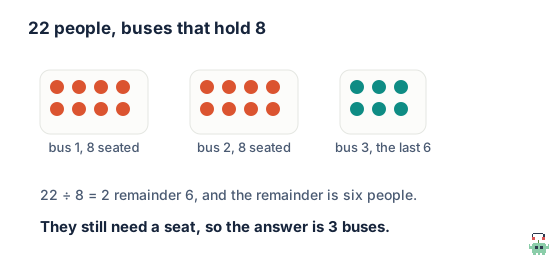
VC2M5N07: a remainder is not an error, it is information
The misconception: that division either works out evenly or the problem is wrong, so a student either abandons a division problem with a remainder or reports the remainder without connecting it back to the original context.
What you will see: given “22 people need seats on buses that hold 8,” a student calculates 22 ÷ 8 = 2 remainder 6 and answers “2 buses,” leaving six people behind, because the remainder was computed but not interpreted. Given a money-sharing problem with the same numbers, the same student may report the remainder as a whole number rather than converting it to cents.
The fix: after every division calculation, ask the context question explicitly: does the remainder round up, round down, become a decimal, or become a fraction? Practise all four interpretations on the same numbers so the child sees the computation is constant and only the interpretation changes.
VC2M5A01: multiplication and division are the same relationship, viewed from two directions
The misconception: that multiplication facts and division facts are two separate sets to memorise, so a student who knows 6 × 7 = 42 fluently still has to work out 42 ÷ 7 from scratch.
What you will see: given a fact family triangle with 6, 7 and 42, a student can generate the two multiplication facts instantly but pauses noticeably on the two division facts, or gets one direction wrong.
The fix: teach every new multiplication fact as one member of a four-fact family from the start, using an array to show both directions physically, so “multiplication undoes division” is demonstrated with the same picture rather than stated as a separate rule to remember.
What students need to arrive with
Level 5 leans on two Level 4 codes directly. VC2M4N03 (fraction-decimal equivalence) is the direct prerequisite for VC2M5N04 percentages; a child who cannot yet say that 3/10 and 0.3 are the same number should not start percentages. VC2M4A02 (multiplication facts to 10 × 10) is the prerequisite for VC2M5A01’s inverse-operations work and VC2M5N06’s multi-digit multiplication, both of which assume instant fact recall rather than derived answers. The fix for a shaky arrival is a short return to Level 4’s decimal and fraction work rather than pushing ahead into percentages.
What this level sets up
- VC2M5N04 (percentages) becomes Level 6’s work connecting fractions, decimals and percentages to solve problems, including everyday contexts like discounts and interest.
- VC2M5N07 (interpreting remainders) becomes Level 6’s multi-step problems where remainder interpretation is assumed rather than taught.
- VC2M5A01 (multiplication and division as inverse operations) becomes Level 6’s work solving equations involving the four operations.
- VC2M5P02 (frequency and likelihood estimation) becomes Level 6’s numerical probability, expressing chance as a value between 0 and 1.
Our guide to which curriculum your state uses is worth checking if you are unsure whether AC9, VC2 or a NSW syllabus applies to your child.
A term-by-term order
- Term 1: extend and consolidate. VC2M5N02 factors and multiples, VC2M5N03 comparing common unit fractions, VC2M5SP01 nets, and VC2M5M01 choosing appropriate metric units, confirming Level 4 held before adding new structure.
- Term 2: percentages and fraction operations. VC2M5N04 percentages as the centrepiece, taught in the same unit as VC2M5N01 decimal place value beyond two places and VC2M5N05 adding and subtracting fractions.
- Term 3: multiplication, division and inverse operations. VC2M5A01 multiplication and division as inverse operations, VC2M5N06 multiplying larger numbers, VC2M5N07 interpreting remainders, and VC2M5A02 unknown values in equations.
- Term 4: apply and extend. VC2M5N08 and VC2M5N09 reasonableness and financial planning, VC2M5N10 algorithms, VC2M5M02 to VC2M5M04 perimeter, area, time and angles, VC2M5SP02 and VC2M5SP03 coordinates and transformations, VC2M5P01 and VC2M5P02 chance and frequency, and VC2M5ST01 to VC2M5ST03 data acquisition, line graphs and statistical investigations.
Percentages sit in Term 2, deliberately in the same unit as decimal place value and fraction operations, because a student who already trusts that 3/10, 0.3 and 30% are one number has an easier time trusting that multiplication and division are one relationship, viewed from two directions, when that arrives in Term 3.
Five checks before Level 6
- Number: ask what 25% of 20 is and how the child worked it out. An answer that reasons from the quarter, 20 ÷ 4 = 5, confirms VC2M5N04; a memorised procedure with no explanation means reteach percentages as fractions with a fixed denominator before moving on.
- Number: give “22 people need seats on buses that hold 8” and ask for the number of buses needed. An answer of 3, with reasoning about the leftover six people, confirms VC2M5N07; an answer of “2 remainder 6” left uninterpreted means reteach remainder interpretation against the specific context.
- Algebra: ask for 6 × 7, then immediately for 42 ÷ 7, without a pause between them. Instant recall of both confirms VC2M5A01; a noticeable pause on the division fact means reteach the fact family as one relationship shown with an array.
- Measurement: hand the child a protractor and ask them to measure a 45-degree angle drawn on paper. An accurate reading confirms VC2M5M04; difficulty aligning the protractor means reteach the tool itself before angle problems.
- Probability: after ten repeated trials of a biased spinner, ask the child to estimate the likelihood of each outcome using the frequency data. A frequency-based estimate confirms VC2M5P02; a guess based on the number of sections alone means reteach that frequency from actual trials can differ from theoretical equal-likelihood assumptions.
Capabilities and record keeping
Victoria assesses four Capabilities alongside the learning areas, and Level 5’s algorithm work in Number (VC2M5N10), which explicitly names branching and repetition, overlaps directly with the Digital Literacy Capability’s content on designing algorithms involving control structures. A single lesson that has a child trace an algorithm with a repeated step can legitimately evidence both a Mathematics and a Capabilities code.
Whether you are programming for a class or building a VRQA home education portfolio, record the code on the activity as you go. “Maths worksheet” tells a reviewer nothing; “VC2M5N04, percentages as fractions of 100, 12 May” answers the question before it is asked. Our guide to state-by-state registration requirements covers what reviewers actually ask for, and teaching maths through interests covers how to wrap these codes around whatever your child is currently into.
Sprout Lessons builds a full interactive lesson from any of these codes, pitched at Level 5 and wrapped in whatever your student is into, with self-checking practice that hints rather than just marking wrong, and the exact VC2 code recorded in the lesson footer. Try it free and generate a Level 5 Maths lesson in about a minute. You can also browse ready-made Year 5 Maths lessons against these codes directly.
Curriculum codes reference the Victorian Curriculum F–10 Version 2.0 © VCAA. The curriculum can be accessed directly at f10.vcaa.vic.edu.au. The VCAA does not endorse this product. Always verify against the current content descriptions and achievement standards.
FAQ
How many maths codes are there in Year 5 (Level 5) of the Victorian Curriculum?
Twenty-four: ten in Number (VC2M5N01 to VC2M5N10), two in Algebra (VC2M5A01 and VC2M5A02), four in Measurement (VC2M5M01 to VC2M5M04), two in Probability (VC2M5P01 and VC2M5P02), three in Space (VC2M5SP01 to VC2M5SP03) and three in Statistics (VC2M5ST01 to VC2M5ST03).
How is Year 5 Maths in the Victorian Curriculum different from the Australian Curriculum?
Structurally, it is not: all 24 codes match the national Year 5 curriculum descriptor for descriptor and number for number, the first primary Maths level where this is true. The one wording difference is VC2M5N03, which specifies comparing "common unit fractions" where the national equivalent says simply "fractions", narrowing the intended difficulty slightly.
What is the most important Year 5 maths code in the Victorian Curriculum?
VC2M5N04, percentages. A percentage is not a new operation but a fraction with a fixed denominator of 100, and students who cannot connect 50%, 0.5 and 1/2 as the same amount will struggle with every percentage problem from here on.
Why can my child calculate 50% of a number but not 25%?
This usually means a procedure was memorised, halve for 50%, without understanding that a percentage is a fraction of 100. The fix is anchoring every new percentage to a fraction the child already trusts, 25% is 1/4, and requiring the fraction and decimal form to be stated alongside every percentage calculation.
How do I check if my child is ready to move from Level 5 to Level 6 maths?
Ask for 6 x 7, then immediately 42 divided by 7, without a pause between them. Instant recall of both confirms multiplication and division are understood as one relationship (VC2M5A01); a noticeable pause on the division fact means reteaching the fact family as one relationship, shown with an array, before Level 6 assumes it is automatic.