
AC9M4N01 is the Year 4 content description where decimals arrive in the Australian Curriculum. It is a deceptively large piece of the year: almost everything a student does with decimals from Year 5 onwards, comparing them, ordering them, adding them, converting them to percentages, rests on whether this one descriptor actually landed. It is also the point where a class quietly splits into students who understand place value and students who have learned to move a decimal point around.
This is a working guide to the descriptor: what it says, what it does and does not include, the four misconceptions that reliably derail it, a teaching sequence that holds, and the check questions that tell you whether it worked.
What AC9M4N01 actually says
“recognise and extend the application of place value to tenths and hundredths and use the conventions of decimal notation to name and represent decimals”
That is Mathematics, Year 4, Number strand, in Version 9 of the Australian Curriculum. The two verbs are doing different jobs, and both matter. Extend the application of place value means the student already understands that each position is worth ten times the one to its right, and is now continuing that same rule past the ones column rather than learning a new system. Use the conventions of decimal notation means they can read, write, say and represent a decimal correctly. A student can do the second without the first, which is exactly the failure mode this descriptor is written to prevent.
How to read the code
AC9 codes are systematic once you see the structure, which makes the whole framework much faster to search:
- AC9 - Australian Curriculum, Version 9.
- M - the learning area, Mathematics. (E for English, S for Science, H for HASS, and so on.)
- 4 - the year level. F is Foundation.
- N - the strand. In Mathematics: N Number, A Algebra, M Measurement, SP Space, ST Statistics, P Probability.
- 01 - the position within that strand for that year.
So AC9M4N01 is the first Number descriptor of Year 4 Maths, and AC9M5N01 is its Year 5 successor. Once you know the pattern you can jump straight to the neighbouring years, which is the single most useful thing you can do when a student is not ready for the descriptor in front of them.
What it covers, and what it does not
The most common planning error with AC9M4N01 is doing too much. The descriptor is about naming and representing decimals to two places. It is not about calculating with them.
- In scope: tenths and hundredths, reading and writing decimal notation, placing decimals on a number line, representing them with materials and diagrams, saying them correctly, and connecting the notation back to place value.
- Not in scope here: thousandths and beyond, which belong to AC9M5N01 (“interpret, compare and order numbers with more than 2 decimal places”).
- Not in scope here: adding, subtracting, multiplying or dividing decimals. Multiplying and dividing by powers of 10 sits in AC9M4N05, and it is a different lesson.
- Partner descriptor: AC9M4N03, equivalent representations of fractions using related denominators and the connection between fractions and decimal notation. AC9M4N01 and AC9M4N03 are the same idea from two directions, and teaching them in the same unit is usually better than treating them as separate topics.
Where it sits in the sequence
A student arrives at AC9M4N01 carrying AC9M3N02 (unit fractions including halves, thirds, quarters, fifths and tenths) and AC9M3N01 (whole number place value beyond 10 000). Those two are the prerequisites. If a Year 4 student cannot show you a tenth of something, the problem is not decimals, and the fix is a week back in Year 3 fractions, not more decimal worksheets.
Downstream, AC9M5N01 extends the same idea past two places, and Year 6 leans on it for percentages. Decimals are one of the clearest examples of a skill where a gap compounds, so it is worth being slow here and fast later.
The four misconceptions that derail it
1. Longer is bigger
A student who believes 0.45 is larger than 0.7 is applying whole number logic, where more digits means more value. This is the single most common decimal error in Year 4, and it survives a surprising amount of teaching because most practice sets happen to compare decimals with the same number of places. Deliberately mix them: 0.7 against 0.45, 0.3 against 0.29, 0.6 against 0.60.
2. The decimal point separates two whole numbers
Students who read 3.5 as “three and five” treat the right-hand side as a second counter that resets. It shows up when they claim 3.9 plus 0.1 is 3.10. The fix is not a rule, it is a number line: put 3.9 and 4 on it and ask what sits between them.
3. Saying it wrong, and therefore thinking it wrong
“Zero point thirty-four” embeds the misconception in the student’s own voice. Insist on “zero point three four”, and separately on the place value reading, “thirty-four hundredths”. Being able to switch between those two readings is close to a proof of understanding, and it takes about a minute a day to build.
4. Zero as a placeholder is invisible
0.5 and 0.05 look similar to a student who is reading digits rather than positions. Money helps enormously here, because five dollars and five cents is a distinction they already care about, but do not stop at money: money always has exactly two places, which quietly teaches that decimals always do.
A teaching sequence that holds
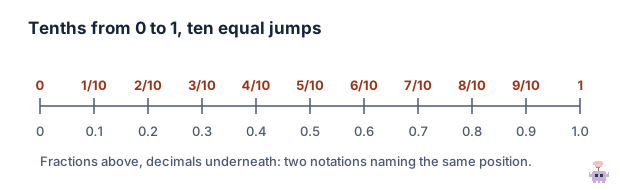
- Start with tenths only, on a number line. One line from 0 to 1, ten equal jumps. Label them as fractions first, then as decimals underneath. The student should see the two notations naming the same position.
- Add measurement before money. Metres and centimetres give a physical model for tenths and hundredths that money does not, because a metre visibly splits into ten and then into a hundred. Money comes next, as the familiar case rather than the first case.
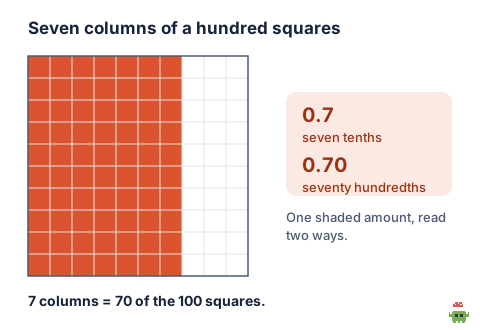
- Introduce hundredths with a 10 by 10 grid. Shade 7 columns and ask for the value two ways: 0.7 and 0.70, seven tenths and seventy hundredths. This is where the “longer is bigger” misconception dies, because the student can see it.
- Extend the place value chart to the right. Only now write the columns: hundreds, tens, ones, tenths, hundredths. Ask what rule takes you from one column to the next, in both directions. The point of the whole descriptor is that the answer is the same rule they already knew.
- Go back to fractions and close the loop. Bring in AC9M4N03 explicitly: three tenths, 3/10, 0.3, 30/100, 0.30. Same number, five costumes.
Three tasks pitched at this descriptor
- Sprint times. Give six real 100 m or swimming times to two decimal places and ask the student to order them and place them on a number line. Athletics results are full of 0.7 against 0.65 comparisons, and there is a right answer the student cares about.
- Build the number. Read a decimal aloud and have the student build it in a place value chart, then rebuild it as a fraction, then find it on a number line. Three representations of the same number is the assessment, not three separate exercises.
- Find the decimals in a thing they like. Batting averages, lap times, in game statistics, ingredient masses in a recipe, distances in a favourite sport. The curriculum outcome does not specify whose numbers, so the wrapper is free. We cover the method in teaching maths through interests.
Five questions that tell you whether it landed
- Which is larger, 0.7 or 0.45? A wrong answer means whole number logic is still running.
- Write seven hundredths as a decimal. If you get 0.7, the placeholder zero is invisible.
- What number is halfway between 0.3 and 0.4? Answering “there is no number” means the student thinks tenths are the smallest unit.
- Is 0.6 the same as 0.60? Explain why. The explanation matters more than the answer.
- Read 4.09 aloud, twice, two different ways. “Four point zero nine” and “four and nine hundredths” is the target.
Five questions, three minutes, and each wrong answer points at a specific reteach rather than a vague “needs work on decimals”.
Recording the alignment
If you are a teacher writing a program, or a homeschooling parent building evidence for registration review, the useful habit is to record the code on the task rather than reconstructing it later. “Decimals worksheet” tells a reviewer nothing; “AC9M4N01, tenths and hundredths on a number line, 12 May” answers the question before it is asked. Our guide to which curriculum your state uses covers which code set applies to you, and the state-by-state registration requirements covers what reviewers actually ask for.
Sprout Lessons builds a full interactive lesson from a descriptor like this one, pitched at Year 4 and wrapped in whatever your student is into, with worked examples, self-checking practice that hints rather than just marking wrong, and the exact AC9 code recorded in the lesson footer. Try it free and generate an AC9M4N01 lesson in about a minute.
Australian Curriculum content descriptions are © ACARA and licensed under CC BY 4.0. Quoted here unmodified. ACARA does not endorse this product. Always verify against the current content descriptions and achievement standards at australiancurriculum.edu.au.
FAQ
What is AC9M4N01?
AC9M4N01 is the Year 4 Mathematics content description in Version 9 of the Australian Curriculum: "recognise and extend the application of place value to tenths and hundredths and use the conventions of decimal notation to name and represent decimals". It is the point where decimals are introduced, and it covers naming and representing them rather than calculating with them.
How do you read an AC9 curriculum code?
The code is systematic. AC9 is the Australian Curriculum Version 9, the next letter is the learning area (M for Mathematics, E for English, S for Science), the digit is the year level (F for Foundation), the following letters are the strand (in Maths: N Number, A Algebra, M Measurement, SP Space, ST Statistics, P Probability), and the final digits are the position within that strand. So AC9M4N01 is the first Number descriptor of Year 4 Mathematics.
Does AC9M4N01 include adding and subtracting decimals?
No. AC9M4N01 is about naming and representing decimals to two places using place value. Multiplying and dividing by multiples and powers of 10 sits in AC9M4N05, decimals beyond two places belong to AC9M5N01 in Year 5, and formal operations with decimals come later. Planning the calculation work into this descriptor is the most common way Year 4 decimal units become overloaded.
What are the most common Year 4 decimal misconceptions?
Four dominate. Believing longer is bigger, so 0.45 seems larger than 0.7. Treating the decimal point as a separator between two whole numbers, which produces answers like 3.9 plus 0.1 equals 3.10. Reading 0.34 as "zero point thirty-four", which embeds the error in the student’s own voice. And missing the placeholder zero, so 0.5 and 0.05 look interchangeable.
What should a student know before starting AC9M4N01?
Two Year 3 descriptors are the prerequisites: AC9M3N02, unit fractions including halves, thirds, quarters, fifths and tenths, and AC9M3N01, whole number place value beyond 10 000. If a Year 4 student cannot show you a tenth of something, the problem is not decimals, and a week back in Year 3 fractions will do more than more decimal worksheets.