
One word decides most of what an Australian primary student is expected to do with fractions, and almost nobody outside a staffroom has noticed it: related. Years 4 and 5 of the Australian Curriculum Version 9 restrict fraction work to the same or related denominators. Year 6 drops the word.
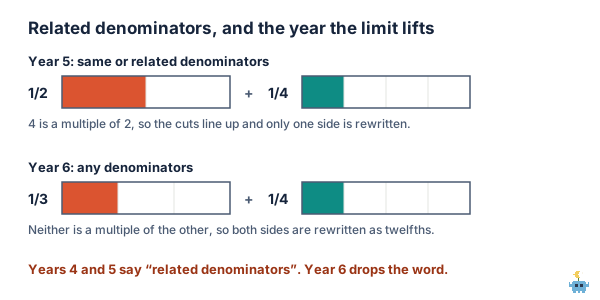
So a Year 5 student is expected to add one half and one quarter. A Year 5 student is not expected to add one third and one quarter. That is Year 6 work, and a parent who sets the second problem and watches their child fail it has learned nothing except that the child is in Year 5.
Fractions do not start where people think
There is no fraction content description in Foundation, and none in Year 1. The Year 1 descriptors that use the word “partition” are about place value and equal groups, not fractions. Fractions arrive in Year 2, and they arrive through halving.
AC9M2N03 asks students to recognise and describe one-half as one of 2 equal parts of a whole, and to connect halves, quarters and eighths through repeated halving. AC9M2M02 covers the same three fractions in relation to shapes, objects and events. Thirds are not in Year 2. They cannot be reached by halving, which is exactly why they are held back.
The ladder, year by year
- Foundation and Year 1: nothing. No fraction content description in either year. What is being built instead is part-part-whole with collections, which is the groundwork.
- Year 2: halves, quarters, eighths, by repeated halving. Two descriptors, one in Number and one in Measurement. Also quarter, half and three-quarter turns, and telling time to the half-hour and quarter-hour, which is where most children first meet the words.
- Year 3: unit fractions, and only five of them. AC9M3N02 names them: one-half, one-third, one-quarter, one-fifth and one-tenth, and their multiples. Students combine fractions with the same denominator to complete the whole. This is the year thirds finally appear.
- Year 4: equivalence with related denominators, and the decimal link. AC9M4N03 asks for equivalent representations using related denominators and for connections between fractions and decimal notation. AC9M4N04 adds counting by fractions including mixed numerals and locating them on number lines.
- Year 5: comparing, ordering, adding and subtracting, still related. Three descriptors. AC9M5N03 compares and orders fractions with the same and related denominators including mixed numerals, applying knowledge of factors and multiples. AC9M5N05 solves addition and subtraction problems with the same or related denominators. AC9M5N04 brings in percentages, with 100% as the complete whole.
- Year 6: the restriction lifts. AC9M6N03 asks students to apply knowledge of equivalence to compare, order and represent common fractions on the same number line and justify their order. AC9M6N05 solves addition and subtraction problems using knowledge of equivalent fractions, with no denominator limit attached. AC9M6N07 adds finding a familiar fraction, decimal or percentage of a quantity.
- Year 7: the four operations. AC9M7N06 is where multiplying and dividing fractions finally has a home, inside using the 4 operations with positive rational numbers.
What “related denominators” means
ACARA’s mathematics glossary defines the term:
“Related denominators occur where one denominator is a multiple of the other; for example, the fractions 1/3 and 5/9 have related denominators because 9 is a multiple of 3.”
Why it is a real distinction rather than curriculum pedantry: with related denominators, only one fraction has to be rewritten, and the rewriting is a single act of multiplying up. With unrelated denominators, both have to change, and the student needs a common multiple before they can start. That is a genuinely different skill, and it sits on the factors and multiples work that Year 5 is doing at the same time.
It also explains a thing parents notice and cannot account for: a child who can confidently add halves and eighths but freezes on thirds and quarters is not being inconsistent. They have been taught exactly what the curriculum asked for.
What is not there yet
The half of the question that stops unnecessary worry, and the same shape of answer as our times tables by year page.
- Multiplying a fraction by a fraction is not a primary descriptor. It lands in Year 7, inside AC9M7N06.
- Dividing by a fraction is the same. Year 7, same descriptor. If your Year 6 child cannot divide by three-quarters, they are ahead of the requirement rather than behind it.
- Adding unrelated denominators is not Year 5. It is Year 6, and this is the one that catches out the most parents.
- Thirds are not Year 2. Year 3.
- Percentages are not Year 4. Year 5, at AC9M5N04, starting from 100% as the whole.
Year 6 does include finding a familiar fraction of a quantity, so two-thirds of 24 is fair game in Year 6. That is not the same as multiplying two fractions together, and the curriculum keeps them apart on purpose.
The five-minute check
Four questions, pitched at the middle of primary. You are listening to the reasoning rather than grading the answer.
- “Which is bigger, one third or one fifth?” If the answer is one fifth, your child is reading a fraction as two whole numbers, and that is the thing to fix before anything else on this page. It is the single most common fraction error at every year level.
- Draw a line, mark 0 and 1, and ask them to put three-quarters on it. Number lines are named explicitly in AC9M4N04, AC9M5N03 and AC9M6N03, three years running, which tells you how much weight the curriculum puts on a fraction being a number rather than a shaded picture.
- “What is three-quarters made of?” The answer you want is three one-quarters. That is the Year 3 unit-fraction idea, and it is what everything after Year 4 quietly assumes.
- Set one half plus one quarter, then one third plus one quarter. A Year 5 child should manage the first. Struggling on the second is on schedule, not a gap.
If something is missing
- Fold paper before you write anything. Strips folded in half, then in half again, then in thirds. Repeated halving is literally how the Year 2 descriptor is worded, and it is the fastest way to show that more pieces means smaller pieces.
- Say the unit fraction out loud. Three one-quarters, not three over four. It sounds fussy for two days and then it does the work by itself.
- Use the number line as often as the pizza. The curriculum asks for it three years in a row and most home practice never gets there.
- Do not accelerate to catch up. The order is load-bearing: comparing with related denominators in Year 5 is what makes unrelated denominators reachable in Year 6, and skipping it produces a child who can follow a procedure and cannot say what the answer means.
- Short and often beats a weekend blitz. The plan for doing this at home without a tutor is its own page.
A note on which curriculum applies to you
Everything above is Version 9 of the Australian Curriculum, which most states and territories use. Victoria does not. Victorian schools follow the Victorian Curriculum F–10 Version 2.0, which is derived from the Australian Curriculum but is a separate document with its own codes, and the differences are set out here. New South Wales runs its own K–10 syllabuses organised by stage rather than year, covered in our NSW explainer. Check your state before you check your child.
Where to go next
The full descriptor-by-descriptor guides for the years that carry the fraction work:
- Year 3 maths: unit fractions arrive
- Year 4 maths: equivalence and the decimal link
- Year 5 maths: comparing, adding, percentages
- Year 6 maths: the restriction lifts
- Year 7 maths: the four operations
The other two primary maths topics parents ask about most: which year the times tables are due and what the curriculum actually says about long division, which is less than almost everyone assumes.
The short version
Fractions start in Year 2 with halving, reach unit fractions and thirds in Year 3, equivalence and number lines in Year 4, and comparing, ordering, adding and subtracting in Year 5. Through Years 4 and 5 the curriculum restricts all of it to the same or related denominators, meaning one denominator is a multiple of the other. Year 6 removes the restriction and Year 7 brings in multiplying and dividing fractions.
The practical consequence is a single sentence. One half plus one quarter is Year 5. One third plus one quarter is Year 6. Setting the second and worrying about the result is the most common mistake a well-meaning parent makes with fractions in this country.
Sprout Lessons builds curriculum-aligned lessons for Foundation to Year 10, with the code on every lesson. Start free.
Codes and descriptor wording checked 19 September 2026 against our copy of the Machine Readable Australian Curriculum Version 9, accessed 2026-06-24, not written from memory. Read the official text at the Australian Curriculum mathematics pages. Australian Curriculum content © ACARA, licensed under CC BY 4.0. The definition of related denominators is quoted from ACARA’s mathematics glossary; the Version 9 glossary is rendered in the browser and cannot be fetched, so the stable glossary page is linked and the definition is unchanged. Victoria and New South Wales run their own documents: check the one that applies to you.
FAQ
What year do Australian children learn fractions?
Year 2 is the first year with a fraction content description. AC9M2N03 asks students to recognise and describe one-half as one of 2 equal parts of a whole and to connect halves, quarters and eighths through repeated halving. There is no fraction descriptor in Foundation or Year 1: the Year 1 descriptors using the word partition are about place value and equal groups. Thirds are held back to Year 3, because they cannot be reached by halving.
What are related denominators in the Australian Curriculum?
ACARA’s mathematics glossary defines them as denominators where one is a multiple of the other, giving 1/3 and 5/9 as the example because 9 is a multiple of 3. It matters because only one fraction has to be rewritten, and the rewriting is a single act of multiplying up. With unrelated denominators both fractions change and the student needs a common multiple first, which is a genuinely different skill and sits on the factors and multiples work of Year 5.
Should a Year 5 student be able to add one third and one quarter?
No. AC9M5N05 restricts addition and subtraction of fractions to the same or related denominators, and neither 3 nor 4 is a multiple of the other. That problem is Year 6 work, at AC9M6N05, which asks for addition and subtraction using knowledge of equivalent fractions with no denominator limit attached. Setting it in Year 5 and worrying about the result is the most common mistake a well-meaning parent makes with fractions.
When do Australian students multiply and divide fractions?
Year 7. There is no primary content description for multiplying a fraction by a fraction or dividing by a fraction. Both sit inside AC9M7N06, which asks students to use the 4 operations with positive rational numbers including fractions, decimals and percentages. Year 6 does include finding a familiar fraction, decimal or percentage of a quantity at AC9M6N07, so two-thirds of 24 is fair game, but that is not the same as multiplying two fractions together.
When do percentages start in the Australian Curriculum?
Year 5. AC9M5N04 asks students to recognise that 100% represents the complete whole and to use percentages to describe, represent and compare relative size, connecting familiar percentages to their decimal and fraction equivalents. Year 6 extends it to finding a percentage of a quantity including percentage discounts.
Does this apply in Victoria and New South Wales?
Not directly. Victoria follows the Victorian Curriculum F-10 Version 2.0, which is derived from the Australian Curriculum but is a separate document with its own codes. New South Wales runs its own K-10 syllabuses organised by stage rather than by year. The sequence is broadly similar in both, but the codes and the exact wording differ, so check the document that applies to your state.