
The Australian Curriculum tells you which times tables belong to which year, by name. Twos in Year 2. Threes, fours, fives and tens in Year 3. Everything up to 10 × 10 by the end of Year 4. Almost no parent has been shown this, which is why so many families are worrying about the wrong table in the wrong year.
If your Year 3 child cannot do 7 × 8, they are not behind. The sevens and eights are Year 4 work, and the curriculum says so in AC9M4A02. That single fact resolves a large proportion of the anxiety about times tables in Australian homes.
The three achievement standards, word for word
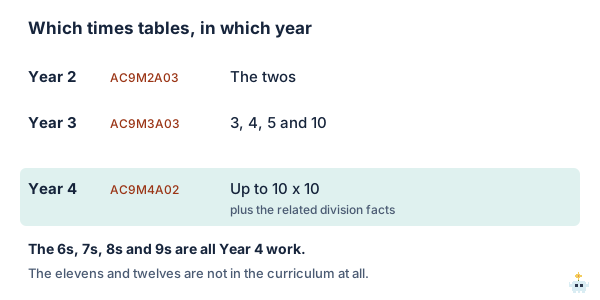
| Year | Code | What it asks for |
|---|---|---|
| Year 2 | AC9M2A03 | Multiplication facts for twos |
| Year 3 | AC9M3A03 | Multiplication facts for 3, 4, 5 and 10 |
| Year 4 | AC9M4A02 | Multiplication facts up to 10 × 10 and related division facts |
Two things are worth pulling out of that table, and both change how the practice at home should look.
The sixes, sevens, eights and nines are all Year 4
Read the Year 3 list again: 3, 4, 5 and 10. That is it. The 6, 7, 8 and 9 tables are not named until Year 4, which means the tables children find hardest are also the ones the curriculum schedules last.
The practical consequence: a Year 3 child who has the threes, fours, fives and tens is exactly where the curriculum expects them to be, even if 7 × 8 gets a blank look. Drilling the whole grid in Year 3 is running two years ahead of the sequence, and it is the most common way children decide early that they are bad at maths.
Every one of the three includes division
All three descriptors carry the same second clause: extend and apply facts to develop the related division facts. Division is bundled in from Year 2, not added later as a separate topic.
So when your child learns that 6 × 7 is 42, the curriculum expects 42 ÷ 7 and 42 ÷ 6 to come with it. Saying both out loud together costs nothing and prevents the very common situation where a child has solid tables and treats division facts as unfamiliar territory.
10 × 10 is the ceiling
AC9M4A02 says up to 10 × 10. The elevens and twelves are not in the Australian Curriculum. They are a leftover from the imperial era, when twelve pennies made a shilling and twelve inches made a foot, and there is nothing in the modern curriculum that depends on them.
If your child is struggling and you are drilling to twelve, stopping at ten removes about a fifth of the material for free. Learn them later if you like them. They are not part of what your child is expected to know.
How much is actually left to memorise
Even inside 10 × 10, the number of facts a child must hold is far smaller than the grid suggests, and it is worth showing them the arithmetic because the relief is immediate.
- Multiplication is commutative, so 3 × 4 and 4 × 3 are one fact. That alone halves the grid, and plenty of children have never been told, so they quietly learn every product twice.
- The ones and tens are rules, not facts.
- The twos are doubling, which your child could do before they met multiplication at all. The curriculum knows this, which is why the twos come first in Year 2.
- The fives come from counting by fives and from clock faces.
- The nines have a pattern: the digits of the answer add to nine, and the tens digit is one less than the number you multiplied by. 7 × 9 is 63, six is one less than seven, and six plus three is nine.
Take all of that out and the genuinely hard facts are a handful, clustered in the threes, fours, sixes, sevens and eights, with 6 × 7, 6 × 8 and 7 × 8 at the centre of it. Those are the ones worth two or three minutes a day. The rest of the grid is not.
What the curriculum asks for that is not memorising
All three descriptors use the same phrase: recall and demonstrate proficiency. Not recall alone. And each one ends by asking the child to extend and apply the facts, in Year 4 to develop efficient mental strategies.
This is the part a flashcard app cannot do. Proficiency means your child can get from a fact they have to a fact they do not: 6 × 7 is 5 × 7 plus another 7, and 4 × 8 is double 2 × 8. That skill is what recall grows out of, and it is also what stops a forgotten fact from being a dead end.
Year 5 makes the same point again in AC9M5A01, which asks students to recognise and explain the connection between multiplication and division as inverse operations, and to use it to develop families of number facts. Two years after the tables are meant to be known, the curriculum is still asking for the relationships rather than the recall.
Three questions worth asking
- Ask 4 × 3, then straight away 3 × 4. If the second takes longer, your child does not have commutativity and is carrying twice the load they need to. That one conversation can halve the remaining work.
- Ask 6 × 7, and if it is wrong, ask 5 × 7. If the fives come back instantly, this is not a memory problem. Nobody has shown them how to get from a fact they have to a fact they do not, which is the “efficient mental strategies” clause of AC9M4A02.
- Ask 42 ÷ 6. A child who knows 6 × 7 and cannot do 42 ÷ 6 has had the two taught as separate topics, which is exactly what all three descriptors are written to prevent.
What to do in each year
- Year 2: doubling, in objects and in your head. That is the twos, and it is the whole requirement.
- Year 3: threes, fours, fives and tens, with the division said out loud alongside each one. Do not add the rest.
- Year 4: the remainder, which is where the sixes, sevens, eights and nines finally arrive. This is the year to do the strategy work, because the facts that are left are the ones with no shortcut.
- Year 5 and beyond: stop drilling and start using them. Factors, multiples and divisibility in AC9M5N02, and prime, composite and square numbers in AC9M6N02, all sit directly on this and are the real reason the recall matters.
The short version
The curriculum names the tables year by year: twos in Year 2, then 3, 4, 5 and 10 in Year 3, then everything up to 10 × 10 in Year 4. The hardest tables are scheduled last, so a Year 3 child who cannot do 7 × 8 is not behind.
Ten by ten is the ceiling. The elevens and twelves are not in the curriculum at all. Commutativity halves what is left, the ones, twos, fives and tens are rules or patterns, and the nines have a trick, which leaves a handful of genuinely hard facts around 6, 7 and 8.
And every descriptor asks for the division facts in the same breath as the multiplication ones, so say both together every time. If your child is behind more broadly rather than stuck here, helping with maths at home without a tutor is the wider plan.
Sprout Lessons builds practice around whatever your child is already into, and puts the AC9 code on every lesson. Start free.
Codes and descriptors in this guide were taken from our copy of the Machine Readable Australian Curriculum v9, accessed 2026-06-24, not written from memory. Australian Curriculum content descriptions are © ACARA and licensed under CC BY 4.0. Quoted here unmodified. ACARA does not endorse this product. Always verify against the current content descriptions and achievement standards at australiancurriculum.edu.au. If your state uses its own syllabus, check it as well: NSW and Victoria sequence some of this differently.
FAQ
Which times tables should my child know in Year 3?
Threes, fours, fives and tens. AC9M3A03 names exactly those four, and asks students to recall and demonstrate proficiency with them and to extend and apply them to develop the related division facts. The sixes, sevens, eights and nines are not on the Year 3 list, so a Year 3 child who cannot do 7 x 8 is precisely where the curriculum expects them to be.
When are all the times tables meant to be known?
By the end of Year 4. AC9M4A02 asks for multiplication facts up to 10 x 10 and the related division facts, extended and applied to develop efficient mental strategies. The sequence across the three years is twos in Year 2, then 3, 4, 5 and 10 in Year 3, then the remainder in Year 4, which means the hardest tables are the ones the curriculum schedules last.
Do Australian children need the 11 and 12 times tables?
No. AC9M4A02 sets the ceiling at 10 x 10, so the elevens and twelves are not in the Australian Curriculum at all. They are a leftover from the imperial era, when twelve pennies made a shilling and twelve inches made a foot, and nothing in the modern curriculum depends on them. If your child is struggling and you are drilling to twelve, stopping at ten removes about a fifth of the material for free.
How many facts are genuinely left to memorise?
Far fewer than the grid suggests. Commutativity makes 3 x 4 and 4 x 3 one fact, halving the grid. The ones and tens are rules, the twos are doubling, the fives come from counting by fives, and the nines follow a digit pattern. Take all of that out and what remains is a handful of facts clustered around the threes, fours, sixes, sevens and eights, with 6 x 7, 6 x 8 and 7 x 8 at the centre. Those are the ones worth practising; the rest of the grid is not.
Is recall all the curriculum asks for?
No, and this is the part a flashcard app cannot cover. All three descriptors say recall and demonstrate proficiency, not recall alone, and each ends by asking the child to extend and apply the facts, in Year 4 to develop efficient mental strategies. Proficiency means getting from a fact you have to one you do not, so 6 x 7 is 5 x 7 plus another 7. Year 5 makes the same point again in AC9M5A01, which asks students to explain multiplication and division as inverse operations and use that to build families of number facts.
Why does it matter if the tables are not solid by Year 5?
Because a lot sits directly on them. AC9M5N02 asks students to express natural numbers as products of their factors, recognise multiples and determine divisibility, and AC9M6N02 asks for the properties of prime, composite and square numbers. Neither is reachable without recall. A child still counting on their fingers for 6 x 7 in Year 5 is not behind on one topic, they are paying a tax on every piece of mathematics they attempt.