
The Australian Curriculum never asks your child to do long division. Not in Year 4, not in Year 6, not anywhere. There is no content description at any year level that names the standard algorithm, the one with divide, multiply, subtract, bring down. It is not delayed and it is not optional. It is simply not what the curriculum asks for.
What it asks for instead is in the wording of the descriptors themselves, and once you have read them the fight at the kitchen table usually looks different.
What the curriculum actually says
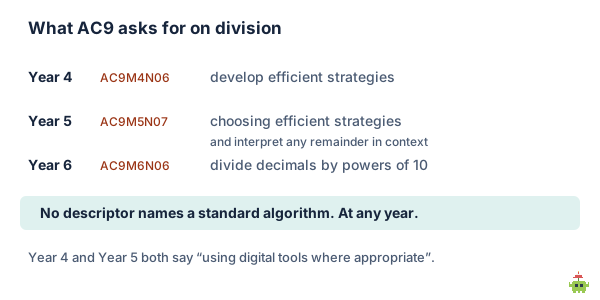
- Year 4, AC9M4N06: develop efficient strategies and use appropriate digital tools for solving problems involving addition and subtraction, and multiplication and division.
- Year 5, AC9M5N07: solve problems involving division, choosing efficient strategies and using digital tools where appropriate; interpret any remainder according to the context.
- Year 6, AC9M6N06: multiply and divide decimals by multiples of powers of 10 without a calculator, applying knowledge of place value.
Three years of division and the word algorithm does not appear once. Where AC9 does use “algorithm”, it means something else entirely: AC9M4N09 and AC9M5N010 are about following and creating sequences of steps and decisions to generate sets of numbers, which is computational thinking rather than arithmetic procedure.
This is a real difference from other countries, not a wording quirk. In US Common Core there is an explicit standard requiring students to fluently divide multi-digit numbers using the standard algorithm, at grade 6. The Australian Curriculum has no equivalent at any year.
What “choosing efficient strategies” means for you
The verb is the point. Year 5 does not say use an efficient strategy, it says choosing one. The selection is part of what is being assessed.
That has a consequence most parents find surprising: a child who always does long division, correctly, is not obviously meeting AC9M5N07. A student who reaches for the same procedure regardless of the numbers is not choosing anything. Ask them 3000 ÷ 6 and watch. If they set out a formal algorithm rather than saying 500, the strategy is being applied rather than selected.
Chunking, which is what the descriptors describe
The method that fits the wording best goes by partial quotients or chunking, and it asks the honest version of the question: how many 6s are in 856?
- A hundred 6s is 600. That fits inside 856, so take it. 856 minus 600 leaves 256.
- Forty 6s is 240. 256 minus 240 leaves 16.
- Two 6s is 12, leaving 4, which is smaller than 6 so it stops.
- Add the chunks: 100 plus 40 plus 2 is 142, remainder 4.
Every line is a real quantity. Place value never disappears, so an answer of 14 or 1420 is obviously wrong. Any chunk size works, so a child who cannot see the 40 can take 10 four times and arrive at the same place. And it checks itself: 142 × 6 is 852, plus the 4, is 856, which is the reasonableness check AC9M4N07 and AC9M5N08 both ask for by name.
Why the formal algorithm causes the trouble it does: it is the only arithmetic procedure that hides place value while you use it. It opens by asking how many times 6 goes into 8, when in 856 that 8 is eight hundred. That is why digits land in the wrong columns, why a zero in the answer causes total collapse, and why a child who forgets one of the four steps has nothing to rebuild it from.
The remainder clause, which is easy to miss
AC9M5N07 asks students to interpret any remainder according to the context. That is a separate skill from producing one, and no procedure delivers it.
Twenty-two people and buses that hold eight: 22 ÷ 8 is 2 remainder 6, and the answer is three buses. Twenty-two dollars shared between eight people: the answer is $2.75. Twenty-two metres of rope cut into eight-metre lengths: two lengths, with a piece left over. Same division, three different answers, and the difference is entirely in the situation.
Worth practising on its own. Give the same division in three contexts and ask what the remainder means each time. It takes ten minutes and it is a named part of a content description that a procedure-first approach never reaches.
Calculators, which the curriculum explicitly allows
Both AC9M4N06 and AC9M5N07 include the phrase using digital tools where appropriate. That is in the descriptor, not in a footnote.
It is worth being clear about what it does and does not mean. It does not mean division does not need to be understood, since the same descriptors ask for efficient strategies and reasonableness checks. It does mean that grinding through arithmetic by hand is not, by itself, the objective, and that a child who understands the operation and reaches for a calculator on an awkward computation is doing what the curriculum describes.
Three questions worth asking
- Ask 3000 ÷ 6. If your child sets out a written procedure rather than answering 500, they are applying a method rather than choosing one, which is the actual wording of AC9M5N07.
- Ask roughly how many 6s are in 856 before any calculation. More than ten? More than a hundred? A child who cannot estimate has no anchor, and with no anchor no arithmetic slip is ever noticed. Estimation and reasonableness are their own descriptors, AC9M4N07 and AC9M5N08.
- Ask what 42 ÷ 6 is. If the division facts are not automatic, division by any method is guessing with extra steps. AC9M4A02 puts the facts up to 10 × 10 and the related division facts in Year 4, and which tables belong to which year is worth knowing before you decide anything is behind.
So should my child ever learn long division?
It is not forbidden, and “efficient strategies” is broad enough to include it. For some children it becomes the efficient choice once the understanding is there, and there is nothing wrong with that.
What is worth abandoning is the belief that it is compulsory, that a child who cannot do it is behind, or that it should be drilled before the place value reasoning is solid. None of those is supported by anything in the curriculum, and all three are common. If you are teaching it, teach chunking first and present the algorithm afterwards as the compressed version of the same idea, which is what it is.
The short version
No content description in the Australian Curriculum names the standard algorithm for division at any year level. Year 4 asks for efficient strategies, Year 5 asks the student to choose them and to interpret remainders in context, and both explicitly allow digital tools.
Use chunking, because it is what the wording describes: how many 6s in 856, take a hundred of them, then forty, then two, giving 142 remainder 4. Every line is a quantity, the place value stays visible, and it checks itself.
Then do the two things procedures never cover. Ask for an estimate before every calculation, and give the same division in three different contexts so the remainder has to be interpreted rather than just produced.
Sprout Lessons builds maths practice around whatever your child is already into, with the AC9 code on every lesson. Start free.
Codes and descriptors in this guide were taken from our copy of the Machine Readable Australian Curriculum v9, accessed 2026-06-24, not written from memory. Australian Curriculum content descriptions are © ACARA and licensed under CC BY 4.0. Quoted here unmodified. ACARA does not endorse this product. Always verify against the current content descriptions and achievement standards at australiancurriculum.edu.au. If your state uses its own syllabus, check it as well: NSW and Victoria word some of this differently.
FAQ
Is long division taught in the Australian Curriculum?
Not as a requirement. No content description at any year level names the standard algorithm, the one with divide, multiply, subtract, bring down. Year 4 asks students to develop efficient strategies, Year 5 asks them to choose efficient strategies and interpret remainders in context, and Year 6 covers dividing decimals by powers of 10. This is a genuine difference from other countries: US Common Core has an explicit grade 6 standard requiring fluent division using the standard algorithm, and the Australian Curriculum has no equivalent.
Where AC9 does mention algorithms, what does it mean?
Computational thinking rather than arithmetic procedure. AC9M4N09 and AC9M5N010 are about following and creating a sequence of steps and decisions to generate sets of numbers or to experiment with factors, multiples and divisibility. That is a different sense of the word from a written method for dividing numbers, and it is worth not confusing the two when reading the curriculum.
My child can do long division. Is that a problem?
Not in itself, but it may not be enough. AC9M5N07 says choosing efficient strategies, and the selection is part of what is assessed, so a child who applies the same written procedure regardless of the numbers is not obviously meeting it. Ask 3000 divided by 6 and watch what happens: an immediate 500 is choosing, and setting out a formal algorithm is not. The method is not forbidden and efficient strategies is broad enough to include it; what is not supported is treating it as compulsory.
What should my child use instead?
Chunking, also called partial quotients, which asks the honest version of the question: how many 6s are in 856? A hundred of them is 600, leaving 256; forty more is 240, leaving 16; two more is 12, leaving 4. That is 142 remainder 4. Every line is a quantity your child can point at, so place value stays visible and an answer of 14 or 1420 is obviously wrong. Any chunk size works, so a child who cannot see the 40 can take 10 four times and get there.
Why does the standard algorithm cause so much trouble?
Because it is the only arithmetic procedure that hides place value while you use it. It opens by asking how many times 6 goes into 8, when in 856 that 8 is eight hundred. Every other written method keeps the columns honest and this one does not, which is why digits land in the wrong columns, why a zero in the answer causes total collapse, and why a child who forgets one of the four steps has nothing to rebuild it from.
Does the curriculum really allow calculators for division?
Yes, and it says so in the descriptors rather than in a footnote: both AC9M4N06 and AC9M5N07 include using digital tools where appropriate. It does not mean division need not be understood, since the same descriptors ask for efficient strategies and reasonableness checks. It does mean grinding through arithmetic by hand is not itself the objective, and a child who understands the operation and reaches for a calculator on an awkward computation is doing what the curriculum describes.