
Reversing letters is typical and fairly common up until second grade, and on its own it is not a sign of dyslexia. That is the finding most parents have never been told, and it is the reason this page exists, because the internet will tell you the opposite within about four seconds of searching.
Most children who reverse letters before age seven turn out not to have dyslexia. If your child is five, six or in first grade and writing b for d, or a backwards 3, or their name in mirror writing, you are looking at ordinary development rather than a warning sign.
There is a point at which it does become worth asking about, and it is further along than most people think. It is at the end of grade 2.
Why letters are the hardest objects a child has ever met
This is worth understanding, because once you see it the reversals stop looking like carelessness.
For the whole of your child’s life until now, nothing has changed identity when it turned around. A cup is a cup upside down. A chair seen from behind is still a chair. A dog facing left is the same dog it was facing right. Every object your child has ever learned keeps its name in any orientation, and learning that is one of the genuine achievements of early childhood.
Then letters arrive and break the rule. A b flipped becomes a d, and that is a different letter with a different sound. A p rotated becomes a q, or a b, or a d, depending which way you turn it. The same four shapes, four different answers.
A child who reverses letters is not failing to notice a difference. They are applying, correctly, a rule about the world that has been true for their entire life, to the first set of objects that does not obey it.
The timeline, and when to actually ask
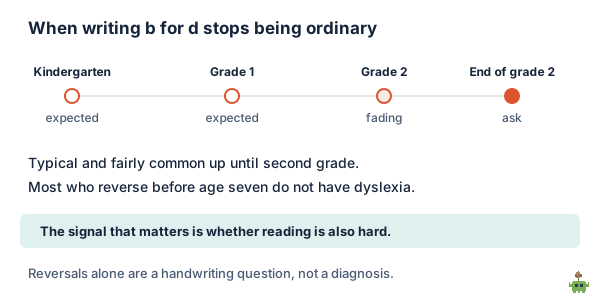
- Kindergarten and grade 1: expected. Reversals here are common enough that their absence is not a milestone and their presence is not a symptom.
- Grade 2: fading. Most children outgrow reversing as they get stronger at reading and writing. It is the strengthening that does it, not drilling the letters.
- End of grade 2, still frequent: ask. This is the point to raise it with your child’s teacher or doctor. Not because it means dyslexia, but because persistent reversals can point to visual processing difficulties or a weak memory for how letters are formed, and those are worth knowing about.
The much more important signal, at any age, is not the reversals. It is whether reading itself is hard: whether your child struggles to hear and manipulate the sounds in spoken words, to sound out unfamiliar words, or to read at anything like the pace of their peers. A child who reads well and writes a backwards 5 has a handwriting quirk. A child who reverses and cannot sound out words has something worth investigating, and it is the second half of that sentence doing the work.
What actually helps
Almost everything here is about how the letter gets formed, not about how it looks once it is on the page.
- Teach b and d as far apart as you can manage. This is the single most useful change and it is the opposite of what feels natural. Presenting them side by side to “show the difference” teaches your child that these two belong together, which is exactly the association you are trying to avoid. Teach one thoroughly, leave weeks, then teach the other.
- Fix the starting point. Most reversals are formation errors rather than perception errors. A b starts at the top with a straight line down; a d starts with the circle. If your child begins in the right place, the letter usually comes out right, so watch the hand rather than the page.
- Say the formation out loud while writing it. Line down, back up, around. Saying and doing together builds a motor memory that looking at a chart does not.
- Use the bed picture. Make a fist with each hand, thumbs up, and the left hand makes a b and the right makes a d, spelling “bed” with the mattress between. It is a genuine memory aid because it gives an anchor with a left and a right, which the letter alone does not have.
- Make it bigger and rougher. Letters written large, in sand, in shaving foam, in the air with a whole arm, or traced on sandpaper. More of the body involved means more to remember the direction by.
- Correct sparingly and specifically. One letter at a time, and only the one you are working on. A page returned with every reversal circled teaches a child that writing is a test they failed, which costs far more than the reversals do.
What not to do
- Do not tell a five-year-old they have a problem. They do not. The anxiety is more durable than the reversal and it is much harder to undo.
- Do not drill worksheets of b and d together. See above. It strengthens the very link that causes the confusion.
- Do not conclude dyslexia from reversals. Reversing letters or mirror writing is not necessarily a sign of it, and treating it as one leads families either to unnecessary alarm or, worse, to a false reassurance when the real signals are in the reading.
- Do not stop writing until it is fixed. Reversals fade because reading and writing get stronger. Less writing means slower fading.
Numbers, which are the same problem
Reversed 3s, 5s, 7s and 9s follow the same logic and the same timeline, and they need the same response: watch the starting point, say the formation, make it big. One extra thing helps with numbers specifically, which is a visible number line or number strip on the table. A child copying a correctly oriented 5 from a few inches away is getting a reference they can check against without asking, and self-correction is worth far more than being told.
Reversed digits in arithmetic are a separate matter and usually harmless: a child who writes 21 for 12 in an answer may be reversing the digits of the number rather than the shape of one. If that is happening, place value is the thing to check, not handwriting.
Three questions worth asking
- How old is your child, in school years rather than in months? Before the end of grade 2, reversals on their own are a development question and not much else.
- Is reading hard too? This is the question that matters. Sounding out unfamiliar words, hearing the individual sounds in a spoken word, reading at a reasonable pace. If those are fine, the reversals are a handwriting matter. If they are not, that is what to raise, and the reversals are almost beside the point.
- Does it happen when they write slowly and carefully? If careful writing comes out right and fast writing does not, this is automaticity rather than confusion, and it will resolve with practice and time rather than with intervention.
The short version
Reversing letters is typical and fairly common up until second grade, and most children who reverse letters before age seven do not have dyslexia. Letters are the first objects your child has met whose identity changes when they turn around, and getting that takes a while.
Teach b and d weeks apart rather than side by side, watch where the pencil starts rather than what the page looks like, say the formation out loud, and correct one letter at a time.
Ask at the end of grade 2 if reversals are still frequent. But ask sooner, and about something else, if reading itself is hard, because that is the signal that actually carries information. If your child reads aloud fluently and still does not follow what they read, that is a different problem again, covered in reads fluently but does not understand. And if the resistance is to writing rather than to letter shapes, holding the pen for them is the place to start.
Sprout Lessons builds practice around whatever your child is already into, so handwriting comes with something worth writing about. Start free.
Checked 9 September 2026 against Understood.org on reversing letters and dyslexia, which is where the typical-until-second-grade timeline and the point about most children who reverse letters before age seven not having dyslexia come from. This page is general information and not a diagnosis. If you have concerns about your child’s reading, writing or vision, speak to their teacher, your doctor or an optometrist: dyslexia, visual processing difficulties and dysgraphia are real, diagnosable and worth identifying early.
FAQ
Is it normal for my child to write letters backwards?
Yes. Reversing letters is typical and fairly common up until second grade, and most children outgrow it as they get stronger at reading and writing. If your child is five, six or in first grade and writing b for d, a backwards 3, or their name in mirror writing, that is ordinary development. It happens because letters are the first objects a child has met whose identity changes when they turn around: a cup is a cup upside down, but a flipped b is a d.
Does reversing letters mean my child has dyslexia?
Not on its own. Reversing letters or mirror writing is not necessarily a sign of dyslexia, and most children who reverse letters before age seven end up not having it. The signal that actually matters is whether reading itself is hard: difficulty hearing and manipulating the sounds in spoken words, difficulty sounding out unfamiliar words, or reading much slower than peers. A child who reverses and cannot sound out words is worth investigating, and it is the second half of that sentence doing the work.
At what age should I be concerned about letter reversals?
The end of second grade is the point to ask. If reversals are still frequent then, raise it with your child’s teacher or your doctor, not because it means dyslexia but because persistent reversals can point to visual processing difficulties or a weak memory for how letters are formed, and both are worth identifying. Ask sooner, and about the reading rather than the reversals, if reading itself is difficult at any age.
Should I show my child b and d side by side to compare them?
No, and this is the most common well-meant mistake. Presenting them together to show the difference teaches your child that these two letters belong together, which strengthens exactly the association causing the confusion. Teach one thoroughly, leave a gap of weeks, then teach the other. Focus on where the pencil starts rather than on what the finished letter looks like, because most reversals are formation errors rather than perception errors.
What about reversed numbers?
Same problem, same timeline, same response: watch the starting point, say the formation out loud, make it big. One extra thing helps with numbers, which is a visible number line or number strip on the table, so your child can check a correctly oriented 5 without asking. Note that reversed digits within an answer are separate: a child writing 21 for 12 may be reversing the order of the digits rather than the shape of one, and that is a place value question rather than a handwriting one.
Should we stop writing until the reversals are fixed?
No. Reversals fade because reading and writing get stronger, so less writing means slower fading. What is worth changing is how you respond to it: correct one letter at a time, and only the one you are currently working on. A page returned with every reversal circled teaches a child that writing is a test they failed, which costs far more than the reversals themselves do.