
Reading aloud well is a decoding score. It says almost nothing about whether your child understood the page. A child can turn every letter into the right sound, at pace, with expression, and arrive at the end of a paragraph holding nothing at all. It is not laziness and it is not a lack of effort. The two skills are genuinely separate, and only one of them is on display when your child reads to you.
This usually surfaces somewhere between grade 3 and grade 5, and there is a reason for the timing. Up to about grade 2, most of what children read is a story about people doing things, and the story does a lot of the comprehension work by itself. From grade 3 onward the texts turn informational and the sentences get longer, and a child who has been coasting on narrative structure runs out of road.
The twenty-minute diagnosis
Before changing anything, find out which problem you have. There are three, they look identical from the outside, and they need completely different responses. You need two short passages at the same reading level: one about something your child already knows well, and one about something they know nothing about.
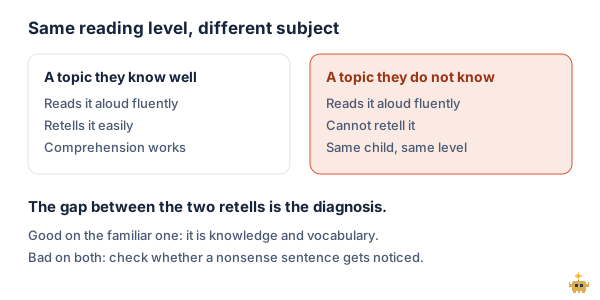
The familiar passage can be about anything they are into: a sport, a game, an animal, a hobby. Around 150 words each is plenty. Have them read one aloud, cover it, and tell you what it said. Then the other one, same way.
Result 1: good on the familiar passage, lost on the unfamiliar one
This is the common outcome, by a wide margin. Your child’s comprehension machinery works. You just watched it work. What the second passage was missing was not skill, it was the words and the background knowledge that would have made the sentences mean something.
This one is good news, and it is also the result that gets misdiagnosed most often, because a parent who only ever tests on school texts about unfamiliar subjects sees a child who cannot comprehend.
Result 2: bad on both, and they did not notice
Run one more check. Take a third short passage and edit one sentence in the middle so that it is quietly nonsense: swap in a word that does not belong, or contradict the sentence before it. Have your child read it aloud.
If they read straight through without a flicker, that is the diagnosis. They are not monitoring. Reading has become a performance to be got through rather than something that is supposed to make sense, and the internal alarm that should fire on a sentence that does not add up has been switched off, usually by years of being praised for reading smoothly.
Result 3: bad on both, but they did notice
If they stop at the nonsense sentence and say that is wrong, the monitoring is intact. What is missing is the retell itself. They understood each sentence as it went past and nothing accumulated, so by the end of the paragraph there is no summary in there to give you, because one was never built.
This is the most fixable of the three, and the fix is uncomfortably simple.
What to do about each one
If it is knowledge and vocabulary
More reading practice will not fix this, and this is the single most expensive mistake parents make here. A child who does not know what a legislature is does not learn it by reading the paragraph again more slowly.
- Front-load the topic before the text. Five minutes of talking, a short video, a picture, anything that means the words in the passage have somewhere to land. This feels like cheating. It is the entire intervention.
- Read in blocks on one subject rather than a different topic every day. Four texts about volcanoes in a row is far more productive than four unrelated texts, because each one makes the next one easier. Variety is the enemy here.
- Teach the connector words, not just the topic words. However, therefore, although, whereas, despite. These carry the logic of a sentence, they are rare in speech and in children’s fiction, and a child who reads over them loses the argument while understanding every noun.
If it is monitoring
- Say out loud that the point is meaning, not smoothness. Many children have genuinely never been told this. Some of them visibly relax.
- Keep planting nonsense sentences for a couple of weeks, and make catching them the game. It teaches the alarm to fire without a single worksheet.
- Slow the reading down deliberately. A child who has been rewarded for pace will need permission to stop, and stopping is where comprehension happens.
If it is the retell
Stop and say it back, after every paragraph. Cover the text, and have them tell you what that paragraph said in their own words. Not a summary of the whole thing at the end, which is too late. Every paragraph, out loud, from memory.
Expect it to be painful for about a week. Expect the first attempts to be the last sentence repeated word for word, which is the normal starting point and is why you cover the text. Then expect it to work, and to keep working, because saying a thing back in your own words is the act of building the model that was missing.
Three things that do not work, and why they look like they should
- More reading time. Volume helps a child whose comprehension already works. For the child in result 1 it just means more minutes of not understanding, which is also how a child learns to dislike reading.
- Comprehension worksheets. Answering questions with the text open is a search task, and a fluent decoder is excellent at search. They will score well and learn nothing. If you use them, close the book first.
- Strategy instruction on repeat. Predicting, visualizing and inferring are real things, and a few weeks of them is worth doing. Two years of them is not, and by then the strategies have become another performance. The child in result 1 does not need a strategy, they need to know what a legislature is.
How to tell it is working
Not by asking whether they understood, because the honest answer to that is usually yes and the child believes it. Use these instead.
- The unfamiliar passage retell gets better on topics you have been reading in blocks. That is the knowledge repair showing up.
- They interrupt themselves. A child who stops mid-paragraph to say wait, that does not make sense has switched the monitoring back on, and this is the single best sign there is.
- They ask what a word means while reading rather than after. It means the words are being processed for meaning rather than pronunciation.
Where this sits in what schools teach
Every grade from about 3 upward opens its reading standards with two that are exactly this work: cite what the text says and draw inferences from it, and determine the central idea and summarize the text. Both are impossible for a child who cannot retell a paragraph, and neither is measured by reading aloud.
It matters most going into middle school, where the 41 English standards for grades 6, 7 and 8 assume this is in place and never revisit it, and where the 29 reading and writing standards for history and science put your child in front of exactly the unfamiliar, knowledge-heavy text that result 1 is about.
The short version
Two passages at the same level, one familiar topic and one not. If the familiar one comes back fine, your child can comprehend and the problem is knowledge and vocabulary, so front-load the topic and read in blocks on one subject. If both come back badly, plant a nonsense sentence: read straight past it means monitoring, caught it means the retell was never built.
And if you do only one thing, do this one. After every paragraph, cover the page and have them tell you what it said. It takes a week to stop being painful, it costs nothing, and it does more than any workbook on the shelf.
Sprout Lessons builds reading lessons around whatever your child is already into, which is the cheapest way there is to close a knowledge gap. Start free.
FAQ
Why can my child read aloud perfectly but not understand what they read?
Because reading aloud measures decoding, which is turning letters into sounds, and comprehension is a separate skill that decoding does not carry with it. A child can be fluent, fast and expressive and arrive at the end of a paragraph holding nothing. It usually surfaces between grade 3 and grade 5, when texts stop being stories about people doing things and turn informational, because until then the narrative structure was doing much of the comprehension work by itself.
How do I tell whether it is a comprehension problem or a knowledge problem?
Two passages at the same reading level, one on a topic your child knows well and one on a topic they know nothing about, each read aloud and then retold with the text covered. If the familiar one comes back fine, comprehension works and the problem is knowledge and vocabulary. This is the most common result and the most frequently misdiagnosed, because a parent who only ever tests on school texts about unfamiliar subjects sees a child who cannot comprehend.
Will more reading practice fix this?
Not for the most common cause, and this is the expensive mistake. Volume helps a child whose comprehension already works. For a child whose problem is missing vocabulary and background knowledge, more reading is more minutes of not understanding, which is also how a child learns to dislike reading. Front-load the topic before the text and read in blocks on one subject, so each text makes the next one easier.
What is the nonsense sentence check?
Take a short passage and quietly edit one sentence in the middle so that it is wrong: swap in a word that does not belong, or contradict the sentence before it. Have your child read it aloud. If they read straight through without a flicker, they are not monitoring for meaning, and the internal alarm that should fire on a sentence that does not add up has been switched off, usually by years of praise for reading smoothly.
Do comprehension worksheets help?
Much less than they appear to, because answering questions with the text open is a search task and a fluent decoder is excellent at search. They score well and learn nothing. If you use them, close the book first. The same caution applies to strategy instruction: predicting, visualizing and inferring are real and a few weeks of them is worth doing, but two years of them turns the strategies into another performance.
How will I know it is working?
Not by asking whether they understood, because the honest answer is usually yes and the child believes it. Watch for three things instead. The retell on unfamiliar topics improves in the subjects you have been reading in blocks. They interrupt themselves mid-paragraph to say that does not make sense, which is the single best sign there is. And they ask what a word means while reading rather than afterwards.