
Grades 6, 7 and 8 English are 41 standards each. Not roughly 41. Exactly 41, three years running, in the same five strands with the same counts. Ten informational reading, ten writing, nine literature, six language, six speaking and listening. Every year. Nothing is added and nothing retires.
That makes middle school English a genuinely different planning problem from the other two subjects. Math renames four of its five domains at grade 6, and science drops grade labels entirely. English does neither. You cannot plan the year around what is new, because nothing is.
The 41 standards, identical in all three years
| Strand | Standards | What it covers |
|---|---|---|
| Reading: Informational Text | 10 | Central idea, evidence, structure, author’s purpose, arguments, comparing sources |
| Writing | 10 | Argument, informative, narrative, process, research, evidence, routine writing |
| Reading: Literature | 9 | Theme, character, plot, figurative language, structure, point of view, comparison |
| Language | 6 | Grammar, conventions, vocabulary, figurative language, word relationships |
| Speaking and Listening | 6 | Discussion, evaluating a speaker, presenting, using media |
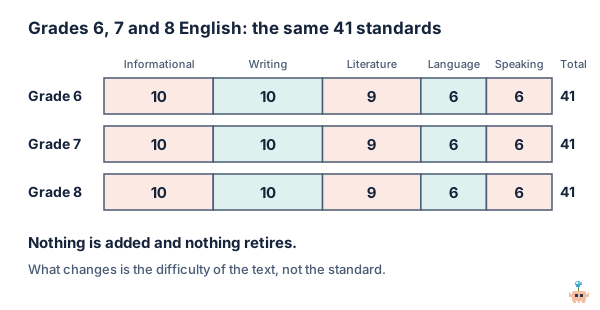
One number in that table is worth pausing on. Informational text has ten standards and literature has nine. Middle school reading is not mostly novels, and a year built around a stack of fiction is under-serving the larger of the two reading strands.
What actually changes between the years
If the standards are identical, something has to be doing the work, and three things are.
- Text complexity. Each grade’s reading standards end with a comprehension standard tied to a complexity band. The standard reads almost the same in grade 6 and grade 8; the texts it is applied to do not.
- Independence. The scaffolding language thins out across the three years. What a grade 6 child does with support, a grade 8 child is expected to do alone.
- Sophistication of the same move. Citing evidence in grade 6 means pointing at the sentence that says it. By grade 8 it means citing the evidence that most strongly supports an inference, which is a different act wearing the same words.
The planning consequence: do not build three different years. Build one repeating cycle and raise the difficulty of the material inside it. A parent who tries to find forty-one new things to teach in grade 7 will invent busywork, because the curriculum is not asking for new things.
The 29 standards a grade search will never show you
This is the single most useful thing on this page, and it is invisible in every grade-level list.
Alongside the 41 grade-level standards, Common Core publishes 29 more for grades 6 to 8 covering reading and writing in history and social studies, and in science and technical subjects. They are coded RH.6-8, RST.6-8 and WHST.6-8, and because they are written as a 6 to 8 band rather than per grade, searching for grade 7 English standards will not return them.
They are not English extension work. They are the standards that say a child should be able to read a history source and a science procedure, which is a different skill from reading a novel and is the one that decides whether high school goes well. Homeschooling families skip them almost universally, because nothing in an English curriculum points at them.
They have their own page: the reading and writing standards that live outside English class. Read it before planning a middle school year, because it changes where three of your subjects overlap.
The three hard ones
Citing the evidence that best supports an inference
The first reading standard in every strand and every year, and it escalates quietly: grade 6 asks for evidence supporting analysis, grade 8 asks for the evidence that most strongly supports it.
The wrong answer it produces: the child quotes the first relevant sentence they find, or quotes a whole paragraph and hopes. Ask why that quote and not another and you get a shrug. They are retrieving, not selecting.
The fix: make them find three pieces of evidence and rank them. The ranking is the standard. A child who can say “this one is better than that one because it says it directly rather than implying it” has done the grade 8 version, and it takes one text rather than a unit.
Argument writing, which is not persuasive writing
Middle school writing opens with argument, and Common Core is deliberate that this is not the same as persuasion.
The wrong answer it produces: the child writes to win. Emotive language, a strong opinion, no acknowledgement that another view exists, and evidence chosen because it agrees. It often reads well, which is why it survives.
The fix: require a counterclaim, in writing, every time. An argument that never names the opposing view is a persuasive piece, and by grade 7 the standards ask explicitly for the counterclaim to be acknowledged. The quickest route is to have your child write the strongest version of the side they disagree with first, then respond to it.
Comparing what two texts do with the same material
The ninth reading standard in both strands, and the one most often left undone because it needs two texts.
The wrong answer it produces: a summary of each, side by side, with no comparison. The child describes text one, describes text two, and stops.
The fix: never ask “what did each one say”. Ask what one includes that the other leaves out, and why the author might have made that choice. Two accounts of the same event, one from each side, does more for this standard than any worksheet, and it doubles as the history reading work.
How long middle school English takes at home
About 160 to 190 hours a year, roughly 55 minutes a day across four days, which is broadly flat across the three years for the same reason the standards are.
- Reading: about 40%, and it should be split closer to even between informational and literary than most home programs manage.
- Writing: about a third. The writing standards ask for routine writing over both extended and short time frames, so this is daily rather than weekly.
- Language and speaking take the rest, and both work best folded into the reading and writing rather than taught as separate units.
What to compress when it runs long. The speaking and listening standards compress into a genuine audience: one presentation a term to actual people covers most of them. Do not compress the writing volume, because the routine-writing standard is explicitly about frequency, and it is the one thing on this list that cannot be done in a burst.
Readiness check
- Can they read a page and tell you what it said? Fluent reading aloud is not the same thing, and middle school is where the difference surfaces. If this is shaky, see reads fluently but does not understand before starting.
- Can they write a paragraph with a point and support? The grade 5 opinion and informative standards are the foundation the middle school argument standards sit on.
- Do they read anything that is not fiction? Ten of the reading standards are informational, and a child who only reads novels meets fewer than half of them.
A sequence for a flexible year
Because the standards repeat, this is one cycle rather than a progression. Run it three or four times a year on different material, and raise the difficulty each time.
- Read one substantial text, alternating literary and informational across cycles.
- Evidence work: three quotes, ranked, with a reason for the ranking.
- Structure and purpose: how is this put together, and why did the author do it that way.
- A second text on the same subject, and the comparison question: what is in one and not the other.
- Write, alternating argument and informative across cycles, with a counterclaim whenever it is an argument.
- Revise with feedback, which is its own standard and the step most often dropped.
- Present or discuss it with a real audience, which is the speaking strand.
Language standards ride along: teach the grammar and vocabulary that the cycle’s text and the child’s draft actually raise, rather than as a separate track.
The split-grade case
Middle school English is the easiest subject in the curriculum to combine across grades 6 to 8, and it follows directly from the standards being identical.
- Three children can read the same text and each meet their own year. The standard is the same; what differs is the sophistication you expect from the answer and how much support you give.
- Differentiate by the question, not the material. Ask the grade 6 child for evidence, and the grade 8 child which evidence is strongest and why.
- Discussion improves with more people in it, which makes the speaking and listening strand easier in a mixed group than alone.
The honest summary
Forty-one standards, identical in grades 6, 7 and 8, in five strands that never change. Do not look for new content each year: build one cycle, run it repeatedly, and raise the difficulty of the text and the independence you expect.
Informational reading is the bigger of the two reading strands, so a year of novels under-serves it. Argument is not persuasion, and the counterclaim is what separates them. And comparison means asking what one text leaves out, not summarizing both.
Then the thing a grade-level list will never tell you: there are 29 more standards for grades 6 to 8, covering reading and writing in history and science, filed under a band rather than a grade. Almost nobody teaching at home knows they exist. They are here.
Sprout Lessons builds standards-aligned lessons for grades K–12. Start free.
Standard counts in this guide were taken from our copy of the Common Core dataset, accessed 2026-07-16, not written from memory. Read the official wording at the Common Core English Language Arts standards. Common Core State Standards © 2010 National Governors Association Center for Best Practices and Council of Chief State School Officers. All rights reserved. This product is not endorsed by NGA/CCSSO. Not every state uses Common Core: check your state department of education for the standards that apply to you.
FAQ
How many English standards are there in middle school?
Exactly 41 in each of grades 6, 7 and 8, in five strands with identical counts every year: ten Reading Informational Text, ten Writing, nine Reading Literature, six Language and six Speaking and Listening. Nothing is added and nothing retires across the three years, which makes middle school English a different planning problem from math, where four of the five domains are renamed at grade 6, or science, which drops grade labels entirely.
If the standards are identical, what actually changes between grade 6 and grade 8?
Three things. Text complexity, because each grade’s reading standards end with a comprehension standard tied to a complexity band, and the standard reads almost the same while the texts do not. Independence, because the scaffolding language thins across the three years: what a grade 6 child does with support, a grade 8 child does alone. And the sophistication of the same move: citing evidence in grade 6 means pointing at the sentence that says it, while by grade 8 it means citing the evidence that most strongly supports an inference.
Should middle school reading be mostly novels?
No, and the standard counts say so directly. Informational text carries ten standards and literature carries nine, so a year built around a stack of fiction is under-serving the larger of the two reading strands. Split reading closer to even between informational and literary than most home programs manage, and remember that the reading your child does in history and science counts toward this rather than competing with it.
What is the difference between argument writing and persuasive writing?
A counterclaim. Persuasion writes to win: emotive language, a strong opinion, no acknowledgement that another view exists, and evidence chosen because it agrees. It often reads well, which is why it survives. Common Core is deliberate that argument is not this, and by grade 7 the standards ask explicitly for the opposing claim to be acknowledged. Require a counterclaim in writing every time, and have your child write the strongest version of the side they disagree with first.
How long does middle school English take at home?
About 160 to 190 hours a year, roughly 55 minutes a day across four days, and broadly flat across the three years. Reading is about 40%, writing about a third, with language and speaking taking the rest and working best folded into the reading and writing rather than taught separately. If it runs long, compress the speaking standards into one real presentation a term, and do not compress writing volume, because the routine-writing standard is explicitly about frequency.
Are there English standards outside the grade-level list?
Yes, 29 of them for grades 6 to 8, covering reading and writing in history and social studies and in science and technical subjects. They are coded RH.6-8, RST.6-8 and WHST.6-8, and because they are published as a three-year band rather than per grade, a search for grade 7 English standards returns none of them. They are the standards that decide whether high school reading goes well, and homeschooling families skip them almost universally because nothing in an English curriculum points at them.