
English is 41 standards a year from grade 6 to grade 12. Seven years, the same five strands, the same counts, never changing. Ten informational reading, ten writing, nine literature, six language, six speaking and listening. Grade 6 and grade 12 have the same shape and the same size.
That is a longer run of identical structure than anything else in the curriculum, and it is why so many high school English plans go wrong. Families look for the new content and there is none, so they invent it, usually as a reading list. The escalation is real, but it happens inside the wording of standards that keep their numbers, and you have to read the words to see it.
There is also a structural surprise: high school has only two bands, 9-10 and 11-12. There is no such thing as a grade 11 English standard.
Seven years, one list
| Band | Grade-level standards | Plus disciplinary literacy |
|---|---|---|
| Grade 6 | 41 | 29 (band 6-8) |
| Grade 7 | 41 | |
| Grade 8 | 41 | |
| Grades 9-10 | 41 | 29 |
| Grades 11-12 | 41 | 29 |
The strand counts behind each 41 are identical in all five rows: Reading Informational Text 10, Writing 10, Reading Literature 9, Language 6, Speaking and Listening 6.
What escalation actually looks like
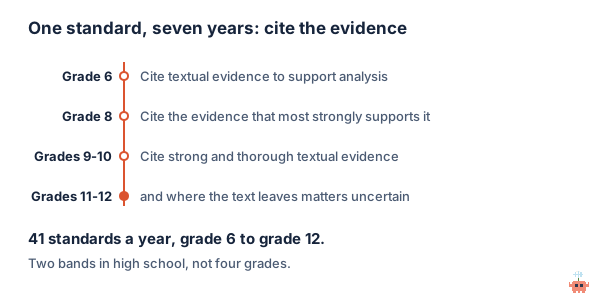
Here is the first informational reading standard, word for word, at four points across the seven years. It carries the same number every time.
- Grade 6. “Cite textual evidence to support analysis of what the text says explicitly as well as inferences drawn from the text.”
- Grade 8. “Cite the textual evidence that most strongly supports an analysis …”
- Grades 9-10. “Cite strong and thorough textual evidence …”
- Grades 11-12. “… including determining where the text leaves matters uncertain.”
That last clause is the whole of high school English in eight words. Grade 6 finds the sentence that says it. Grade 8 picks the best one. Grades 9-10 want several, and good ones. Grades 11-12 want the student to notice what the text does not settle.
The teaching consequence: the question changes, not the material. Ask a grade 11 student what this text is not telling you, and what it would take to know. That single habit is the difference between the two high school bands, and it costs nothing.
The standard that changes once in seven years
Argument writing is the other end of the spectrum. The first writing standard is identical in grade 6 and grade 8: “Write arguments to support claims with clear reasons and relevant evidence.” Then at grades 9-10 it becomes “Write arguments to support claims in an analysis of substantive topics or texts, using valid reasoning and relevant and sufficient evidence” and it stays exactly that through grades 11-12.
One change, at the start of high school, and three words carry it: substantive, valid, sufficient. The topic has to be worth arguing about, the reasoning has to hold, and the evidence has to be enough rather than merely present.
The wrong answer it produces: a well-organized essay on a topic with no real disagreement in it, with three quotes because three was the number asked for. It is fluent, it follows the structure, and it fails all three words.
The fix: pick topics where your child does not already know the answer, and ask after every draft whether this is enough evidence rather than whether there is any. Sufficiency is a judgment, and it only develops by being questioned.
The one place the standards name what to read
Common Core is almost entirely content-neutral. It tells you what a student should be able to do and leaves the texts to you, which is exactly why homeschoolers can use it without giving up their own reading choices. High school is where that stops, in two standards.
RI.11-12.9 asks a student to analyze seventeenth-, eighteenth- and nineteenth-century foundational US documents of historical and literary significance, “including The Declaration of Independence, the Preamble to the Constitution, the Bill of Rights, and Lincoln’s Second Inaugural Address”, for their themes, purposes and rhetorical features.
Note the word including. The equivalent standard at grades 9-10 lists Washington’s Farewell Address, the Gettysburg Address, Roosevelt’s Four Freedoms speech and King’s Letter from Birmingham Jail, but as e.g., which is a suggestion. At 11-12 it is not.
RL.11-12.9 does the same on the literature side, asking for demonstrated knowledge of eighteenth-, nineteenth- and early-twentieth-century foundational works of American literature, including how two texts from the same period treat similar themes.
Why this matters to a homeschooling family more than to a school: a school covers these by default because its curriculum was built around them. A family building a reading list from their own shelves can meet all 41 standards for years and never touch a founding document, and this is the one place where the standards say the text itself is the requirement.
The 29 that are not English at all
Each high school band also carries 29 disciplinary literacy standards, coded RH, RST and WHST, covering reading and writing in history and in science and technical subjects. Ten, ten and nine, in both 9-10 and 11-12, exactly as in the grades 6-8 band.
So the real load per band is 70 standards, not 41, and the extra 29 are the ones that decide whether college reading goes well, because college reading is mostly not novels.
WHST.3 does not exist at any band, high school included. There is no narrative writing standard in the disciplinary set, because narration is folded into the informative and explanatory standard. That is guidance, not an omission: a lab report is explanation, not a story.
The citation standard, WHST.8, is the one to start early. It is the only place in the whole English curriculum that requires a standard citation format, and it is the skill a first-year college student is assumed to arrive with.
How long high school English takes at home
About 160 to 190 hours a year, which is the usual basis for one credit, so roughly 55 minutes a day across four days. Flat across the four years, for the same reason the standard count is.
- Reading about 40%, split more evenly between informational and literary than most home programs manage. Informational reading has ten standards and literature has nine.
- Writing about a third, and the routine-writing standard is explicitly about frequency over both long and short time frames, so this is daily rather than weekly.
- Language and speaking take the rest, and both work better folded into the reading and writing than taught as separate units.
What to compress when it runs long. Speaking and listening compresses into a genuine audience: one real presentation a term covers most of the strand. Do not compress writing volume, and do not compress the founding documents, because those are the two things nothing else in the year replaces.
Readiness check
- Is middle school English actually finished? The 41 standards for grades 6 to 8 are the same 41, so this is really a question about the wording: can your child pick the best evidence rather than the first, and write an argument with a counterclaim in it?
- Can they read a page of unfamiliar nonfiction and retell it? If reading aloud is fluent but nothing comes back, start with reads fluently but does not understand, because the high school standards assume comprehension and never revisit it.
- Have they ever cited a source properly? If not, WHST.8 is the first thing to start, because it is a habit rather than a skill.
A four-year shape
Because the standards repeat, this is one cycle with a rising ceiling, not a progression through new content.
- Grade 9. Establish the cycle: one substantial text, evidence ranked with reasons, structure and purpose, a second text for comparison, then write, revise with feedback, and present. Alternate literary and informational.
- Grade 10. Same cycle, harder texts, and push on the 9-10 wording: strong and thorough evidence, valid reasoning, sufficient evidence. Bring the seminal US documents in here rather than saving them.
- Grade 11. The foundational works year, because two standards require it. American literature and the founding documents, read for rhetoric and purpose rather than as history.
- Grade 12. Uncertainty and independence. Where does this text leave matters unsettled, and what would it take to know? Research with real citation, and writing long enough that structure has to be planned rather than discovered.
The 29 disciplinary standards run alongside all four, in whatever history and science your child is doing.
The honest summary
Forty-one standards a year, the same five strands and the same counts, from grade 6 through grade 12. High school has two bands rather than four grades, so there is no grade 11 English standard.
The escalation is in the wording of standards that never change their numbers. Citing evidence goes from cite it, to cite the strongest, to cite strong and thorough evidence, to noticing where the text leaves matters uncertain. Argument writing changes exactly once in seven years, at grades 9-10, and three words carry it: substantive, valid, sufficient.
Two things are genuinely new in high school. The standards name specific founding documents and American literature, which is the only place they tell you what to read. And each band carries 29 more standards for reading and writing in history and science, so the real number is 70.
Sprout Lessons builds standards-aligned lessons for grades K–12. Start free.
Standard counts and wording in this guide were taken from our copy of the Common Core dataset, accessed 2026-07-16, not written from memory. Read the official text at the Common Core English Language Arts standards. Common Core State Standards © 2010 National Governors Association Center for Best Practices and Council of Chief State School Officers. All rights reserved. This product is not endorsed by NGA/CCSSO. Not every state uses Common Core, and graduation credit requirements are set by your state rather than by the standards: check your state department of education.
FAQ
How many English standards are there in high school?
Forty-one grade-level standards in each band, which is the same 41 as grades 6, 7 and 8, in the same five strands with the same counts. High school is published as two bands, 9-10 and 11-12, rather than four grades, so there is no grade 11 English standard. Each band also carries 29 disciplinary literacy standards for history and science, which makes the real load 70 rather than 41.
If the standards never change, what actually gets harder?
The wording, inside standards that keep their numbers. Take the first informational reading standard: grade 6 asks the student to cite textual evidence, grade 8 asks for the evidence that most strongly supports the analysis, grades 9-10 ask for strong and thorough evidence, and grades 11-12 add including determining where the text leaves matters uncertain. That last clause is the whole of high school English in eight words, and you teach it by changing the question rather than the material.
Do the standards say which books my child has to read?
Almost never, which is exactly why they suit homeschooling. High school is the exception, in two standards. RI.11-12.9 names The Declaration of Independence, the Preamble to the Constitution, the Bill of Rights and Lincoln’s Second Inaugural Address using the word including rather than e.g., and RL.11-12.9 requires demonstrated knowledge of eighteenth-, nineteenth- and early-twentieth-century foundational works of American literature. The equivalent 9-10 standard lists Washington’s Farewell Address, the Gettysburg Address, Roosevelt’s Four Freedoms and King’s Letter from Birmingham Jail, but as examples.
How does argument writing change in high school?
Once, and then not again. The first writing standard is word-for-word identical in grade 6 and grade 8. At grades 9-10 it becomes write arguments to support claims in an analysis of substantive topics or texts, using valid reasoning and relevant and sufficient evidence, and it stays exactly that through grades 11-12. Three words do the work: substantive, valid, sufficient. The failure it produces is a fluent, well-organized essay on a topic with no real disagreement in it, carrying three quotes because three was the number asked for.
How long does high school English take at home?
About 160 to 190 hours a year, which is the usual basis for one credit, so roughly 55 minutes a day across four days, and flat across the four years for the same reason the standard count is. Reading is about 40% and should be split more evenly between informational and literary than most home programs manage, writing about a third and daily rather than weekly, with language and speaking folded into both.
What should I cut if the year runs long?
Speaking and listening, which compresses into one genuine presentation a term to a real audience and covers most of the strand that way. Do not compress writing volume, because the routine-writing standard is explicitly about frequency over both extended and short time frames. And do not compress the founding documents, because those two standards are the only place the curriculum says the text itself is the requirement, so nothing else in the year replaces them.