
There are 29 Common Core standards for grades 6 to 8 that will never appear in a search for grade 7 English standards. They are filed under a three-year band rather than a grade, and they are not stored with English at all. They cover reading and writing in history and social studies, and in science and technical subjects.
Almost every homeschooling family skips them, and not out of carelessness. Nothing points at them. An English curriculum does not include them because they are not English. A science curriculum does not include them because they are literacy standards. In a school they belong to the history and science teachers, who mostly did not train as reading teachers. In a homeschool there is one teacher for all of it, which is the only setting where these standards are genuinely easy.
What the 29 actually are
Three sets, coded RH, RST and WHST, all carrying the band 6-8 in place of a grade number.
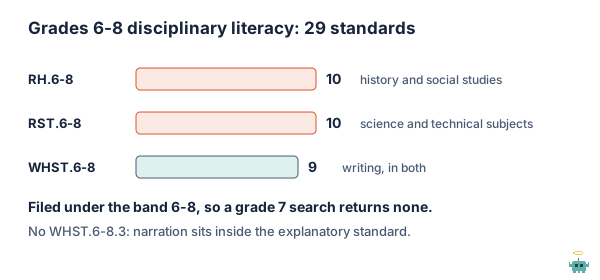
| Code | Set | Count |
|---|---|---|
| RH.6-8 | Reading in history and social studies | 10 |
| RST.6-8 | Reading in science and technical subjects | 10 |
| WHST.6-8 | Writing in history, science and technical subjects | 9 |
RH and RST run in parallel: both are numbered 1 to 10, and both follow the same skeleton. Evidence, central idea, then a discipline-specific one at 3, then vocabulary, structure, purpose, visual information, a reliability standard at 8, a comparison at 9, and a text complexity standard at 10. The interesting part is the four places where the parallel breaks.
The four places history and science ask different things
| # | History (RH.6-8) | Science (RST.6-8) |
|---|---|---|
| 3 | Identify key steps in a description of a process, such as how a bill becomes law | Follow precisely a multistep procedure when carrying out experiments, taking measurements or performing technical tasks |
| 6 | Identify what reveals the author’s point of view, such as loaded language | Analyze the author’s purpose in explaining, describing or discussing |
| 8 | Distinguish among fact, opinion, and reasoned judgment | Distinguish among facts, reasoned judgment based on research findings, and speculation |
| 9 | Analyze the relationship between a primary and a secondary source on the same topic | Compare information gained from experiments, simulations or video with that gained from reading a text on the same topic |
Number 3 is the one worth reading twice. “Follow precisely a multistep procedure when carrying out experiments” is a reading standard. Not a science standard. The claim underneath it is that a set of instructions is a text with a structure, and that following it accurately is an act of reading. If your child does experiments and you have been handling the procedure for them, you are doing RST.6-8.3 on their behalf.
Number 8 is the other one. History separates fact, opinion and reasoned judgment. Science separates facts, reasoned judgment based on research findings, and speculation. The middle term is shared and the outer terms are not, because a historian’s bad claim is usually an opinion dressed as a fact, and a scientist’s is usually speculation dressed as a finding. Those are different failures and they need different questions.
The standard that does not exist
The writing set runs 1, 2, then jumps to 4. There is no WHST.6-8.3. In grade-level English, the third writing standard is narrative writing. Here it has been deliberately removed as a separate requirement, and the narration folded into the informative standard instead, which reads: write informative and explanatory texts, including the narration of historical events, scientific procedures and experiments, or technical processes.
That gap is a piece of guidance, not an oversight. Telling the story of an experiment is explanatory writing, and the standards refuse to let it be treated as creative writing. It is a useful correction for a home program, because a lab write-up done as a story about what we did today is the most common way this work goes wrong.
The three that carry the most weight
WHST.6-8.8, the only place citation is actually required
It asks a child to gather information from multiple print and digital sources, use search terms effectively, assess the credibility and accuracy of each source, and quote or paraphrase while avoiding plagiarism and following a standard citation format.
Nothing in grade-level middle school English asks for a citation format. This does, and it is the standard that decides how the first year of high school goes. It is also the one a homeschool can meet almost accidentally, because a child who is looking things up all day is already doing four fifths of it. The missing fifth is writing down where it came from.
The fix: pick one format, any format, and require it on everything. Which format does not matter at this age. Consistency does.
RH.6-8.9, primary against secondary
Analyze the relationship between a primary and a secondary source on the same topic. This is the hardest of the 29 to fake, because it needs two documents and a real question.
The wrong answer it produces: the child summarizes the textbook, then summarizes the letter or the photograph, and treats the primary source as decoration proving the secondary one was right.
The fix: ask what the secondary source left out, and what it could only have known from a source like this one. A letter written at the time and a paragraph written a century later are not two versions of the same thing, and the standard is about the relationship between them rather than the content of either.
RST.6-8.7, words into a diagram and back
Integrate quantitative or technical information expressed in words with a version of the same information expressed visually, in a flowchart, diagram, model, graph or table.
The wrong answer it produces: the child reads the paragraph, looks at the diagram, and treats them as two separate items to be got through. Ask what the diagram adds and you get the paragraph back.
The fix: make them build the missing half. Give the text and ask for the flowchart. Give the graph and ask for the paragraph. Translating in both directions is the standard, and it takes about ten minutes rather than a unit.
How to fit 29 more standards into a year without adding a subject
You do not add a subject. That is the whole point of where these are filed. They describe the reading and writing your child is already doing in history and science, done deliberately.
- Read the actual sources, not only the summary of them. A textbook paragraph about a treaty meets almost none of these. The treaty, plus the paragraph, meets six of them.
- Let your child run the procedure. Hand over the instructions and stop narrating. RST.6-8.3 is met by not helping.
- Write the experiment up as explanation. Not as a story, and not as a form to fill in. What happened, why, and what it means.
- Two sources on anything, always. Standard 9 in both sets is a comparison, and neither can be met with one document.
- Cite it. Every time, in the same format.
Time cost: close to zero if history and science are already happening, because this is a change in how rather than a change in how much. Budget an extra 20 minutes a week for the writing, which is the one part that is genuinely additional.
Readiness check
- Can they read a paragraph of history and tell you what it said? If they read it aloud fluently and then cannot retell it, start with reads fluently but does not understand, because none of these 29 will land until that is fixed.
- Do they notice when a text is telling them what to think? RH.6-8.6 and both number 8s are all versions of this question.
- Have they ever written down where a fact came from? If not, WHST.6-8.8 is the first thing to start, because it is a habit rather than a skill and habits take longest.
How this connects to the rest of middle school English
These 29 sit alongside the 41 grade-level English standards, which are identical in grades 6, 7 and 8. The two sets rhyme deliberately: cite evidence, determine central ideas, analyze structure and purpose, compare two sources. The disciplinary versions are the same moves performed on a different kind of text.
That is the practical opportunity. A single well-chosen pair of history sources can meet an English standard and a history reading standard at once, and the write-up meets a writing standard in both sets. In a school those are three teachers who never see each other’s planning. At your kitchen table it is one afternoon.
Science works the same way. The middle school science standards already ask for evidence, argument and communicating information, which is RST and WHST wearing different codes.
The honest summary
Twenty-nine standards for grades 6 to 8, filed under a band rather than a grade, which is why nobody finds them. Ten for reading history, ten for reading science and technical text, nine for writing in both, and no narrative standard because narration belongs inside explanation here.
They are not extra work. They are a description of how the reading and writing in your history and science should already be happening: real sources rather than only summaries, two of them rather than one, the procedure in the child’s hands rather than yours, and a note of where every fact came from.
And they are the standards that most reliably predict whether high school reading goes well, because high school is mostly not novels.
Sprout Lessons builds standards-aligned lessons for grades K–12. Start free.
Standard counts and wording in this guide were taken from our copy of the Common Core dataset, accessed 2026-07-16, not written from memory. Read the official text of all three sets, RH, RST and WHST, at the Common Core English Language Arts standards. Common Core State Standards © 2010 National Governors Association Center for Best Practices and Council of Chief State School Officers. All rights reserved. This product is not endorsed by NGA/CCSSO. Not every state uses Common Core: check your state department of education for the standards that apply to you.
FAQ
What are the RH, RST and WHST standards?
They are the Common Core literacy standards for the content subjects: RH is reading in history and social studies, RST is reading in science and technical subjects, and WHST is writing in all three. For grades 6 to 8 there are 29 of them, ten and ten and nine. They are published as a band covering the three years rather than per grade, which is exactly why a search for grade 7 English standards will never return them.
Why does nobody teach these standards?
Because nothing points at them. An English curriculum leaves them out because they are not English, and a science or history curriculum leaves them out because they are literacy standards. In a school they belong to the history and science teachers, most of whom did not train as reading teachers, and they fall between departments. A homeschool is the one setting with a single teacher across all three subjects, which makes these the easiest standards in middle school to meet rather than the hardest.
Why is there no WHST.6-8.3?
Because narrative writing has been deliberately removed as a separate requirement in the disciplinary writing standards, and the narration folded into the informative and explanatory standard instead, which reads: write informative/explanatory texts, including the narration of historical events, scientific procedures/experiments, or technical processes. Telling the story of an experiment is explanatory writing, and the gap in the numbering is the standards refusing to let it be treated as creative writing.
How do reading in history and reading in science differ?
The two sets run in parallel from 1 to 10 and break in four places. At 3, history asks for the key steps in a described process while science asks the student to follow a multistep procedure precisely. At 6, history looks for what reveals the author’s point of view while science looks at the author’s purpose. At 8, history separates fact, opinion and reasoned judgment while science separates facts, reasoned judgment from research findings, and speculation. At 9, history compares a primary with a secondary source while science compares an experiment or simulation with a text.
How much extra time do these 29 standards take?
Close to none, if history and science are already happening, because this is a change in how rather than a change in how much. Budget an extra 20 minutes a week for the writing, which is the one genuinely additional part. The rest is a description of how the reading in those subjects should already be running: real sources rather than only summaries, two of them rather than one, and the procedure in your child’s hands.
How do these relate to the grade-level English standards?
They rhyme deliberately. The 41 grade-level English standards for grades 6, 7 and 8 also ask a child to cite evidence, determine central ideas, analyze structure and purpose, and compare two sources, and the disciplinary versions are the same moves performed on a different kind of text. That is the practical opportunity: one well-chosen pair of history sources can meet an English standard and a history reading standard at once, and the write-up meets a writing standard in both sets.