
There is a media literacy curriculum in Common Core. It is 58 standards for grades 9 to 12, it is thorough, and it is filed under history and science where nobody looks for it. Not under English, not under digital citizenship, and not under anything with the word literacy in the title that a parent would search for.
By grades 11-12 these standards ask a student to evaluate an author’s premises by corroborating or challenging them with other information, to verify data when possible, and to resolve conflicting information between sources. That is the whole of what people mean when they say children should be taught to think critically about what they read, written down as requirements, eight years ago, and almost nobody teaching at home knows it is there.
What the 58 are
Twenty-nine in the 9-10 band and 29 in the 11-12 band, the same three code sets as the 29 for grades 6 to 8: RH for reading in history and social studies, RST for reading in science and technical subjects, and WHST for writing in both. Ten, ten and nine in every band.
Same codes, same numbering, same counts. What changes is everything the standards actually say.
The escalation, verbatim
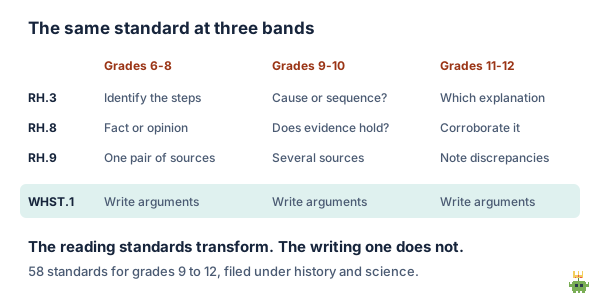
These are not the same standard with a harder adjective. Read RH.3 across the three bands.
- Grades 6-8. “Identify key steps in a text’s description of a process related to history/social studies.”
- Grades 9-10. “Analyze in detail a series of events described in a text; determine whether earlier events caused later ones or simply preceded them.”
- Grades 11-12. “Evaluate various explanations for actions or events and determine which explanation best accords with textual evidence, acknowledging where the text leaves matters uncertain.”
The grades 9-10 version is correlation and causation, written as a history standard. Did the earlier thing cause the later thing, or did it merely come first? That is the most useful question a person can carry out of school, and here it is, in the history reading standards, where a family planning an English year will never see it.
The three that make it a media literacy curriculum
RH.8 and RST.8: from spotting opinion to checking the work
At 6-8, RH.8 asks a student to distinguish among fact, opinion and reasoned judgment. At 9-10 it becomes assessing the extent to which reasoning and evidence support the author’s claims. At 11-12: “Evaluate an author’s premises, claims, and evidence by corroborating or challenging them with other information.”
The science version goes further. RST.11-12.8 asks a student to evaluate the hypotheses, data, analysis and conclusions in a science or technical text, “verifying the data when possible” and corroborating or challenging the conclusions with other sources.
Verifying the data. Not trusting the summary, not evaluating the tone, checking the numbers. That is a high school science reading standard and it is the single most direct answer to how anyone should read a claim about a study.
RH.9 and RST.9: from comparing to resolving
At 6-8 the ninth standard asks a student to analyze the relationship between one primary and one secondary source. At 9-10 it becomes several sources. At 11-12: “Integrate information from diverse sources, both primary and secondary, into a coherent understanding of an idea or event, noting discrepancies among sources.”
RST.11-12.9 is the same move in science: “Synthesize information from a range of sources into a coherent understanding of a process, phenomenon, or concept, resolving conflicting information.”
The wrong answer it produces: a student who reads five sources and reports the majority view, or reports the last one they read, or lists all five without deciding. Noting discrepancies and resolving conflicts are the standard. The disagreement between the sources is the work, not an obstacle to it.
The fix: deliberately give sources that disagree. Two accounts of the same event that cannot both be right. Two studies with different conclusions. Then the question is never what happened, it is why these two accounts differ and which one you believe more, and why.
RH.6: from spotting bias to weighing it
At 6-8, identify aspects of a text that reveal the author’s point of view. At 9-10, compare the point of view of two or more authors on the same topic, including which details they include and emphasize. At 11-12, evaluate authors’ differing points of view by assessing their claims, reasoning and evidence.
The escalation is from noticing that a text has a slant, to seeing what each author chose to leave out, to judging which of them argued better. The last step is the one that matters, because spotting bias without being able to judge an argument leaves a student who dismisses everything equally, which is not skepticism.
The standard that never changes
Set against all of that, WHST.1 is word for word identical in all three bands: “Write arguments focused on discipline-specific content.” Grade 6 and grade 12, the same sentence.
That is not an oversight. The reading standards escalate because what a student can extract from a text changes enormously between 11 and 18. The writing task does not change, because writing an argument about your subject is the same act at every age and it gets harder only because the reading behind it got harder.
The planning consequence: do not look for a more advanced writing assignment each year. Give the same assignment and harder sources. The escalation is in the input.
The research standards, which are where college readiness actually lives
WHST.7 and WHST.8 are the two that most directly predict how a first year of college goes, and they both change at the 9-10 boundary and then hold.
- WHST.7 adds “more sustained” research projects to the short ones, and adds narrowing or broadening the inquiry when appropriate. A student who can only do a short project on a question someone else set is not meeting this.
- WHST.8 escalates three times. At 6-8 it is multiple sources, effective search terms, and assessing credibility and accuracy. At 9-10 it is multiple authoritative sources, advanced searches, and assessing the usefulness of each source in answering the research question. At 11-12 it is assessing the strengths and limitations of each source in terms of the specific task.
Read that progression again: credible, then useful for this question, then strong and limited in these particular ways. A source is no longer good or bad. It is good for something and weak for something else, which is how an adult actually reads.
How to teach 58 standards without adding a subject
You do not add one. These describe the reading and writing already happening in your history and science, done deliberately, exactly as in the middle school band.
- Pick sources that disagree, every time. The 9s in both sets are about discrepancy and conflict, and neither can be met with agreeing sources.
- Ask the causation question on everything. Did that cause this, or did it just come first? It is one sentence and it is a whole standard.
- Check one number a week. RST.11-12.8 says verify the data when possible. Following a statistic in a news article back to its source takes fifteen minutes and there is nothing else in the curriculum quite like it.
- Keep the writing task constant and raise the sources. WHST.1 never changes, so neither should the assignment.
- Make source evaluation specific. Not is this reliable, but what is this source good for and where does it run out. That is the 11-12 wording and it is a better habit anyway.
Time cost: close to zero if history and science are already running, plus about 20 minutes a week for the writing.
Readiness check
- Has the 6-8 band actually happened? If your child has never analyzed a primary source against a secondary one, start at the grades 6-8 standards regardless of their age. The 9-10 versions assume the 6-8 versions.
- Can they read a page of unfamiliar nonfiction and retell it? If not, none of this will land, and fluent reading without comprehension is the thing to fix first.
- Have they ever been given two sources that contradict each other? If every source they have read agreed with every other, the entire ninth standard in both sets is untouched.
How this fits the rest of high school
These 58 sit alongside the 41 grade-level English standards in each band, so the real English load is 70 per band. They also run straight through the 71 high school science standards, which are themselves built around argument from evidence and communicating information, so the two documents are describing the same work from two directions.
The honest summary
Fifty-eight standards for grades 9 to 12, twenty-nine in each band, filed under history and science rather than English, which is why a grade-level search returns none of them and why families skip them almost universally.
They are not extra reading. They are a media literacy curriculum: does this evidence support this claim, did that cause this or merely precede it, why do these two sources disagree and which do you believe, what is this source good for and where does it run out, and can you verify the number yourself.
And the writing standard behind all of it never changes in seven years, which tells you where the difficulty is supposed to come from. Not from a harder assignment. From harder sources.
Sprout Lessons builds standards-aligned lessons for grades K–12. Start free.
Standard counts and wording in this guide were taken from our copy of the Common Core dataset, accessed 2026-07-16, not written from memory. Read the official text of the RH, RST and WHST standards at the Common Core English Language Arts standards. Common Core State Standards © 2010 National Governors Association Center for Best Practices and Council of Chief State School Officers. All rights reserved. This product is not endorsed by NGA/CCSSO. Not every state uses Common Core: check your state department of education for the standards that apply to you.
FAQ
What are the 58 standards and where are they published?
They are the Common Core disciplinary literacy standards for grades 9 to 12: 29 in the 9-10 band and 29 in the 11-12 band, coded RH for reading in history and social studies, RST for reading in science and technical subjects, and WHST for writing in both, at ten, ten and nine per band. They are filed under the content subjects rather than under English and are published as two-year bands rather than per grade, which is why a search for grade 11 English standards returns none of them.
Why call these a media literacy curriculum?
Because of what they ask for by grades 11-12: evaluate an author’s premises, claims and evidence by corroborating or challenging them with other information; evaluate the hypotheses, data, analysis and conclusions in a technical text, verifying the data when possible; integrate diverse sources into a coherent understanding while noting discrepancies; and evaluate differing points of view by assessing claims, reasoning and evidence. That is the whole of what people mean by teaching students to read critically, written as requirements, and filed where no English or digital citizenship curriculum will find it.
How much do these standards change between middle school and high school?
Completely. They are rewritten rather than reworded. RH.3 goes from identify key steps in a described process at 6-8, to determining whether earlier events caused later ones or simply preceded them at 9-10, to evaluating competing explanations and deciding which best accords with the evidence at 11-12. RH.8 goes from distinguishing fact, opinion and reasoned judgment, to assessing whether reasoning and evidence support the claims, to corroborating or challenging the author’s premises with other information.
Why does the writing standard never change?
WHST.1 reads write arguments focused on discipline-specific content in all three bands, grade 6 through grade 12, unchanged. That is deliberate rather than an oversight: the reading standards escalate because what a student can extract from a text changes enormously between 11 and 18, while writing an argument about your subject is the same act at every age. It gets harder only because the reading behind it got harder, so the planning consequence is to give the same assignment and harder sources.
Which of these standards matter most for college?
The two research standards. WHST.7 adds more sustained research projects to the short ones and asks the student to narrow or broaden the inquiry when appropriate, so a student who can only do a short project on a question someone else set is not meeting it. WHST.8 is the source-evaluation ladder and is the only place in the whole English curriculum requiring a standard citation format. Both change once at the 9-10 boundary and then hold, so there is no reason to delay either.
Do I need to add a subject to cover them?
No, and that is the point of where they are filed. They describe the reading and writing already happening in your history and science, done deliberately: sources that disagree rather than sources that agree, the causation question asked on everything, one number verified a week, a constant writing task with rising sources, and source evaluation phrased as what is this good for rather than is this reliable. Budget about 20 minutes a week extra for the writing, which is the only genuinely additional part.