
Biology, chemistry, physics. Three years, three courses, and it leaves 23 of the 71 high school science standards without a home. That is not a rounding error at the edges. It is nearly a third of the document, and the largest piece of it, Earth and space science, is 19 standards that the standard American high school sequence simply never reaches.
Meanwhile chemistry, which gets an entire year in that sequence, is eight standards.
Where the 71 actually sit
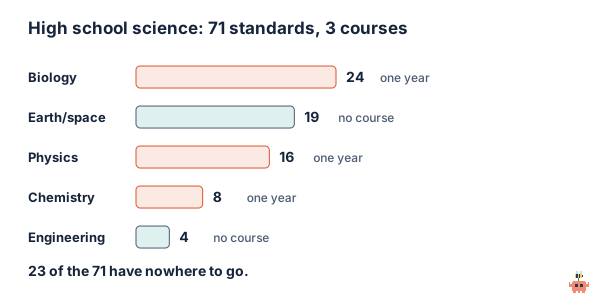
| Block | Standards | In the usual sequence |
|---|---|---|
| Life science (HS-LS) | 24 | Biology, one year |
| Earth and space science (HS-ESS) | 19 | Nothing |
| Physical science, motion, energy and waves (HS-PS2 to PS4) | 16 | Physics, one year |
| Physical science, matter and its interactions (HS-PS1) | 8 | Chemistry, one year |
| Engineering design (HS-ETS) | 4 | Nothing |
Two things follow immediately. The sequence most families inherit spends two of its three years on 24 standards and none of them on 23. And the block it skips entirely is the second largest in the document.
Like the middle school standards, none of these carry a grade label. They are published for the whole 9 to 12 band, so nothing tells you which year anything belongs in, and any course structure is a decision you are making rather than one the document made for you.
What is actually in the 19 nobody teaches
It is worth knowing what gets dropped, because the usual assumption is that earth science is the soft option and it is not what the standards contain.
- Earth’s Place in the Universe, 6 standards. The life span of the sun and nuclear fusion in its core, the Big Bang and the astronomical evidence for it, how stars produce the elements over their life cycle, orbital motion, plate tectonics, and the age of Earth read from ancient materials and meteorites. This is astrophysics and deep time, and it is the part of science most teenagers would actually choose.
- Earth’s Systems, 7 standards. Feedback between systems, the carbon cycle, the water cycle, how the geosphere and biosphere interact. HS-ESS2-2 asks a student to analyze geoscience data to claim that one change to Earth’s surface creates feedbacks that change other systems, which is systems thinking with real data.
- Earth and Human Activity, 6 standards. Natural resources, natural hazards, climate forecasting from global climate models, sustainability, and evaluating competing design solutions for managing energy and mineral resources. HS-ESS3-1 asks for an evidence-based explanation of how resource availability, natural hazards and changes in climate have influenced human activity.
That last group is the most publicly consequential science in the entire high school document. It is the science a citizen uses. And it is the science that the biology, chemistry, physics sequence is structurally unable to reach, which is a reason to change the sequence rather than a reason to accept the gap.
The overlap that makes a fourth course cheaper than it looks
The standards are not as separate as the course names suggest, and two of them are nearly the same sentence.
HS-LS2-7 asks a student to “design, evaluate, and refine a solution for reducing the impacts of human activities on the environment and biodiversity.” HS-ESS3-4 asks them to “evaluate or refine a technological solution that reduces impacts of human activities on natural systems.” One is filed under biology and one under earth science.
The practical consequence: a single serious project on human impact meets a biology standard, an earth science standard and at least one engineering standard at the same time. The overlap is not sloppiness in the document, it is a signal that these were never meant to be three sealed courses, and it is the cheapest route into the 19 for a family that thinks it has no room for a fourth year.
Engineering design, which is four standards and no course
HS-ETS1 has four standards and, like the earth science block, no place in the traditional sequence. They are also unlike anything else in the document, because they are not about a science topic at all.
HS-ETS1-3 asks a student to “evaluate a solution to a complex real-world problem based on prioritized criteria and trade-offs that account for a range of constraints, including cost, safety, reliability, and aesthetics, as well as possible social, cultural, and environmental impacts.”
Read that again as a parent rather than as a teacher. Cost, safety, reliability, aesthetics, social and cultural impact, all weighed against each other with no correct answer at the end. There is no way to worksheet this. It needs an actual problem, an actual constraint and an actual decision, which is the sort of thing a homeschool can arrange in an afternoon and a school timetable usually cannot.
The three hard ones
Chemical behavior from the periodic table, not from memorization
HS-PS1-2 asks a student to construct and revise an explanation for the outcome of a simple chemical reaction based on the outermost electron states of atoms, trends in the periodic table and the patterns of chemical properties.
The wrong answer it produces: a student who has memorized that sodium reacts violently with water and cannot predict what potassium will do. The standard asks for prediction from structure, and memorized facts look identical to understanding right up until you ask about an element that was not on the list.
The fix: never state a reaction outcome first. Give the position on the table and ask what should happen and why, then check. Being wrong and revising is written into the standard, which says construct and revise.
Natural selection explained rather than described
HS-LS4-4 asks for an explanation, based on evidence, of how natural selection leads to adaptation of populations.
The wrong answer it produces: the giraffe stretched its neck to reach the leaves. Individuals do not adapt, populations do, and this misconception is close to universal, survives an entire biology course, and is invisible unless you ask for the mechanism rather than the definition.
The fix: insist on the population. Every explanation has to start from variation that already existed in the group. If your child’s answer has a single organism changing during its own lifetime, the standard is not met however fluent the paragraph is.
Feedback loops, which are the actual content of earth science
HS-ESS2-2 asks a student to analyze geoscience data to make the claim that one change to Earth’s surface can create feedbacks that cause changes to other Earth systems.
The wrong answer it produces: a linear chain. Ice melts, so less light reflects, so it gets warmer, full stop. A feedback loop returns to its own starting point, and a student who writes chains rather than loops has understood the vocabulary and not the idea.
The fix: make them draw it and make the arrow come back. If the diagram does not close, it is not a feedback. This single habit carries most of the Earth’s Systems block.
A four-block plan that covers all 71
Not four separate years necessarily, because the overlap above means the fourth block is smaller than it sounds. Time is counted in credits on a transcript, and one credit is usually about 150 to 180 hours.
- Biology, 24 standards. The largest block and the usual starting point, which is fine. Pull the human-impact standard into the earth science work rather than treating it as the last chapter.
- Chemistry, 8 standards. The smallest content block by some distance. A full conventional year here is generous relative to the standards, and the spare capacity is the obvious place to put earth science material or a serious lab practice focus.
- Physics, 16 standards. Motion and forces, energy, and waves and information technologies. The waves block is five standards and is the one most often shortened because it arrives last in the year.
- Earth, space and engineering, 23 standards. The block that usually disappears. Run it as a fourth science credit, or fold it through the other three using the human-impact overlap and one substantial design project for the engineering standards.
If you only have room for three: shorten chemistry rather than dropping earth science, because the standards say chemistry is eight standards and earth science is nineteen. That is the opposite of what almost every home science program does.
Readiness check
- Is the middle school band actually finished? The 59 standards for grades 6 to 8 are the direct foundation, and the high school versions assume them rather than revisiting them.
- Can your child read a technical procedure and follow it without you? Every standard here is a performance expectation involving investigation, modeling or argument, and the reading side of that is covered by the 29 disciplinary literacy standards, which apply here as much as in middle school.
- Do you have a lab plan? Not equipment, a plan. Many colleges want to see lab work described on a transcript, and the standards are written around doing rather than reading about, so this is worth settling in grade 9 rather than grade 12.
The honest summary
Seventy-one standards, no grade labels, published for the whole 9 to 12 band. The biology, chemistry, physics sequence covers 48 of them and leaves 23 with nowhere to go: 19 earth and space science and 4 engineering design.
The arithmetic is the argument. Chemistry is eight standards and gets a full year. Earth and space science is nineteen and gets none, and it contains the astrophysics, the systems thinking and the climate and resources work that a student will actually use as an adult.
You do not necessarily need a fourth year to fix it. The human-impact standards in biology and earth science are nearly the same sentence, so one serious project can meet several at once. But you do need to decide deliberately, because the default sequence decides it for you and decides it badly.
Sprout Lessons builds standards-aligned lessons for grades K–12. Start free.
Standard counts and wording in this guide were taken from our copy of the NGSS dataset, accessed 2026-07-16, not written from memory. Read the official text at the Next Generation Science Standards. Next Generation Science Standards © 2013 Achieve, Inc. NGSS is a registered trademark of WestEd; this product is not endorsed by WestEd or the lead states. Not every state uses NGSS, and graduation credit requirements are set by your state rather than by the standards: check your state department of education.
FAQ
How many high school science standards are there in NGSS?
Seventy-one, published for the whole 9 to 12 band with no grade labels at all, so nothing tells you which year anything belongs in. They split into life science 24, Earth and space science 19, physical science 24 and engineering design 4. Because there are no grades, any course structure is a local decision rather than something the standards require.
What does the biology, chemistry, physics sequence miss?
Twenty-three of the 71 standards, which is nearly a third. Nineteen of those are Earth and space science and four are engineering design, and neither block has a place in the traditional three-course sequence. The arithmetic is the argument: chemistry is eight standards and gets a full year, while Earth and space science is nineteen and gets none.
Is earth science really worth a year of high school?
On the standards, yes, and it is not the soft option it is assumed to be. The 19 standards cover the life span of the sun and nuclear fusion, the Big Bang and the evidence for it, how stars produce the elements, plate tectonics, feedback between Earth systems, the carbon and water cycles, natural hazards, resource management and evidence-based climate forecasting from global climate models. It is the most publicly consequential science in the whole high school document.
Can I cover all 71 standards in three years instead of four?
Yes, if you use the overlap deliberately. The human-impact standards in life science and Earth science are nearly the same sentence, so a single substantial project meets both plus an engineering standard. Fold the rest of the Earth science through the other three courses and shorten chemistry, which has the fewest standards and the most conventional slack, rather than shortening the block with nineteen.
What are the engineering design standards and where do they go?
Four standards, HS-ETS1-1 to HS-ETS1-4, and they belong to no course in the usual sequence. They are unlike everything else in the document because they are not about a science topic: they cover defining a global challenge with criteria and constraints, breaking a complex problem into manageable pieces, evaluating a solution against prioritized trade-offs, and using a computer simulation to model the impact of proposed solutions. One serious design project covers most of them.
How many science credits does my child need to graduate?
The standards say nothing about credits, courses or graduation, so this is a state question rather than an NGSS one, and it varies. Check your state department of education. As a working basis, one credit is usually about 150 to 180 hours, and the useful planning question is not how many credits but whether your sequence reaches all 71 standards or stops at 48.