
There is no such thing as a grade 10 math standard. High school math in Common Core is one undivided block of 156 standards with no grade labels anywhere in it. Kindergarten through grade 8 is nine tidy grade-by-grade lists. Then at grade 9 the grade numbers stop, and what replaces them is a single four-year set organized by five conceptual categories.
That is a real change and it catches families out, because every planning habit built over the previous nine years stops working at once. But it is also the most useful thing that happens to a homeschooling family in high school, and there is a second fact underneath it that matters even more.
Forty-three of those 156 standards are optional. They carry a (+) at the start of their own text, and they are not part of what the standards treat as the college and career ready core. A parent who counts 156 and panics is counting a number that does not apply to their child.
113 required, 43 optional
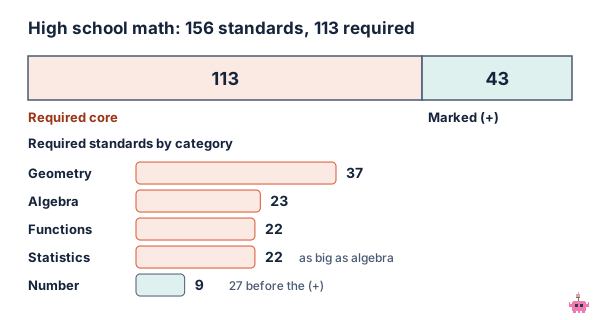
| Conceptual category | Total | (+) | Required |
|---|---|---|---|
| Geometry | 43 | 6 | 37 |
| Algebra | 27 | 4 | 23 |
| Functions | 28 | 6 | 22 |
| Statistics and Probability | 31 | 9 | 22 |
| Number and Quantity | 27 | 18 | 9 |
| Total | 156 | 43 | 113 |
Read the last two columns rather than the first. Number and Quantity looks like a major category at 27 standards and is the smallest thing in high school math once the plus standards come out, at nine. Two whole strands are optional end to end: Vector and Matrix Quantities, all 12 of them, and Using Probability to Make Decisions, all 7. If your child is not heading for calculus or an engineering program, those 19 standards are not a gap in your year. They were never in it.
What the (+) actually means
It is printed inside the standard, not in a footnote. HSN-VM.A.1 begins: “(+) Recognize vector quantities as having both magnitude and direction. Represent vector quantities by directed line segments…” The marker signals mathematics beyond the college and career ready threshold: the material a student needs for advanced courses such as calculus, advanced statistics or discrete mathematics.
Two practical consequences. First, a curriculum that covers all 156 is not better than one that covers 113; it is aimed at a different child. Second, if your child does want a STEM degree, the plus standards are the map of exactly what to add, and they are concentrated rather than scattered: 18 of the 43 sit in Number and Quantity, and 5 more in Trigonometric Functions.
The thing that upends the traditional sequence
Look at the required column again and compare it with how a typical American high school math program is built.
- Geometry is the largest category, by a distance. 37 required standards, a third of the whole requirement. In the standard Algebra 1, Geometry, Algebra 2 sequence, geometry is the one-year interruption in the middle, and it is routinely the year families rush or outsource. The standards do not agree that it is a side trip.
- Statistics and Probability is as big as Algebra. 22 required standards against Algebra’s 23, and 31 against 27 before the plus standards come out. It is also the most-skipped material in high school math at home, because the traditional three-course sequence has nowhere to put it and most programs sprinkle it into the last few weeks of a year, if at all.
- Algebra and Functions are separate categories. 23 and 22 required standards respectively. Solving an equation and understanding a function are treated as different kinds of knowledge here, which is why a child can be fluent at algebraic manipulation and still unable to read a graph.
The planning consequence: if you inherit the Algebra 1, Geometry, Algebra 2 sequence without thinking about it, you will over-serve algebraic manipulation and under-serve the two largest bodies of required material in the document. The standards themselves name no courses at all. Any course structure is a local decision, which means it is yours.
Where trigonometry actually lives
Nowhere on its own, and this trips up families building a course list from the standards. Trigonometry is split across two conceptual categories:
- Similarity, Right Triangles, and Trigonometry sits in Geometry: 11 standards, 3 of them plus. This is the ratio and right-triangle work.
- Trigonometric Functions sits in Functions: 9 standards, 5 of them plus. This is the unit circle and periodic behavior.
So more than half of the Trigonometric Functions strand is optional, while the right-triangle trigonometry in Geometry is mostly required. A student who needs trigonometry for a trade, surveying or construction needs the Geometry half. A student heading for calculus needs both.
The three that cause the most trouble at home
Interpreting a function rather than evaluating one
HSF-IF.B.4 asks a student to interpret key features of graphs and tables in terms of the quantities they model, and to sketch a graph from a verbal description.
The wrong answer it produces: the child can substitute a number into f(x) flawlessly and cannot say what the graph is telling them. Ask where this function is increasing and what that means about the situation, and you get the y-values read out loud.
The fix: stop asking for values and start asking for stories. Every graph gets the same three questions: what is happening here, where does it change, and why would it do that. This is nine standards worth of the Functions category and it responds to conversation rather than to more practice sets.
Statistics as a way of thinking rather than a set of calculations
HSS-IC.B.3 asks a student to recognize the purposes of and differences among sample surveys, experiments and observational studies, and to explain how randomization relates to each.
The wrong answer it produces: a student who can compute a standard deviation and has no idea whether a study supports its own conclusion. This is the single most useful piece of mathematics in the document for a child who will never take another math course, and it involves almost no computation.
The fix: use real studies from the news. The statistics standards are written around interpretation, not arithmetic, and a homeschool can do this better than a classroom because it can follow whatever story is running that week.
Modeling, which is a practice rather than a topic
HSG-MG.A.3 asks a student to apply geometric methods to solve design problems, giving the example of designing an object or structure to satisfy physical constraints or minimize cost. HSN-Q.A.1 asks them to use units to guide the solution of multi-step problems and to choose and interpret scale and origin sensibly.
The wrong answer it produces: word problems that are arithmetic with a sentence wrapped around them. The child looks for the numbers, applies the operation the chapter is about, and never questions whether the answer is the right size.
The fix: give problems with no chapter attached, where choosing the approach is the work. A real building project, a real budget, a real measurement with real units. Modeling standards are marked throughout the high school standards precisely because they are meant to run across all five categories rather than sit in one.
How long high school math takes at home
About 150 to 180 hours per course-year, which is the usual basis for one credit, so roughly 50 minutes a day across four days for four years. That is the framing that matters, because high school work gets counted in credits on a transcript rather than in standards covered.
- Three years covers the 113 comfortably if the time is allocated by the required counts rather than by tradition: geometry gets more than a year’s worth of material, and statistics needs a genuine block rather than an afterthought.
- A fourth year is where the plus standards go, if they are going anywhere: precalculus in practice, which is mostly Trigonometric Functions, the Complex Number System and Vector and Matrix Quantities.
- Check your own state’s graduation expectations before deciding how many credits to award. The standards say nothing about credits, courses or transcripts. Those are state and college questions, not Common Core ones.
Readiness check
- Is grade 8 genuinely finished? Grade 8 carries the first real function work and the linear equation fluency that all 23 Algebra standards assume. High school is the wrong place to discover it did not land.
- Can they read a graph as a story? If a graph is only a source of coordinates, start there rather than with the algebra, because the Functions category is 22 required standards and almost all of them are interpretation.
- Do you know whether this child is heading for a STEM program? This is the one question that changes the plan, because it is the difference between 113 standards and 156. You do not need a final answer in grade 9, but you need to have asked by the end of grade 10.
A four-year shape that follows the standards
Not a course list, because the standards do not give one. This is an allocation of the 113 required standards across four years in proportion to their size.
- Year one: Algebra and the Real Number System. Creating equations, structure in expressions, reasoning with equations and inequalities, and linear and exponential models. Bring Quantities and units in here rather than treating them as revision.
- Year two: Geometry, given its real weight. Congruence alone is 13 required standards, the largest single strand in the document, and right-triangle trigonometry sits in this year rather than in a later one.
- Year three: Functions and the rest of Algebra. Interpreting and building functions, polynomials and rational expressions, and the geometry of circles and coordinates.
- Year four: Statistics and Probability as its own course. 22 required standards is a full year, and giving it one is the single biggest departure from the traditional sequence on this page. For a STEM-bound student, run precalculus alongside or instead, and use the plus standards as the syllabus.
Modeling is not a year. It runs through all four, which is what the standards intend.
The honest summary
High school math has no grade levels: 156 standards in one four-year block, in five conceptual categories. Forty-three carry a (+) and are advanced material, so the actual requirement is 113, and two entire strands, 19 standards, are optional from end to end.
Read the required counts rather than the totals and the traditional sequence stops making sense. Geometry is the largest body of required work at 37 standards, not the interruption between two algebra courses. Statistics and Probability is the same size as Algebra and is the most-skipped material in high school math at home. Number and Quantity looks big and is nine standards.
The one question that changes everything is whether this child is going into a STEM program, because that is the difference between 113 and 156. Ask it by the end of grade 10, and until you have an answer, teach the 113.
Sprout Lessons builds standards-aligned lessons for grades K–12. Start free.
Standard counts and wording in this guide were taken from our copy of the Common Core dataset, accessed 2026-07-16, not written from memory. Read the official text at the Common Core mathematics standards. Common Core State Standards © 2010 National Governors Association Center for Best Practices and Council of Chief State School Officers. All rights reserved. This product is not endorsed by NGA/CCSSO. Not every state uses Common Core, and graduation credit requirements are set by your state rather than by the standards: check your state department of education.
FAQ
Why are there no grade levels in high school math standards?
Because Common Core stops using grades after grade 8. High school mathematics is published as one undivided four-year block of 156 standards organized by five conceptual categories rather than by year, so there is no such thing as a grade 10 math standard. The standards also name no courses, which means any course structure, whether the traditional Algebra 1, Geometry, Algebra 2 sequence or an integrated one, is a local decision rather than something the document requires.
What does the (+) on a Common Core math standard mean?
It marks mathematics beyond the college and career ready threshold: the material a student needs for advanced courses such as calculus, advanced statistics or discrete mathematics. The marker is printed inside the standard text itself, so HSN-VM.A.1 begins with (+) before its first word. Forty-three of the 156 high school standards carry it, which means the actual requirement is 113 and a curriculum covering all 156 is not better, just aimed at a different child.
How many high school math standards does my child actually have to cover?
One hundred and thirteen, once the 43 plus standards come out. By category that is Geometry 37, Algebra 23, Functions 22, Statistics and Probability 22, and Number and Quantity 9. Number and Quantity is the category most distorted by the plus standards: it looks like a major category at 27 standards and is the smallest thing in high school math once 18 optional ones are removed.
Is geometry really bigger than algebra in high school?
Yes, and by a distance. Geometry carries 37 required standards against Algebra’s 23, and Congruence alone is 13, the largest single strand in the document. In the standard three-course sequence geometry is the one-year interruption in the middle and is routinely the year families rush or outsource. The standards do not treat it as a side trip.
Where does trigonometry sit in the high school standards?
Nowhere on its own. It is split across two conceptual categories: Similarity, Right Triangles and Trigonometry sits inside Geometry with 11 standards of which 3 carry a plus, and Trigonometric Functions sits inside Functions with 9 standards of which 5 carry a plus. So the right-triangle and ratio work is mostly required while more than half of the unit-circle and periodic work is optional. A student heading into a trade needs the geometry half; a student heading for calculus needs both.
How many credits of math should I award on a homeschool transcript?
The standards say nothing about credits, courses or transcripts, so this is a state and college question rather than a Common Core one. Check your own state’s graduation expectations. As a working basis, one credit is usually about 150 to 180 hours, and three years of that covers the 113 required standards comfortably if time is allocated by the required counts rather than by tradition, with a fourth year for statistics as its own course or for the plus standards.