
Grade 6 math is 29 Common Core standards, and four of the five domain names change. From kindergarten to grade 5 the domains are fixed, the same five headings every single year. In grade 6, only Geometry keeps its name. That is not a filing decision. It is the curriculum telling you, in the table of contents, that the subject has changed.
The year runs about 180 to 210 hours at home, roughly an hour a day across four days. It is heavier than grade 5, and unlike grade 5 the weight is spread rather than concentrated in one topic.
What actually changed
| Grades K to 5 | Grade 6 | What the rename means |
|---|---|---|
| Operations and Algebraic Thinking | Expressions and Equations | Letters start standing for numbers, and stay |
| Number and Operations in Base Ten, and Number and Operations - Fractions | The Number System | Two domains merge, and negatives join them |
| Measurement and Data | Statistics and Probability | From reading a graph to describing a distribution |
| Nothing | Ratios and Proportional Relationships | A genuinely new domain, only in grades 6 and 7 |
| Geometry | Geometry | The only heading that survives |
Two of those are worth pausing on. Ratios and Proportional Relationships did not exist before grade 6 and will not exist after grade 7: in grade 8 it is gone, replaced by Functions. It is a two-year domain carrying one of the most useful ideas in school math, which is a good argument for not letting it get squeezed.
And the merge of base ten with fractions into The Number System is the point of the whole year. Whole numbers, fractions, decimals and negatives stop being four separate topics with four separate rulebooks and become one set of numbers on one line.
The 29 standards, by domain
| Domain | Standards | What it is |
|---|---|---|
| Expressions and Equations | 9 | Exponents, variables, equivalent expressions, one-step equations, inequalities |
| The Number System | 8 | Fraction division, decimal fluency, GCF and LCM, negatives, four quadrants |
| Statistics and Probability | 5 | Statistical questions, distributions, center and spread, dot plots and box plots |
| Geometry | 4 | Area of triangles and polygons, volume with fractional edges, nets, coordinate polygons |
| Ratios and Proportional Relationships | 3 | Ratio language, unit rate, tables and double number lines |
Only three standards in the ratio domain, which badly undersells it. 6.RP.A.3 alone contains the tables, tape diagrams, double number lines, unit pricing and percent work, and it will take longer than several of the nine algebra standards put together. Do not plan this year by counting standards per domain.
The three hard ones
6.NS.A.1, dividing a fraction by a fraction
Interpret and compute quotients of fractions, and solve word problems involving division of fractions by fractions, e.g., by using visual fraction models and equations to represent the problem.
The misconception: that dividing makes things smaller. It has been reliably true for six years and grade 5 already started dismantling it, which is exactly why this is the standard that exposes whoever got through grade 5 on procedure.
The wrong answer it produces: ask for one half divided by one quarter. The child either writes 1/8 (they multiplied) or says the answer “has to be smaller than a half” and then cannot produce anything. The correct answer, 2, looks wrong to them, and no amount of repeating the procedure fixes that, because their objection is not about the procedure.
The reteach: stop saying “divided by” and say “how many of these fit into that”. How many quarters fit in a half? Two. Cut the paper. How many thirds fit in two? Six. Once a dozen of these are answered without any written method at all, the child has an independent way to check whether an answer is plausible. Then, and only then, introduce invert-and-multiply as a shortcut they can already sanity-check.
6.EE.A.2 and 6.EE.B.6, what a letter means
Write, read, and evaluate expressions in which letters stand for numbers. Use variables to represent numbers and write expressions when solving a real-world or mathematical problem; understand that a variable can represent an unknown number, or, depending on the purpose at hand, any number in a specified set.
The misconception: that a letter is an abbreviation for an object. b means “a book” rather than “the number of books”. Notice that the standard says stand for numbers, and then 6.EE.B.6 says it again in different words. Common Core rarely repeats itself.
The wrong answer it produces: the classic one. Ask the child to write an equation for “there are six times as many students as teachers” and they write 6S = T. It reads left to right like the sentence, and it is backwards. Test it with numbers, as most people never do: with 2 teachers there are 12 students, and 6 × 12 does not equal 2. The correct equation is S = 6T.
The reteach: a rule with no exceptions. Every letter is read aloud as “the number of ...”, every time, out loud, for a month. Not “t” but “the number of teachers”. And every equation gets tested with one actual number before it is accepted. Those two habits prevent most of the algebra trouble that shows up two years later.
6.NS.C.5 to 6.NS.C.7, negative numbers
Understand that positive and negative numbers are used together to describe quantities having opposite directions or values, understand a rational number as a point on the number line, and understand ordering and absolute value of rational numbers.
The misconception: that the size of the digits tells you the size of the number. Six years of experience say 8 is bigger than 3, and nothing has ever contradicted it.
The wrong answer it produces: ask which is colder, -8 degrees or -3 degrees, and the child says -3. Ask which is greater and they say -8. Both errors come from the same place, and the child is not being careless: they are applying a rule that has worked every time until now.
The reteach: never teach negatives as arithmetic first. Teach them as position. Draw one long number line through zero and put everything on it, including fractions and decimals, because 6.NS.C.6 is explicitly about extending the number line rather than learning new sums. “Greater” means further right, always, with no exceptions for negatives. Thermometers, floors below ground and money owed all work, but pick one and stay with it, because switching contexts mid-repair is what causes the confusion between colder and less.
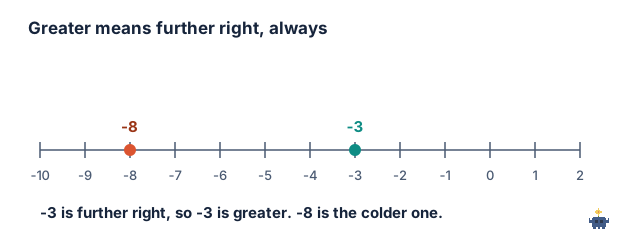
Absolute value belongs to this thread and gets taught badly. It is not “make it positive”. It is how far from zero, which is why a debt of $8 is a bigger debt than a debt of $3 while -8 is still the smaller number. Say the distance sentence and the contradiction disappears.
The last fluency standards in the whole sequence
There is a staircase running through Common Core math that most people never see laid out. The word fluently appears in a handful of standards, one or two per year, and it stops in grade 6.
| Grade | What has to become fluent |
|---|---|
| K | Add and subtract within 5 |
| 2 | Add and subtract within 20 mentally, and within 100 |
| 3 | Add and subtract within 1000, multiply and divide within 100 |
| 4 | Multi-digit addition and subtraction, standard algorithm |
| 5 | Multi-digit multiplication, standard algorithm |
| 6 | Multi-digit division, and all four operations on decimals |
| 7 onward | Nothing. Arithmetic is assumed from here. |
6.NS.B.2 and 6.NS.B.3 are the top of that staircase, and after them the standards stop asking. This matters more at home than at school, because at home nobody else is going to notice. If a child arrives in grade 7 still counting on fingers for times tables or reaching for a calculator for 4.2 × 0.5, every later standard costs them extra effort forever, and no future standard will flag it.
So grade 6 is the last scheduled opportunity, and it is worth ten minutes a day of unglamorous practice all year rather than a unit. This is also the least interesting thing in grade 6, and the easiest to skip when the week is going badly. Do not skip it.
How long this actually takes at home
About 180 to 210 hours, an hour a day over four days with room to spare. Where it goes:
- The Number System: about a third. Fraction division and negatives are both slow, and the fluency work runs alongside everything else.
- Expressions and Equations: about a quarter, most of it in the first four standards, where the variable idea is being built.
- Ratios: more than three standards suggest, realistically six to eight weeks.
- Geometry and statistics split the remainder, and both are shorter than they look.
What to cut when it runs long. 6.G.A.4 (nets and surface area) and 6.SP.B.4 (box plots and histograms) compress well and can be done as single sittings. 6.NS.B.4 (greatest common factor and least common multiple) is worth doing but not worth a fortnight: it is a tool for the fraction work, not a topic. Do not cut fraction division, the variable standards, or the ratio domain. Those three are what grade 7 is built on.
Readiness check
- Can they divide a whole number by a unit fraction? That is 5.NF.B.7, and grade 6 generalizes it immediately. If “how many quarters in 3” gets a blank look, start there rather than in grade 6.
- First-quadrant coordinates. Grade 5 plots points in the first quadrant only. 6.NS.C.8 opens all four, so the child needs the first one to be automatic before negatives land on top of it.
- Volume by counting cubes. 5.MD.C.3 to C.5 build volume physically. 6.G.A.2 does it with fractional edge lengths, which is much harder if the cube picture is not already there.
- Multi-digit division by any method at all. Grade 5 asks for quotients using strategies and area models. Grade 6 asks for the standard algorithm, fluently. Those are different requests, and a child can pass the first while nowhere near the second.
A sequence for a flexible year
- Fraction division as “how many fit” (6.NS.A.1), before any written method. This is where the year is won or lost.
- Decimal and division fluency (6.NS.B.2, 6.NS.B.3), started now and running in the background for the rest of the year, ten minutes a day.
- Ratio and unit rate (6.RP.A.1 to A.3), the longest block, with tables and double number lines. Recipes and prices are genuinely the best material here.
- Negatives as position (6.NS.C.5 to C.7), one number line, no arithmetic yet.
- Four quadrants (6.NS.C.8), which follows straight on and makes negatives feel useful.
- Variables (6.EE.A.1 to A.4), with every letter read aloud as “the number of”. Exponents belong here as notation, not as a topic.
- Equations and inequalities (6.EE.B.5 to B.8), one step only, with substitution used to check every answer.
- Dependent and independent variables (6.EE.C.9), the bridge to grade 8 functions and a natural place to bring the ratio tables back.
- Geometry (6.G.A.1 to A.4), area by composing and decomposing, then volume and nets. Cut paper for this one.
- Statistics (6.SP.A.1 to B.5), finishing with data the child collected themselves, which is the only version of this domain anyone enjoys.
The split-grade case
Grade 6 is where combined-grade math gets harder, and it is worth knowing why before it happens.
- Grades 6 and 7 combine well. They share four of five domains, and the ratio work in grade 7 is a direct extension of grade 6. A shared ratio block with different expectations is realistic.
- Grades 5 and 6 do not. The domains do not line up, and the two years are doing genuinely different things. Shared sessions here mostly waste both children’s time.
- The exception is fluency practice. Ten minutes of arithmetic a day works across any spread of ages, because each child works at their own step of the staircase above. It is the one part of grade 6 math you can run as a family.
And the usual reminder that a child two grades apart across subjects is normal, not a problem to fix. A strong reader who is a year behind in math should do grade 6 math when they are ready for grade 6 math. Nothing in this sequence cares what age they are.
Evidence and records for this grade
Grade 6 is a testing year in North Dakota, which tests in grades 4, 6, 8 and 10 and applies the highest score threshold of any state we have written up. It is not one in Pennsylvania, where the years are 3, 5 and 8. Testing grades vary by state, so check your own rather than assuming, and see what goes in a homeschool portfolio for the general shape.
Worth keeping, specifically for grade 6:
- Dated fraction division work, before and after. A sheet from the start of the year showing 1/2 ÷ 1/4 = 1/8, and one from later showing the child explaining why it is 2. Wrong work kept on purpose is the clearest evidence of learning there is, and most parents throw it away.
- One ratio investigation using real numbers. A recipe scaled, a unit-price comparison, a scale drawing. It covers 6.RP.A.3 and it is the kind of work a reviewer recognizes instantly.
- The statistics project. The child’s own question, their own data, a dot plot or box plot, and a sentence about center and spread. That is 6.SP.A.1 through 6.SP.B.5 in one artifact.
The honest summary
Twenty-nine standards, about 195 hours, and a year that renames four of its five domains because it means it. The merge into The Number System is the real event: whole numbers, fractions, decimals and negatives become one number line, and everything after grade 6 assumes that happened.
Three repairs carry the year. Division as “how many fit”, so that 1/2 ÷ 1/4 = 2 stops looking wrong. Every letter read aloud as “the number of”, so that the students-and-teachers equation comes out the right way round. And negatives taught as position before arithmetic, so that -8 being less than -3 is obvious rather than memorized.
Then the unglamorous one: grade 6 holds the last fluency standards Common Core will ever ask for. Ten minutes a day, all year, and the child walks into grade 7 with arithmetic that costs them nothing.
The previous math year is grade 5, the science equivalent for the year below is grade 5 science, and if you want the method behind these pages rather than one year of it, start with what a scope and sequence actually is. For a child who is behind and needs the gap closed rather than the year covered, choosing a US homeschool curriculum covers the wider decision.
Sprout Lessons builds standards-aligned lessons for grades K–12. Start free.
Common Core State Standards © 2010 National Governors Association Center for Best Practices and Council of Chief State School Officers. All rights reserved. Accessed via the Common Standards Project (accessed 2026-07-16). This product is not endorsed by NGA/CCSSO. Standard counts and domain names in this guide were taken from that dataset, not written from memory. Not every state uses Common Core: check your state department of education for the standards that apply to you.
FAQ
Why does my child say one half divided by one quarter is one eighth?
They multiplied, because dividing making things smaller has been reliably true for six years and the correct answer of 2 looks wrong to them. Repeating the procedure does not help, because their objection is not about the procedure. Ask how many quarters fit in a half instead and cut the paper. Once a dozen of those are answered with no written method, they have a way to check that an answer is plausible, and invert-and-multiply can arrive as a shortcut rather than a rule.
Why does my child write equations backwards?
Because they read the letter as an abbreviation for an object rather than a number. Asked to write there are six times as many students as teachers, most people write 6S = T, which reads left to right like the sentence and is wrong: with 2 teachers there are 12 students, and 6 times 12 is not 2. The fix is two habits. Read every letter aloud as the number of, and test every equation with one real number before accepting it.
Why does my child think negative 8 is bigger than negative 3?
They are applying a rule that has worked every time until now: bigger digits mean a bigger number. Do not start with negative arithmetic. Draw one long number line through zero with fractions and decimals on it, because 6.NS.C.6 is about extending the number line rather than learning new sums. Greater means further right, always. Absolute value belongs to the same thread and is how far from zero, not make it positive, which is why a debt of eight dollars is the bigger debt while negative 8 is still the smaller number.
How many standards are in grade 6 Common Core math?
Twenty-nine, across five domains: nine in Expressions and Equations, eight in The Number System, five in Statistics and Probability, four in Geometry and three in Ratios and Proportional Relationships. Do not plan the year by those counts, though. The three ratio standards take six to eight weeks because 6.RP.A.3 alone contains tables, double number lines, unit pricing and percent.
Why do the math domain names change in grade 6?
Because the subject changes. From kindergarten to grade 5 the five domain headings are fixed. In grade 6 only Geometry keeps its name: Operations and Algebraic Thinking becomes Expressions and Equations, the two number domains merge into The Number System, Measurement and Data becomes Statistics and Probability, and Ratios and Proportional Relationships appears from nothing. That merge is the point of the year, because whole numbers, fractions, decimals and negatives stop being four topics with four rulebooks.
Is grade 6 the last year my child has to get fast at arithmetic?
In terms of what the standards ask for, yes. The word fluently appears in Common Core math from kindergarten through grade 6 and then stops. Grade 4 is addition and subtraction by the standard algorithm, grade 5 is multiplication, and grade 6 is division plus all four operations on decimals. From grade 7 arithmetic is simply assumed, and no later standard will flag a child who is still slow, which matters more at home because nobody else is watching for it.