
Grade 5 math is 26 Common Core standards, and the three hardest are all fractions. That is not an accident. Seven of the 26 are fraction standards, and between them they ask a child to abandon two rules that have been reliably true for five years: that multiplying makes things bigger, and that dividing makes them smaller. A child who cannot let go of those two rules can still get grade 5 answers right by procedure, and will hit a wall in grade 6.
The year runs about 170 to 200 hours at home, roughly 55 minutes a day across four days. It is the heaviest elementary year, and the extra weight is entirely in fractions and decimals.
The 26 standards, by domain
| Domain | Standards | What it is |
|---|---|---|
| Number and Operations in Base Ten | 7 | Decimals to thousandths, powers of 10, long division, decimal arithmetic |
| Number and Operations - Fractions | 7 | Unlike denominators, fraction as division, multiplying and dividing fractions |
| Measurement and Data | 5 | Unit conversion, line plots, and volume |
| Geometry | 4 | The coordinate plane, and classifying figures in a hierarchy |
| Operations and Algebraic Thinking | 3 | Expressions, order of operations, and numerical patterns |
Two things stand out against grade 4. Base ten grows from six standards to seven and turns almost entirely to decimals. And Operations and Algebraic Thinking shrinks to three standards, the smallest domain in the grade, which surprises parents who expect grade 5 to be where algebra starts. It is not. Grade 5 is where fractions finish.
The three hard ones
5.NF.A.1, adding fractions with unlike denominators
The standard asks students to add and subtract fractions with unlike denominators, including mixed numbers, by replacing them with equivalent fractions.
The misconception: that fractions behave like two separate whole numbers stacked on top of each other.
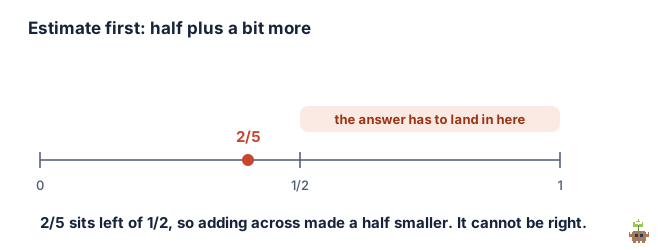
The wrong answer it produces: 1/2 + 1/3 = 2/5. The child adds the tops, adds the bottoms, and produces an answer that is smaller than one of the things they started with. That last part is the diagnostic worth teaching: ask “is your answer bigger than 1/2?” A child who has added across gets 2/5 and does not notice that adding something to a half made it smaller.
The reteach: estimate before computing, every single time. 1/2 plus a bit more must land somewhere between 1/2 and 1. Then find the common denominator. The estimate is not a check at the end, it is the thing that makes the procedure make sense.
5.NF.B.5, multiplication as scaling
Common Core asks students to “interpret multiplication as scaling (resizing)”, and this is the conceptual centre of the grade.
The misconception: multiplication makes things bigger. It has been true in every multiplication the child has ever done, because they have only multiplied by whole numbers greater than 1.
The wrong answer it produces: ask for 8 × 3/4 and the child either computes 6 and then says the answer must be wrong because it went down, or works around the problem by multiplying 8 by 3 and stopping. Both come from the same place. A useful test question: “without calculating, is 12 × 2/3 bigger or smaller than 12?” A child who cannot answer that has the misconception regardless of their arithmetic.
The reteach: teach the comparison before the computation. Multiplying by a number greater than 1 makes it bigger, multiplying by 1 leaves it alone, multiplying by a number less than 1 makes it smaller. Do a week of “bigger, smaller or the same?” with no arithmetic at all.
5.NF.B.7, dividing with unit fractions
Dividing unit fractions by whole numbers, and whole numbers by unit fractions.
The misconception: division makes things smaller. Same shape as the last one, opposite direction, and it is worse because the standard procedure (invert and multiply) gives the right answer while leaving the misconception completely intact.
The wrong answer it produces: ask what 4 ÷ 1/2 is and the child says 2. They have halved 4, because division halves things. The correct answer, 8, strikes them as obviously wrong.
The reteach: stop saying “divide” and start asking “how many halves fit inside 4?” Count them on a strip. Eight. Then ask how many quarters fit in 4, and let the child notice the answer is getting bigger as the piece gets smaller. Only introduce invert-and-multiply once they can predict the direction of the answer.
How long this actually takes at home
About 170 to 200 hours, or roughly 55 minutes a day across four days. Rough proportions:
- Fractions: a third of the year. Seven standards, and the two direction misconceptions above are where the time actually goes.
- Decimals and base ten: a third. Also seven standards. 5.NBT.B.6, long division with two-digit divisors, is the single slowest standard in elementary math.
- Volume, measurement and geometry: a quarter. Hands-on and a genuine relief after the fraction work.
- Expressions and patterns fill the rest.
What to cut when it runs long. Line plots (5.MD.B.2) and the two-pattern work in 5.OA.B.3 compress well, and the shape hierarchy (5.G.B.3, 5.G.B.4) can be a single conversation rather than a unit. Do not compress the fraction operations or long division. Grade 6 opens with ratios and fraction division and assumes both are finished.
Readiness check
- Decimal comparison. Ask which is bigger, 0.45 or 0.5. If the answer is 0.45, fix that before starting: it is a grade 4 standard (4.NF.C.7) and every decimal standard this year sits on it. The grade 4 guide has the reteach.
- Equivalent fractions. Ask for three fractions equal to 2/3. A child who cannot generate them will not manage unlike denominators, because that is the same skill pointed at a harder problem.
- Multi-digit multiplication, fluent. Long division with two-digit divisors is hard enough with automatic multiplication. Without it, it is not a math problem, it is an endurance test.
A sequence for a flexible year
- Place value and powers of 10 (5.NBT.A.1, A.2). The 10 times and 1/10 relationship is the spine of the whole decimal strand, so teach it as a relationship rather than as a rule about moving a point.
- Decimals to thousandths, and rounding (5.NBT.A.3, A.4).
- Multiplication and long division (5.NBT.B.5, B.6). Start early. This takes longer than anything else in the year.
- Adding and subtracting fractions (5.NF.A.1, A.2), with estimation first throughout.
- Fraction as division (5.NF.B.3). The bridge standard, and the one most often skipped. It is what makes 3 ÷ 4 and 3/4 the same object.
- Scaling, then multiplying fractions (5.NF.B.5, then B.4 and B.6). Teach the direction idea before the procedure.
- Dividing with unit fractions (5.NF.B.7), by counting how many fit.
- Decimal arithmetic (5.NBT.B.7), which lands easily once fractions are done.
- Volume (5.MD.C.3 to C.5), by counting unit cubes before any formula, exactly as area was taught in grade 3.
- Coordinate plane and geometry (5.G.A.1, A.2, B.3, B.4), plus expressions and patterns (5.OA.A.1 to B.3) threaded throughout.
The split-grade case
By grade 5 the gap between a child’s strongest and weakest domain is often two full years, and that is still fine. The dependencies that matter:
- The fraction chain is unbroken from grade 3: 3.NF.A.2 to 4.NF.A.1 to 5.NF.A.1 to 5.NF.B.7. Every link is load-bearing. Do not start 5.NF.A.1 with a child who cannot generate equivalent fractions.
- The decimal chain runs alongside it: 4.NF.C.7 to 5.NBT.A.3 to 5.NBT.B.7.
- Volume, geometry and the coordinate plane depend on almost nothing. They are the natural place to work at grade level while the fraction work catches up, and they are genuinely grade 5 content, so a child doing them is not marking time.
Evidence and records for this grade
Grade 5 is a testing year in Pennsylvania (grades 3, 5 and 8) and in Oregon (end of grades 3, 5, 8 and 10). Book the administrator in the fall.
Worth keeping regardless:
- Work showing the fraction operations with a visual model, not just answers. Four of the seven fraction standards explicitly mention visual fraction models.
- Long division work with the strategy visible. 5.NBT.B.6 asks students to illustrate and explain.
- Something from volume and the coordinate plane, which are the domains most likely to be missing entirely from a folder.
What goes in the folder is covered in what goes in a homeschool portfolio, and a printable pack gives you the work sample and the answer key in one artifact.
The honest summary
Twenty-six standards, about 185 hours, and one year that decides whether fractions are understood or merely performed. Both of the hard ideas are about direction, not arithmetic: multiplying can make things smaller, dividing can make them bigger, and a child who has not accepted that will pass grade 5 by procedure and stall in grade 6.
So test the direction question rather than the answer. “Without calculating, is 12 × 2/3 bigger or smaller than 12?” takes five seconds and tells you more than a worksheet.
For the year before, see grade 4 math, and for the foundations, grade 3 math. If a gap has opened, helping with math at home without a tutor and catching up after falling behind cover the repair, and teaching math through interests is how long division stops being a grind.
Sprout Lessons builds standards-aligned lessons for grades K–12. Start free.
Common Core State Standards © 2010 National Governors Association Center for Best Practices and Council of Chief State School Officers. All rights reserved. Accessed via the Common Standards Project (accessed 2026-07-16). This product is not endorsed by NGA/CCSSO. Standard counts in this guide were taken from that dataset, not written from memory. Your state may have adopted modified standards: check your state department of education for the version that applies to you.
FAQ
Why does my child think multiplying always makes numbers bigger?
Because it always has. Every multiplication they have done has been by a whole number greater than 1. Grade 5 asks them to interpret multiplication as scaling, and the diagnostic is to ask, without calculating, whether 12 times 2/3 is bigger or smaller than 12. A child who cannot answer that has the misconception regardless of whether their arithmetic is correct.
Why does my child say 4 divided by 1/2 is 2?
Because division makes things smaller, in every division they have met so far. They have halved 4. The fix is to stop saying divide and start asking how many halves fit inside 4, counting them on a strip. Then ask how many quarters fit in 4, so the child notices the answer grows as the piece shrinks. Only introduce invert-and-multiply once they can predict the direction of the answer.
Why does my child say 1/2 plus 1/3 is 2/5?
They are treating a fraction as two separate whole numbers stacked up, adding the tops and the bottoms. The useful diagnostic is to ask whether the answer is bigger than 1/2: a child who added across gets 2/5 and does not notice that adding something to a half made it smaller. Estimate before computing every time, so the procedure has something to check itself against.
How many math standards are in grade 5 Common Core?
Twenty-six: seven in Number and Operations in Base Ten, seven in Number and Operations Fractions, five in Measurement and Data, four in Geometry, and three in Operations and Algebraic Thinking. Operations and Algebraic Thinking is the smallest domain, which surprises parents expecting grade 5 to be where algebra starts. It is not. Grade 5 is where fractions finish.
How long does grade 5 math take at home?
About 170 to 200 hours, roughly 55 minutes a day across four days. It is the heaviest elementary year and the extra weight is entirely fractions and decimals, which take about a third of the year each. Long division with two-digit divisors is the single slowest standard.
What should I cut if grade 5 math runs long?
Line plots and the two-pattern work in 5.OA.B.3 compress well, and the shape hierarchy can be a single conversation rather than a unit. Do not compress the fraction operations or long division: grade 6 opens with ratios and fraction division and assumes both are finished.