
Grade 2 math is 26 Common Core standards, and ten of them are measurement and data, which is more than any other domain. That surprises parents who expect grade 2 to be arithmetic with bigger numbers. It is partly that, but the year’s real work is making numbers mean something: three-digit place value where a zero holds a place, a number line where numbers are lengths rather than labels, and addition facts that come from memory rather than from counting.
At home it runs about 120 to 150 hours, roughly 40 minutes a day across four days. It is the lightest of the elementary years by hours and one of the most consequential by content.
The 26 standards, by domain
| Domain | Standards | What it is |
|---|---|---|
| Measurement and Data | 10 | Length with real tools, number lines, time, money, and graphs |
| Number and Operations in Base Ten | 9 | Three-digit place value, addition and subtraction within 1000 |
| Operations and Algebraic Thinking | 4 | Word problems, fluency within 20, odd and even, arrays |
| Geometry | 3 | Shape attributes, partitioning rectangles, halves and thirds |
Two of those small domains do outsized work. 2.OA.C.4, using addition to find the total in a rectangular array, is where multiplication begins. And 2.G.A.3, partitioning circles and rectangles into halves, thirds and fourths, is where fractions begin. Neither is named as multiplication or fractions, and both are easy to teach as five-minute filler when they deserve a week.
The three hard ones
2.NBT.A.1, three digits, and the zero that holds a place
The standard uses a deliberately awkward example: “706 equals 7 hundreds, 0 tens, and 6 ones”.
The misconception: that a zero means nothing is there, so it can be ignored.
The wrong answer it produces: dictate “seven hundred and six” and the child writes 76. Or writes 7006, having heard “seven hundred” and appended a six. Both come from the same cause: the zero is being read as an absence rather than as a placeholder doing a job.
The reteach: build 706 with base ten blocks and physically leave the tens column empty. Ask what would happen if you just closed the gap. The child sees 76 appear, and the zero stops being a nothing and becomes the thing holding the hundreds in place.
2.OA.B.2, fluency within 20 from memory
The standard: fluently add and subtract within 20 using mental strategies, and “by end of Grade 2, know from memory all sums of two one-digit numbers”.
The misconception: nobody holds it, but many families read the standard as being about accuracy. It is not. It is about retrieval.
The wrong answer it produces: again, not a wrong answer. It produces a correct answer arrived at by counting fingers, and the cost lands later: a child computing 8 + 7 by counting cannot hold a two-step word problem in their head at the same time. This is the exact same trap as multiplication fluency in grade 3, one year earlier and with addition.
The reteach: teach making ten explicitly. 8 + 7 becomes 8 + 2 + 5. Then five minutes a day of retrieval, not worksheets, and time it only to find which facts are actually missing. Most children have fewer than fifteen genuinely unknown sums.
2.MD.B.6, numbers as lengths on a number line
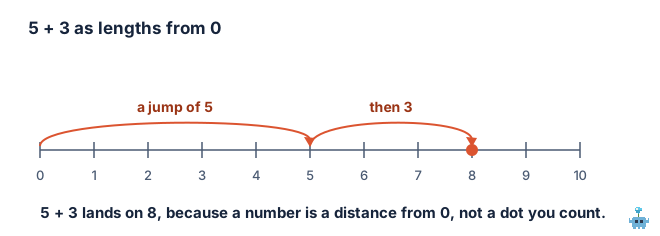
Represent whole numbers as lengths from 0 on a number line diagram with equally spaced points, and represent sums and differences on it.
The misconception: that a number line is a row of labelled dots, so the number is the dot rather than the distance from zero.
The wrong answer it produces: give a child a number line and ask them to show 5 + 3. A child who thinks in dots counts three dots including the one they started on and lands on 7. The error is off by one and it is completely systematic.
Why this one matters more than it looks: this is the standard that grade 3 fractions stand on. When a grade 3 child cannot place 3/4 on a number line, the cause is almost always here: they never learned that a number is a distance. Fixing it in grade 2 costs a week and saves a term.
The reteach: hop along the line with a finger and say the distance, not the dot. Use a ruler as a number line, since a ruler makes distance obvious in a way a drawn line does not.
How long this actually takes at home
About 120 to 150 hours, roughly 40 minutes a day across four days. Rough proportions:
- Place value and computation to 1000: a third. Nine standards, and 2.NBT.B.7 with regrouping is the slow one.
- Measurement and data: a third. Ten standards, but many are short and hands-on.
- Fact fluency: fifteen minutes a day, all year. It is not a block, it is a habit.
- Geometry and the array work fill the rest.
What to cut when it runs long. Picture and bar graphs (2.MD.D.9, 2.MD.D.10) and the two-different-units measuring in 2.MD.A.2 compress well. Never compress fact fluency or the number line work: one gates grade 3 computation and the other gates grade 3 fractions.
Readiness check
- Two-digit place value. Ask what the 1 means in 17. If the answer is “one” rather than “ten”, that is a grade 1 gap (1.NBT.B.2) and three-digit work will not stick. See the grade 1 guide.
- The equal sign. Write 8 + 4 = □ + 5 and see what they put. A child who writes 12 has the grade 1 misconception about what “=” means, and it will make every equation in grade 2 harder than it needs to be.
- Counting on rather than counting all. Ask for 9 + 3. A child who starts at 1 is not ready for fluency work yet.
A sequence for a flexible year
- Fluency within 20 (2.OA.B.2), started in week one and continued daily all year. Everything else is easier behind it.
- Three-digit place value (2.NBT.A.1 to A.4), with blocks, including numbers with a zero in the middle.
- Mental tens and hundreds (2.NBT.B.8), which is a quick win and builds confidence with big numbers.
- Addition and subtraction within 100, then 1000 (2.NBT.B.5 to B.7), with 2.NBT.B.9 (explain why the strategy works) taught alongside rather than after.
- Length with real tools (2.MD.A.1 to A.4), then the number line (2.MD.B.6), which follows naturally from measuring.
- Word problems (2.OA.A.1, 2.MD.B.5), threaded through rather than blocked.
- Time and money (2.MD.C.7, C.8). Money is harder than it looks because it mixes units.
- Odd and even, and arrays (2.OA.C.3, C.4). Give the array work a real week: it is the seed of multiplication.
- Geometry (2.G.A.1 to A.3), finishing with partitioning into halves, thirds and fourths, which is the seed of fractions.
- Graphs (2.MD.D.9, D.10) last, as the most compressible content.
The split-grade case
Grade 2 is often where a homeschooled child first pulls clearly ahead in one domain. A child who reads well frequently races through measurement and data while still consolidating regrouping, and that is normal.
The one chain to respect: fluency, then regrouping, then multi-digit work (2.OA.B.2 to 2.NBT.B.7 to grade 3). Measurement, time, money, geometry and graphs depend on almost nothing and can run at whatever level suits. Record what the child is working on by standard rather than by grade.
Evidence and records for this grade
Grade 2 is not a testing year in any of the twelve state regimes covered in this series, so whatever you keep is for you, for a future school placement, or for a portfolio review in Maryland or Pennsylvania.
Three things worth having:
- A record of which addition facts are automatic, updated a few times a year. It is the most useful diagnostic document you will own in grade 3.
- Work showing three-digit place value including a zero, since that is the standard most likely to be quietly missing.
- Dated work across all four domains. Geometry has three standards and is the easiest to leave out of a folder entirely.
What belongs in the folder is covered in what goes in a homeschool portfolio, and a printable pack gives you a dated work sample and its answer key in one go.
The honest summary
Twenty-six standards, about 135 hours, and a year that looks like arithmetic and is really about meaning. The zero in 706 is doing a job. A number on a number line is a distance, not a dot. And addition facts have to come from memory, because grade 3 needs the working memory for something else.
Give the array work and the partitioning work a real week each, even though they are single standards in small domains. They are where multiplication and fractions actually start.
Next year is grade 3 math, and the year before is grade 1 math. If facts are the sticking point, helping with math at home without a tutor covers the daily practice, and teaching math through interests is how retrieval practice stops feeling like drilling.
Sprout Lessons builds standards-aligned lessons for grades K–12. Start free.
Common Core State Standards © 2010 National Governors Association Center for Best Practices and Council of Chief State School Officers. All rights reserved. Accessed via the Common Standards Project (accessed 2026-07-16). This product is not endorsed by NGA/CCSSO. Standard counts in this guide were taken from that dataset, not written from memory. Your state may have adopted modified standards: check your state department of education for the version that applies to you.
FAQ
Why does my child write 76 when I say seven hundred and six?
They are reading the zero as nothing rather than as a placeholder doing a job. Common Core uses this exact case deliberately: 706 equals 7 hundreds, 0 tens and 6 ones. Build it with base ten blocks and leave the tens column physically empty, then ask what would happen if you closed the gap. The child sees 76 appear and the zero acquires a purpose.
How many math standards are in grade 2 Common Core?
Twenty-six: ten in Measurement and Data, nine in Number and Operations in Base Ten, four in Operations and Algebraic Thinking, and three in Geometry. Measurement and data being the largest domain surprises parents who expect grade 2 to be arithmetic with bigger numbers.
Does grade 2 really require knowing addition facts from memory?
Yes. The standard says fluently add and subtract within 20 using mental strategies, and by end of Grade 2 know from memory all sums of two one-digit numbers. It is about retrieval rather than accuracy: a child computing 8 plus 7 by counting cannot hold a two-step word problem in their head at the same time. It is the same trap as multiplication fluency in grade 3, one year earlier.
Why does my child get number line problems off by one?
They think a number line is a row of labeled dots, so the number is the dot rather than the distance from zero. Asked to show 5 plus 3 they count three dots including the one they started on and land on 7. Hop along the line saying the distance rather than the dot, and use a ruler, which makes distance obvious in a way a drawn line does not.
How long does grade 2 math take at home?
About 120 to 150 hours, roughly 40 minutes a day across four days. It is the lightest of the elementary years by hours. Fact fluency is not a block within that: it is fifteen minutes a day all year.
What should I cut if grade 2 math runs long?
Picture and bar graphs and the two-different-units measuring in 2.MD.A.2 compress well. Never compress fact fluency or the number line work: one gates grade 3 computation and the other gates grade 3 fractions, and a week spent on the number line in grade 2 saves a term in grade 3.