
Grade 1 math is 21 Common Core standards, and one of them is about a symbol most adults have never thought twice about. 1.OA.D.7 asks children to understand the meaning of the equal sign. Almost every child arrives believing it means “the answer comes next”, and almost every child leaves grade 1 still believing it unless someone teaches otherwise. It is the most documented misconception in early mathematics, it costs nothing to fix at six years old, and it costs years of algebra confusion if it is left.
The year runs about 100 to 130 hours at home, roughly 30 to 35 minutes a day across four days. Short sessions matter more here than in any other grade.
The 21 standards, by domain
| Domain | Standards | What it is |
|---|---|---|
| Operations and Algebraic Thinking | 8 | Word problems, properties, the equal sign, fluency within 10 |
| Number and Operations in Base Ten | 6 | Counting to 120, tens and ones, adding within 100 |
| Measurement and Data | 4 | Comparing length, telling time, simple data |
| Geometry | 3 | Defining attributes, composing shapes, halves and fourths |
Operations and Algebraic Thinking is the biggest domain in grade 1, and it stays the biggest through grade 3. That is the through-line of early elementary: not bigger numbers, but a growing understanding of what operations and equations actually mean.
The three hard ones
1.OA.D.7, what the equal sign means
The standard: understand the meaning of the equal sign, and determine if equations involving addition and subtraction are true or false.
The misconception: that “=” is an instruction meaning “write the answer here”, rather than a statement that two sides have the same value.
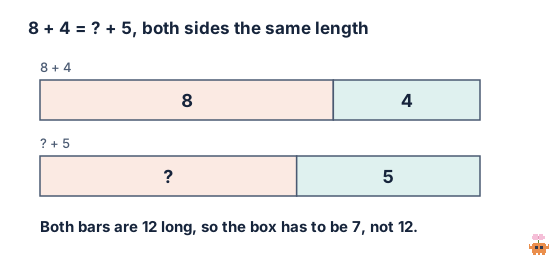
The wrong answer it produces: write 8 + 4 = □ + 5 and ask the child to fill the box. A child who reads the equal sign as a command writes 12, because 8 plus 4 is 12 and the answer goes after the equals. Some write 17, having added everything. The correct answer, 7, requires seeing the sign as a balance. This is worth testing today even if your child is older: it is startling how many children in grade 4 still write 12.
The reteach: stop reading “=” as “makes” and start reading it as “is the same as”. Write true-or-false equations rather than fill-in-the-blank ones: is 7 = 7 true? Is 3 + 4 = 4 + 3 true? Is 5 + 2 = 8 true? Put the answer on the left sometimes, so 12 = 8 + 4 stops looking wrong.
1.NBT.B.2, ten as a unit
Understanding that the two digits of a two-digit number represent amounts of tens and ones, including that a bundle of ten ones is called a “ten”.
The misconception: that 17 is the digits 1 and 7, sitting next to each other.
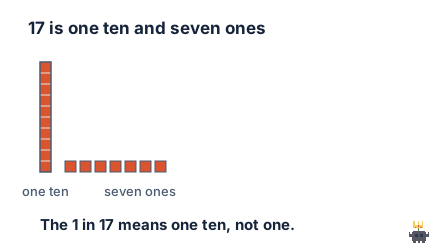
The wrong answer it produces: ask a child to show 17 with blocks. A child who has not unitized puts out 1 block and 7 blocks and is satisfied. Ask what the 1 means and they say “one”. The whole place value system, in every later grade, rests on the answer being “one ten”.
The reteach: physically bundle. Ten straws in a rubber band, counted out one at a time and then treated as a single thing. The bundling has to be done by the child, repeatedly. A pre-made base ten rod skips exactly the step that does the teaching.
1.OA.B.4, subtraction as an unknown addend
Understand subtraction as an unknown-addend problem: 10 minus 8 is the number that added to 8 makes 10.
The misconception: that subtraction is exclusively taking away and counting back.
The wrong answer it produces: not usually a wrong answer, but a slow and fragile one. Ask 13 − 8 and the child counts back eight from thirteen, on fingers, and often lands on 6 because they counted 13 itself as the first step. A child who knows 8 + 5 = 13 answers instantly and is never off by one.
The reteach: teach every fact family as a family. 8 + 5, 5 + 8, 13 − 8, 13 − 5 are one piece of knowledge, not four. This is also what makes grade 2 subtraction with regrouping tractable.
How long this actually takes at home
About 100 to 130 hours, or 30 to 35 minutes a day across four days. Grade 1 is the year where session length matters more than total hours: two focused fifteen-minute sessions beat one distracted forty-minute one, and a six-year-old’s useful attention for new mathematical ideas is genuinely about fifteen minutes.
- Operations and problem solving: nearly half the year. Eight standards, and the meaning-making work is where the time belongs.
- Place value and adding within 100: a third.
- Measurement, time, data and geometry fill the rest, and most of it is hands-on and quick.
What to cut when it runs long. Data with three categories (1.MD.C.4) and composing shapes (1.G.A.2) compress well, and telling time to the half hour (1.MD.B.3) can be taught incidentally on a real clock all year. Never compress the equal sign work or the bundling work.
Readiness check
- Counting on from a number. Ask the child to start at 7 and count to 15. A child who has to start at 1 is not ready for addition strategies yet.
- One-to-one correspondence past 10. Put out 14 objects and ask how many. A child who loses track is not ready for two-digit work.
- Recognizing small quantities without counting. Flash three fingers. If the child counts them, spend a couple of weeks on subitizing before starting fact work.
A sequence for a flexible year
- Counting to 120 (1.NBT.A.1), including starting from any number. More important than it sounds: it is what makes counting on possible.
- Addition and subtraction within 20, by meaning (1.OA.A.1, A.2), using real problems rather than bare equations.
- The equal sign (1.OA.D.7). Teach it early, before a year of fill-in-the-blank worksheets has cemented the wrong reading.
- Properties and strategies (1.OA.B.3, C.5), including counting on and making ten.
- Subtraction as unknown addend (1.OA.B.4, D.8), taught as fact families.
- Fluency within 10 (1.OA.C.6), five minutes a day from here on.
- Tens and ones (1.NBT.B.2, B.3), with physical bundling done by the child.
- Adding within 100 and mental tens (1.NBT.C.4 to C.6).
- Measurement and time (1.MD.A.1, A.2, B.3), where 1.MD.A.2 (laying units end to end) quietly sets up the grade 2 number line.
- Geometry and data (1.G.A.1 to A.3, 1.MD.C.4), finishing with halves and fourths.
The split-grade case
In grade 1 the usual split is not between domains but between conceptual and procedural: a child who understands what is happening but cannot yet recall facts, or the reverse. Both are normal at six.
The chain to respect is short and strict: counting on, then making ten, then fluency within 10, then tens and ones. A child who has not unitized ten should not be pushed into adding within 100, because the procedure will work and the understanding will not follow. Everything in measurement, time, geometry and data can run independently at whatever level suits.
Evidence and records for this grade
Grade 1 is not a testing year anywhere in the twelve state regimes covered in this series, and in several states compulsory instruction has not started yet: Minnesota counts from age seven, and Virginia excuses children under six from the evidence requirement entirely.
Keep records anyway, lightly. At this age photographs do most of the work: a child’s bundled straws, a shape they composed, a page of true-or-false equations. Three things worth having:
- Photos of the physical work. Most of grade 1 mathematics does not survive on paper, and a folder of worksheets misrepresents what actually happened.
- A running note of which facts within 10 are automatic.
- One dated page of true-or-false equations, which is the clearest evidence of the equal sign standard and takes five minutes to produce.
What belongs in a folder is covered in what goes in a homeschool portfolio, and a printable pack is a useful way to get a dated paper artifact out of a year that is mostly hands-on.
The honest summary
Twenty-one standards, about 115 hours, and one small symbol that matters more than anything else in the year. Teach “=” as “is the same as” rather than “the answer comes next”, use true-or-false equations instead of fill-in-the-blanks, and put the answer on the left sometimes.
Then make the child do the bundling themselves, teach fact families rather than isolated facts, and keep sessions to fifteen minutes. Grade 1 rewards short and frequent over long and thorough more than any other year.
Next is grade 2 math. If you want the arc, the grade 3, grade 4 and grade 5 guides show where all of this is heading. For daily practice, helping with math at home without a tutor and teaching math through interests.
Sprout Lessons builds standards-aligned lessons for grades K–12. Start free.
Common Core State Standards © 2010 National Governors Association Center for Best Practices and Council of Chief State School Officers. All rights reserved. Accessed via the Common Standards Project (accessed 2026-07-16). This product is not endorsed by NGA/CCSSO. Standard counts in this guide were taken from that dataset, not written from memory. Your state may have adopted modified standards: check your state department of education for the version that applies to you.
FAQ
What is the equal sign misconception in grade 1?
Children read = as an instruction meaning write the answer here, rather than a statement that two sides have the same value. Write 8 + 4 = box + 5 and a child with the misconception writes 12, because 8 plus 4 is 12 and the answer goes after the equals. Some write 17, having added everything. The correct answer is 7. It is worth testing even on an older child: many in grade 4 still write 12.
How do I teach the equal sign properly?
Stop reading it as makes and start reading it as is the same as. Use true-or-false equations rather than fill-in-the-blank ones: is 7 = 7 true, is 3 + 4 = 4 + 3 true, is 5 + 2 = 8 true. Put the answer on the left sometimes so that 12 = 8 + 4 stops looking wrong. Teach it early in the year, before twelve months of fill-in-the-blank worksheets cement the wrong reading.
Why does my child say the 1 in 17 means one?
They have not unitized ten: 17 is the digits 1 and 7 sitting next to each other rather than one ten and seven ones. Ask them to show 17 with blocks and a child who has not unitized puts out 1 block and 7 blocks and is satisfied. The fix is physical bundling done by the child, repeatedly: ten straws in a rubber band, counted out and then treated as a single thing.
How many math standards are in grade 1 Common Core?
Twenty-one: eight in Operations and Algebraic Thinking, six in Number and Operations in Base Ten, four in Measurement and Data, and three in Geometry. Operations and Algebraic Thinking is the biggest domain in grade 1 and stays biggest through grade 3, which is the through-line of early elementary: not bigger numbers, but what operations and equations mean.
How long should grade 1 math take each day?
About 100 to 130 hours across the year, or 30 to 35 minutes a day over four days. Session length matters more than total hours at this age: two focused fifteen-minute sessions beat one distracted forty-minute one, because a six year old useful attention for new mathematical ideas is genuinely about fifteen minutes.
What records should I keep for grade 1?
Light ones, and mostly photographs, because most of grade 1 mathematics does not survive on paper and a folder of worksheets misrepresents what actually happened. Photograph the bundled straws and the composed shapes, keep a running note of which facts within 10 are automatic, and keep one dated page of true-or-false equations as the clearest evidence of the equal sign standard.