
Grade 3 math is 25 Common Core standards, and three of them are the ones that decide how the next four years go. This is the year multiplication and division stop being new vocabulary and become the operations everything else is built on, the year fractions arrive as numbers rather than as pizza slices, and the year area gets connected to multiplication. Get those three right and grade 4 is straightforward. Get them wrong and you will still be paying for it in grade 6.
At home, the whole grade is roughly 150 to 180 hours of math across a year, which is about 45 minutes a day, four days a week. That is far less than a school spends, and it is not a shortcut: it is what one-to-one teaching costs when nobody is waiting for 23 other children.
The 25 standards, by domain
| Domain | Standards | What it is |
|---|---|---|
| Operations and Algebraic Thinking | 9 | The meaning of multiplication and division, and fluency within 100 |
| Measurement and Data | 8 | Time, mass and volume, graphs, and area and perimeter |
| Number and Operations in Base Ten | 3 | Rounding, adding and subtracting within 1000 |
| Number and Operations - Fractions | 3 | Unit fractions, fractions on the number line, equivalence |
| Geometry | 2 | Shape categories and attributes, partitioning into equal areas |
Look at the distribution before you plan. Operations and Algebraic Thinking is the largest domain and Fractions is one of the smallest, but the three fraction standards carry more long-term weight per standard than anything else in the grade. Standard counts are a poor guide to time. Plan by difficulty instead.
The three hard ones
3.NF.A.2, a fraction is a number on the number line
Common Core states it plainly: “Understand a fraction as a number on the number line; represent fractions on a number line diagram.”
The misconception: fractions are parts of a shape, not numbers. Almost every child arrives at grade 3 with the pizza model and nothing else, and the pizza model does not tell you where 3/4 lives among the numbers.
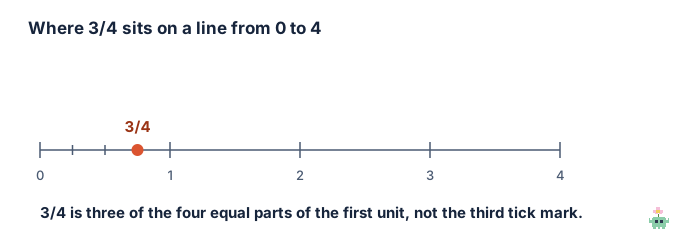
The wrong answer it produces: give a child a number line marked 0 to 4 and ask them to mark 3/4. A child working from the pizza model counts to the third tick mark, landing on 3, or divides the whole line into four parts and marks the third one. Both answers are confident, and both come from the same cause: the child does not know what the whole is.
The reteach: only ever draw number lines from 0 to 1 for a week. Ask “what is the whole here?” before every question. Then move to 0 to 2 and ask it again. The skill is identifying the unit, not counting tick marks.
3.OA.C.7, fluency within 100
The standard asks students to fluently multiply and divide within 100, and adds: “By the end of Grade 3, know from memory all products of two one-digit numbers.”
The misconception: that skip counting is fluency. A child who reaches 7 × 8 by counting 7, 14, 21, 28 has a correct method and no fluency.
The wrong answer it produces: not a wrong answer at all, which is why it hides. It produces a slow right answer, and the damage shows up one layer later: in a two-step word problem, the twelve seconds spent on 7 × 8 costs the child the thread of what they were solving. Grade 4 multi-digit multiplication makes this fatal.
The reteach: separate fact practice from problem solving entirely. Five minutes a day of retrieval, not worksheets. Test with a timer only to find which facts are missing, then drill only those. Most children have fewer than a dozen genuinely unknown facts, clustered around 6, 7 and 8.
3.MD.C.7, area relates to multiplication and addition
Grade 3 builds area from counting unit squares (3.MD.C.5 and 3.MD.C.6) and then connects it to multiplication.
The misconception: that area is a formula. A child taught “length times width” before counting squares has a rule with nothing underneath it.
The wrong answer it produces: give the child an L-shaped figure. The formula-first child multiplies the two longest side lengths and gets a number far too large. The square-counting child decomposes it into two rectangles without being told to, because they know what they are counting.
The reteach: spend a week covering shapes with actual square tiles before the word “formula” is used at all. The multiplication connection should be something the child notices, not something you announce.
How long this actually takes at home
A school math block runs about 60 minutes a day for 180 days, roughly 180 hours, and a meaningful share of that is transitions, waiting and re-explaining to the room. One-to-one, the same content fits in 150 to 180 hours, and most families land near 45 minutes a day across four days with a fifth day for review or a project.
Where the time actually goes, in rough proportion:
- Multiplication and division meaning and fluency: about a third of the year. Nine standards, and the fluency requirement runs in the background the whole time.
- Fractions: about a fifth. Three standards, disproportionate time, and worth every minute.
- Area and perimeter: about a sixth. Hands-on, and slower than it looks.
- Everything else, meaning time, mass and volume, graphs, rounding, addition and subtraction within 1000, and the two geometry standards, fills the rest.
What to cut when it runs long. Scaled picture and bar graphs (3.MD.B.3) and the measurement work in 3.MD.A.2 are the most compressible: they are genuinely useful but they do not gate anything downstream. Never compress fractions or fluency to make room. Those two gate everything.
Readiness check: what grade 3 assumes
Before starting, check three things. Each takes two minutes and each has a specific fix.
- Place value to 1000. Ask what the 4 means in 342. If the answer is “four” rather than “forty”, rounding (3.NBT.A.1) and adding within 1000 will both fail. Fix with base ten blocks before you start the grade.
- Equal groups. Ask the child to draw 4 groups of 3. If they draw 4 objects and 3 objects, multiplication has nowhere to attach. This is grade 2 work and it is worth two weeks now.
- Halves, thirds and fourths of a shape. Ask them to split a rectangle into fourths two different ways. A child who can only quarter it one way is not ready for equivalence in 3.NF.A.3.
If any of these is missing, teach it first. Grade 3 is unusually unforgiving of gaps because three of its five domains build directly on grade 2 content.
A sequence for a flexible year
Not a term calendar. An order, with the dependencies made explicit, so you can move at whatever pace the child actually needs.
- Meaning of multiplication and division (3.OA.A.1 to A.4). Equal groups, arrays, and the unknown-factor idea. Start fact retrieval practice here and never stop it.
- Properties and strategies (3.OA.B.5, B.6). Why 6 × 7 can be found from 5 × 7. This is what makes fluency achievable rather than memorized.
- Rounding and computation in base ten (3.NBT.A.1 to A.3). A natural break from multiplication, and 3.NBT.A.3 needs the multiplication work above it.
- Fractions (3.NF.A.1 to A.3), in that order, slowly. Unit fractions first, then the number line, then equivalence. Do not reorder these.
- Area, then perimeter (3.MD.C.5 to C.7, then 3.MD.D.8). Tiles before formulas. Perimeter after area, because teaching them together is the most reliable way to produce a child who confuses them.
- Measurement and data (3.MD.A.1, A.2, B.3, B.4). Time, mass and volume, and graphs. The line plot in 3.MD.B.4 uses halves and fourths, so it belongs after fractions.
- Geometry (3.G.A.1, 3.G.A.2). 3.G.A.2 is a fraction standard wearing a geometry hat, so it lands naturally at the end.
- Two-step problems and patterns (3.OA.D.8, D.9), threaded throughout rather than saved for the end.
The split-grade case
A homeschooled child is routinely two grade levels apart across domains, and every school-shaped resource pretends otherwise. Grade 3 is where it usually first shows.
The common pattern is a child working a year ahead in computation and a year behind in fractions, or the reverse. That is normal and it does not need fixing. Common Core domains are largely independent within a grade: you can teach grade 4 base ten work to a child who is still consolidating grade 3 fractions, because 4.NBT does not depend on 3.NF.
Two dependencies you cannot skip across, though:
- Fraction work is strictly sequential. 3.NF.A.1 to A.2 to A.3, then 4.NF. Never jump ahead in fractions to match a grade label.
- Fluency gates grade 4 multiplication. Do not start 4.NBT.B.5 until 3.OA.C.7 is genuinely automatic.
For records, note the standard rather than the grade. “Working on 3.NF.A.2 and 4.NBT.A.2” is accurate and useful. “Doing grade 3 math” is neither.
Evidence and records for this grade
Grade 3 is a testing year in Pennsylvania (grades 3, 5 and 8) and in Oregon (end of grades 3, 5, 8 and 10), so if you are in either, this is a year to book a test administrator in the fall rather than the spring.
For everyone else, three things are worth keeping regardless of what your state asks:
- Dated work across all five domains. Geometry has only two standards and is the domain most likely to be missing from a folder entirely.
- A record of which multiplication facts are automatic, updated a few times a year. This is the single most useful diagnostic document you will own in grade 4.
- Work that shows the fraction number-line standard specifically, because it is the standard an evaluator or a future school is most likely to probe.
What to put in a portfolio, and what to leave out, is covered in what goes in a homeschool portfolio.
Sprout Lessons builds lessons from the standard itself, so a grade 3 lesson names 3.NF.A.2 on the page and the work sample doubles as the coverage record. Try it free.
The honest summary
Twenty-five standards, five domains, about 150 hours. Three of the standards matter more than the other twenty-two combined: fractions as numbers on a number line, multiplication fluency that is genuinely automatic, and area built from counting squares rather than from a formula.
Teach those three slowly and let the rest move at whatever pace the child sets. Compress graphs and measurement if the year runs long. Never compress fractions or fluency, because grade 4 spends the entire year standing on both.
For the year after this one, see grade 4 math. If a fraction or fluency gap is already showing, helping with math at home without a tutor and catching up after falling behind cover the daily practice, and teaching math through interests is how the fluency work stops feeling like drilling.
Sprout Lessons builds standards-aligned lessons for grades K–12. Start free.
Common Core State Standards © 2010 National Governors Association Center for Best Practices and Council of Chief State School Officers. All rights reserved. Accessed via the Common Standards Project (accessed 2026-07-16). This product is not endorsed by NGA/CCSSO. Standard counts in this guide were taken from that dataset, not written from memory. Your state may have adopted modified standards: check your state department of education for the version that applies to you.
FAQ
How many math standards are in grade 3 Common Core?
Twenty-five, across five domains: nine in Operations and Algebraic Thinking, eight in Measurement and Data, three in Number and Operations in Base Ten, three in Number and Operations Fractions, and two in Geometry. Standard counts are a poor guide to time, though: the three fraction standards carry more long-term weight per standard than anything else in the grade.
How long does grade 3 math take at home?
Roughly 150 to 180 hours across a year, which is about 45 minutes a day four days a week with a fifth day for review or a project. A school math block is around 180 hours, and a meaningful share of that is transitions, waiting and re-explaining to the room. One-to-one teaching is genuinely faster, and that is not a shortcut.
Why does my child put 3/4 in the wrong place on a number line?
Because they are working from the pizza model, where a fraction is part of a shape rather than a number. Give a child a number line marked 0 to 4 and ask for 3/4 and they will often count to the third tick and land on 3, or divide the whole line into four parts. The fix is to draw only 0 to 1 number lines for a week and ask what is the whole here before every question. The skill is identifying the unit, not counting ticks.
Is skip counting the same as multiplication fluency?
No, and this is the gap that hides longest because it produces correct answers. A child reaching 7 times 8 by counting 7, 14, 21, 28 has a valid method and no fluency. The damage appears one layer later: in a two-step word problem, twelve seconds spent on a fact costs the child the thread of what they were solving. Grade 3 asks students to know from memory all products of two one-digit numbers by the end of the year.
What should I cut if grade 3 math runs long?
Scaled picture and bar graphs and the measurement work in 3.MD.A.2 are the most compressible: useful, but they do not gate anything downstream. Never compress fractions or multiplication fluency. Grade 4 spends the entire year standing on both, so time borrowed from them is repaid with interest.
My child is ahead in some math and behind in others. Is that a problem?
No, and it is the normal case for a homeschooled child. Common Core domains are largely independent within a grade, so you can teach grade 4 base ten work to a child still consolidating grade 3 fractions. Two dependencies you cannot skip across: fraction work is strictly sequential, and multiplication fluency gates grade 4 multi-digit multiplication. For records, note the standard rather than the grade.