
Grade 4 math is 28 Common Core standards, and it is the year decimals arrive, disguised as fractions. Common Core does not introduce decimals as a new kind of number. It introduces them as fractions with denominators of 10 and 100 that happen to have a shorter notation. Understanding that is the difference between a child who knows why 0.5 is bigger than 0.45 and a child who thinks longer means larger for the next three years.
Grade 4 is also the widest grade in elementary math: seven fraction standards, six in base ten, seven in measurement and data. At home it runs about 160 to 190 hours, roughly 50 minutes a day across four days.
The 28 standards, by domain
| Domain | Standards | What it is |
|---|---|---|
| Number and Operations - Fractions | 7 | Equivalence, comparison, adding, multiplying by a whole number, and decimals |
| Measurement and Data | 7 | Unit conversion, area and perimeter formulas, line plots, and angles |
| Number and Operations in Base Ten | 6 | Place value, the standard algorithm, multi-digit multiplication and division |
| Operations and Algebraic Thinking | 5 | Multiplicative comparison, multistep problems, factors and multiples, patterns |
| Geometry | 3 | Lines and angles, classifying figures, symmetry |
The shift from grade 3 is stark. Fractions go from three standards to seven and become the largest domain in the grade. If grade 3 was about what a fraction is, grade 4 is about what you can do with one.
The three hard ones
4.NF.C.7, comparing decimals to hundredths
The standard: “Compare two decimals to hundredths by reasoning about their size. Recognize that comparisons are valid only when the two decimals refer to the same whole.”
The misconception: longer means larger. It is imported wholesale from whole numbers, where it is true: 145 really is bigger than 45. Nobody teaches it and every child arrives with it.
The wrong answer it produces: the child says 0.45 is bigger than 0.5, confidently, because 45 is bigger than 5. Ask them to explain and they will tell you exactly that. This is the most durable misconception in elementary mathematics and it survives into high school unless it is named directly.
The reteach: use the fraction route Common Core actually intends. 0.5 is 5/10, which is 50/100, which is 0.50. Now compare 50 hundredths with 45 hundredths and the answer is obvious. The standard immediately before this one (4.NF.C.5, expressing tenths as hundredths) exists precisely to make this argument available, which is why the ordering matters.
4.OA.A.1 and 4.OA.A.2, multiplicative comparison
Common Core: “Interpret a multiplication equation as a comparison, e.g., interpret 35 = 5 × 7 as a statement that 35 is 5 times as many as 7.”
The misconception: that “times as many” is another way of saying “more than”. Three years of additive comparison have trained the child to hear any comparison as addition.
The wrong answer it produces: “Ana has 3 times as many stickers as Ben. Ben has 4. How many does Ana have?” The child answers 7. They have read “3 times as many” as “3 more”, and 4 plus 3 is 7. The standard explicitly asks students to distinguish multiplicative comparison from additive comparison, because this is what happens when they cannot.
The reteach: always give both versions of the same problem, back to back. “Ben has 4. Ana has 3 more.” and “Ben has 4. Ana has 3 times as many.” Draw both. The contrast does the teaching; explaining the difference in words does not.
4.NF.A.1, why equivalence works
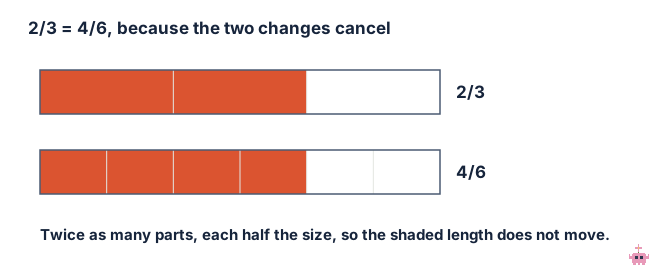
The standard asks students to explain why a/b is equivalent to (n × a)/(n × b), using visual models, “with attention to how the number and size of the parts differ even though the two fractions themselves are the same size.”
The misconception: that equivalence is a procedure applied to the digits. Whatever you do to the top you do to the bottom, with no model underneath it.
The wrong answer it produces: the child adds instead of multiplying and asserts that 2/3 = 3/4, because you add 1 to each. A procedure with no model cannot tell them which operation preserves the value. The same child will also confidently multiply only the numerator.
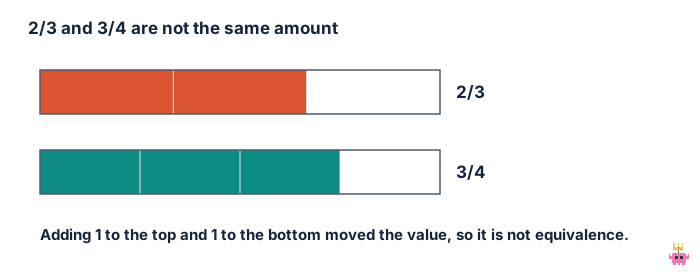
The reteach: read the standard’s own wording aloud and teach exactly that: the number of parts changes and the size of the parts changes, and the two changes cancel. A fraction strip cut into thirds and then each third cut in half shows it in about ten seconds. Adding 1 to each does not cancel anything, and the strip makes that visible rather than assertable.
How long this actually takes at home
About 160 to 190 hours, which is roughly 50 minutes a day across four days, slightly more than grade 3. The extra time is almost entirely fractions.
Rough proportions:
- Fractions and decimals: a third of the year. Seven standards and the heaviest conceptual load in elementary math.
- Multi-digit multiplication and division: a quarter. 4.NBT.B.5 and B.6 are slow, and they are slow for a good reason.
- Measurement, angles and geometry: a quarter. The angle standards (4.MD.C.5 to C.7) are more substantial than they look.
- Everything else, meaning place value, multiplicative comparison, multistep problems, factors and patterns, fills the rest.
What to cut when it runs long. Line plots (4.MD.B.4) and symmetry (4.G.A.3) compress well. Unit conversion (4.MD.A.1) can be taught alongside other work rather than as its own block. Do not compress the fraction sequence or multi-digit multiplication, and in particular do not skip 4.NF.C.5, the tenths-to-hundredths standard, because it is the one that makes decimal comparison make sense.
Readiness check: what grade 4 assumes
- Multiplication facts, automatic. Ask ten mixed facts and time it. If the child is deriving rather than recalling, 4.NBT.B.5 will be painful and 4.NBT.B.6 close to impossible. Fix this before starting the grade, not during it.
- A fraction is a number. Ask them to place 3/4 on a number line from 0 to 2. A child who cannot has a grade 3 gap (3.NF.A.2), and every one of the seven grade 4 fraction standards will land on sand.
- Area by counting, not by formula. Ask for the area of an L-shape. Grade 4 introduces the formula (4.MD.A.3), and a child who never counted squares in grade 3 will apply it to shapes it does not fit.
A sequence for a flexible year
- Place value and comparison (4.NBT.A.1 to A.3). The ten-times relationship in 4.NBT.A.1 is the foundation the decimal work later depends on, so teach it as an idea rather than as a fact about digits.
- Multiplicative comparison (4.OA.A.1, A.2), taught against additive comparison from the first day.
- The standard algorithm, then multi-digit multiplication and division(4.NBT.B.4, B.5, B.6). Slow. Expect this to take longer than you planned.
- Multistep problems and interpreting remainders (4.OA.A.3), immediately after division so remainders have somewhere to live.
- Factors, multiples and patterns (4.OA.B.4, C.5). A natural change of pace, and 4.OA.B.4 sets up grade 5 and 6 fraction work.
- Fractions, in order (4.NF.A.1, A.2, B.3, B.4). Equivalence, then comparison, then addition, then multiplying by a whole number. Do not reorder.
- Decimals, as fractions (4.NF.C.5, C.6, C.7), in exactly that order. Tenths expressed as hundredths first, then the notation, then comparison. This ordering is the whole lesson.
- Measurement and angles (4.MD.A.1 to A.3, C.5 to C.7), with the line plot (4.MD.B.4) after the fraction work since it uses halves, fourths and eighths.
- Geometry (4.G.A.1 to A.3). 4.G.A.1 pairs naturally with the angle standards, so those can be taught together.
The split-grade case
Grade 4 is where being split across grade levels becomes most visible, because the fraction strand accelerates so sharply while base ten work continues at a steady pace.
The usual pattern is a child comfortably doing grade 4 or 5 computation while still working through grade 3 or early grade 4 fractions. That is fine and it does not need correcting. What matters is respecting the two chains:
- The fraction chain is strict: 3.NF.A.2 to 4.NF.A.1 to 4.NF.A.2 to 4.NF.C.5 to 4.NF.C.7. Every link is load-bearing, and the decimal standards at the end are the ones most often taught out of order.
- The computation chain is strict: 3.OA.C.7 fluency to 4.NBT.B.5 to 4.NBT.B.6. Multi-digit division without automatic facts is the most common source of grade 4 misery.
Between the two chains, though, there is no dependency at all. Record what the child is actually working on by standard rather than by grade label.
Evidence and records for this grade
Grade 4 is a testing year in North Dakota (grades 4, 6, 8 and 10). It is not a testing year in Pennsylvania or Oregon, both of which test in grades 3, 5 and 8 or 3, 5, 8 and 10, so a child tested last year in those states gets a year off.
Worth keeping whatever your state requires:
- Work showing the decimal comparison standard. If you keep one piece of grade 4 evidence, make it this one. It is the standard most likely to be probed and the one whose absence causes the most trouble later.
- Multi-digit multiplication and division work with the strategies visible, not just answers. Both standards explicitly ask students to illustrate and explain.
- Something from geometry and angles. Three geometry standards, easily missed entirely in a folder.
What belongs in the folder and what does not is covered in what goes in a homeschool portfolio.
Sprout Lessons builds lessons from the standard, so a grade 4 lesson names 4.NF.C.7 on the page and the work sample is already the coverage record. Try it free.
The honest summary
Twenty-eight standards, about 170 hours, and one idea that carries the year: decimals are fractions with a shorter notation. Teach 4.NF.C.5, C.6 and C.7 in that order and the 0.45 versus 0.5 misconception never takes hold. Teach them out of order, or skip the tenths-to-hundredths step, and it will.
The other two things to guard: automatic multiplication facts before multi-digit work starts, and multiplicative comparison taught against additive comparison rather than on its own. Everything else in grade 4 is ordinary, and there is a lot of it.
For the year before this one, see grade 3 math. If the fraction or fluency chain has a gap, helping with math at home without a tutor and catching up after falling behind cover the repair, and teaching math through interests is how multi-digit practice stops being a grind.
Sprout Lessons builds standards-aligned lessons for grades K–12. Start free.
Common Core State Standards © 2010 National Governors Association Center for Best Practices and Council of Chief State School Officers. All rights reserved. Accessed via the Common Standards Project (accessed 2026-07-16). This product is not endorsed by NGA/CCSSO. Standard counts in this guide were taken from that dataset, not written from memory. Your state may have adopted modified standards: check your state department of education for the version that applies to you.
FAQ
Why does my child think 0.45 is bigger than 0.5?
Because longer means larger is true for whole numbers: 145 really is bigger than 45. Nobody teaches the rule and every child arrives with it. The fix is the fraction route Common Core intends: 0.5 is 5/10, which is 50/100, which is 0.50, so you are comparing 50 hundredths with 45 hundredths. The standard immediately before decimal comparison, expressing tenths as hundredths, exists precisely to make that argument available.
How many math standards are in grade 4 Common Core?
Twenty-eight, across five domains: seven in Number and Operations Fractions, seven in Measurement and Data, six in Number and Operations in Base Ten, five in Operations and Algebraic Thinking, and three in Geometry. Fractions go from three standards in grade 3 to seven in grade 4 and become the largest domain, which is the sharpest jump in elementary math.
How long does grade 4 math take at home?
About 160 to 190 hours across a year, roughly 50 minutes a day over four days. That is slightly more than grade 3, and the extra time is almost entirely fractions. Fractions and decimals take about a third of the year, multi-digit multiplication and division about a quarter, and measurement, angles and geometry about a quarter.
My child says 3 times as many means 3 more. How do I fix it?
Give both versions of the same problem back to back and draw both: Ben has 4 and Ana has 3 more, against Ben has 4 and Ana has 3 times as many. Three years of additive comparison have trained the child to hear any comparison as addition, which is why the standard explicitly asks students to distinguish multiplicative from additive comparison. The contrast does the teaching; explaining the difference in words does not.
Why does my child say 2/3 equals 3/4?
Because they have a procedure with no model underneath it: whatever you do to the top you do to the bottom, and adding 1 to each looks like it qualifies. The standard asks students to explain why a/b equals (n times a)/(n times b) with attention to how the number and size of the parts differ even though the fractions are the same size. A fraction strip cut into thirds, then each third cut in half, shows in ten seconds that multiplying preserves the value and adding does not.
What should I cut if grade 4 math runs long?
Line plots and symmetry compress well, and unit conversion can be taught alongside other work rather than as its own block. Do not compress the fraction sequence or multi-digit multiplication, and in particular never skip the tenths-to-hundredths standard, because it is the one that makes decimal comparison make sense.