
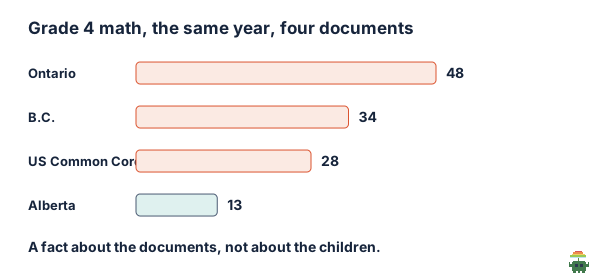
Alberta’s grade 4 math curriculum is 13 learning outcomes. Ontario’s is 48. Same grade, same subject, same child. Alberta does not teach a quarter as much mathematics as Ontario. The two provinces write their curriculum documents at completely different grain sizes, and the count tells you nothing at all about the workload.
That is worth understanding before anything else on this page, because it is the single most common way a family moving provinces, or comparing programs, gets misled.
The same year, four documents
| Curriculum | Grade 4 math items | How they are written |
|---|---|---|
| Ontario | 48 | Granular. Each expectation names tools, contexts and number ranges |
| British Columbia | 34 | Split between curricular competencies and content |
| US Common Core | 28 | Clustered under domains, with sub-standards inside several of them |
| Alberta | 13 | Broad. One sentence per idea, with the detail in supporting documents |
Alberta’s first grade 4 outcome, paraphrased, is that students apply place value to decimal numbers. Ontario spends three separate expectations on reading and representing whole numbers to 10 000, comparing and ordering them, and rounding them. Both curricula expect the same child to end the year able to do the same things. One document says it in a sentence and the other says it in a paragraph.
Three consequences worth acting on
- Never judge workload by counting outcomes. A program advertising “covers all 13 Alberta outcomes” is making a much bigger claim than it sounds, and one advertising 48 Ontario expectations is making a smaller one.
- Moving provinces will feel wrong in both directions. Families arriving from Ontario think Alberta is thin and under-specified. Families arriving from Alberta think Ontario is bureaucratic and overwhelming. Both are reacting to prose style rather than to content.
- A coverage checklist built from one province misleads against another. Ticking 13 Alberta outcomes will leave gaps against Ontario’s 48, and working through 48 Ontario expectations will do things Alberta never asks for. Neither is a failure.
The 13 outcomes, by strand
Paraphrased, since Alberta’s curriculum is Crown copyright:
| Strand | Outcomes | What grade 4 covers |
|---|---|---|
| Number | 6 | Place value in decimals; adding and subtracting within 10 000 including decimals to hundredths; prime and composite numbers; multiplying and dividing within 10 000; equivalence in fractions; interpreting percentages |
| Measurement | 2 | Interpreting and expressing area; determining angles in standard units |
| Algebra | 1 | Representing and applying equality in multiple ways |
| Geometry | 1 | Analyzing and explaining geometric properties |
| Patterns | 1 | Arithmetic and geometric sequences |
| Time | 1 | Communicating duration in standard units |
| Statistics | 1 | Evaluating the use of scale in graphs |
Percentages in grade 4, which is genuinely early
The sixth Number outcome asks grade 4 students to interpret percentages, and that is a real difference rather than a wording difference.
In US Common Core, percent does not arrive until the ratio work in grade 6. Ontario grade 4 goes as far as decimal tenths and fractions to tenths, with no percentages at all. Alberta introduces the idea two years earlier than Common Core does.
This is the outcome to watch when moving. A child arriving in Alberta from Ontario or from a US curriculum in grade 5 will not have met percentages, and everyone will assume they have. A child leaving Alberta will have met them and then not see them again for two years.
Teach it as out of a hundred and nothing else at this age. A hundred-square grid, shading, and the sentence that 100% is the whole thing. Alberta says interpret rather than calculate, and the interpretation is the part that lasts: see why children cannot do percentages for what happens when this idea is skipped and picked up later as a procedure.
The three hard ones
Equivalence in fractions (outcome 05)
The wrong answer it produces: shown two thirds and four sixths, the child says four sixths is bigger, because six is bigger than three and four is bigger than two. Every number in sight is larger.
The fix: two identical strips of paper folded differently, laid on top of each other. The equal length is the argument, and it is the only version of this that survives. Alberta asks for equivalence before it asks for fraction arithmetic, which is the right order and worth respecting.
Prime and composite numbers (outcome 03)
Alberta asks students to explain the properties of prime and composite numbers using multiplication and division, which is more than naming them.
The wrong answer it produces: a memorized list. Ask why 51 is composite and the child cannot say, because they learned which numbers are prime rather than what prime means. Almost everyone puts 51 on the prime list.
The fix: counters, arranged into rectangles. A number that can only make one rectangle, a single row, is prime. Twelve counters make three rectangles and twelve is composite. The definition becomes something the child produced rather than received.
Equality in multiple ways (outcome 07)
The wrong answer it produces: the equals sign read as “now write the answer”. Ask a child to fill in 8 + 4 = __ + 5 and you get 12, because they added the left side and stopped.
The fix: a balance, real or drawn, and the word same as instead of equals for a fortnight. This is the single most consequential misconception in elementary mathematics, because it is invisible until algebra, and Alberta gives it a whole outcome.
How long grade 4 math takes at home
About 150 to 180 hours, roughly 50 minutes a day across four days. Notice that this is the same estimate as for Ontario’s 48 expectations, which is the whole point of the first section.
- Number: about half. Six of the 13 outcomes, and they include the two slowest ideas in the year, fraction equivalence and percentages.
- Measurement and geometry: about a quarter. Area and angles are practical and go quickly with materials.
- Algebra, patterns, time and statistics share the rest, one outcome each, and they are the natural change-of-pace blocks.
The planning warning specific to Alberta: a broad outcome hides its own size. “Students multiply and divide natural numbers within 10 000” is one line and is about eight weeks of work. Read each outcome and ask what it would actually take, rather than dividing the year by 13.
A sequence for a flexible year
- Place value including decimals (01), which everything else in Number sits on.
- Addition and subtraction within 10 000 (02), decimals to hundredths included.
- Multiplication and division (04), the longest block of the year.
- Prime and composite (03), with counters, straight after multiplication while factors are fresh.
- Fraction equivalence (05), with folded paper.
- Percentages (06), on a hundred grid, immediately after fractions.
- Equality (07), with a balance, and worth starting earlier and revisiting.
- Area and angles (09, 10), practical and hands-on.
- Geometric properties (08), sequences (11), duration (12) and scale in graphs (13), the shorter blocks.
Records, and what Alberta asks for
More than the other two provinces, and this is where Alberta differs most. On the funded route, a certificated teacher conducts at least two formal evaluations a year and reviews a portfolio.
So in Alberta, unlike Ontario or BC, the records have an actual audience. Keep dated work across the strands, keep pairs of comparable work from early and late in the year so progress is visible by comparison, and keep receipts if you are claiming the parent portion of the grant.
Following the provincial curriculum is not required even on the funded route, but it makes the portfolio review straightforward, because the evaluator is checking progress against the outcomes of your program and a program written against Alberta’s 13 outcomes is the easiest possible thing to evaluate.
The honest summary
Thirteen outcomes, seven strands and about 165 hours, which is the same year of work as Ontario’s 48 expectations. A broad outcome hides its size, so read each one and ask what it would take rather than dividing the year by 13.
Half the year is Number. The two slow ideas are fraction equivalence, which needs folded paper rather than a rule, and percentages, which Alberta introduces two years before Common Core does and which should be taught as out of a hundred and nothing more at this age.
The outcome most worth taking seriously is equality, because reading the equals sign as “write the answer here” stays invisible until algebra and Alberta gives it an entire outcome of its own.
Sprout Lessons builds lessons against the Alberta curriculum with the outcome on each one, which is exactly what a portfolio review is looking for. Start free.
Outcome counts for all four curricula were taken from our copies of the Alberta, Ontario, BC and US datasets, accessed 16 July 2026, not written from memory. Alberta’s outcomes are paraphrased here rather than reproduced: read the official wording on Alberta’s grade 4 mathematics curriculum page. Alberta curriculum © Crown in Right of Alberta (Alberta Education). This product is not endorsed by Alberta Education.
FAQ
Why does Alberta have only 13 grade 4 math outcomes when Ontario has 48?
Because the two provinces write their curriculum documents at different grain sizes, not because Alberta teaches a quarter as much. Alberta uses broad one-sentence outcomes with the detail in supporting documents; Ontario writes granular expectations that name tools, contexts and number ranges. Both expect the same child to end the year able to do much the same things. For comparison, BC has 34 grade 4 math standards and US Common Core has 28.
Does Alberta really teach percentages in grade 4?
Yes, and it is genuinely early rather than a wording difference. The sixth Number outcome asks grade 4 students to interpret percentages. In US Common Core percent does not arrive until the ratio work in grade 6, and Ontario grade 4 stops at decimal tenths with no percentages at all. That is a two-year difference, and it is the outcome to watch when a family moves into or out of Alberta.
How long does grade 4 math take at home in Alberta?
About 150 to 180 hours, roughly 50 minutes a day across four days, which is the same estimate as Ontario’s 48 expectations. Half the year is the Number strand. The warning specific to Alberta is that a broad outcome hides its own size, so plan from what each outcome would take rather than from the fact that there are only thirteen of them.
Why does my child say four sixths is bigger than two thirds?
Because every number in sight is larger: six beats three and four beats two. It is the standard failure of fraction equivalence and it does not respond to a rule. Fold two identical paper strips into thirds and sixths, shade two thirds and four sixths, and lay one on top of the other. The equal length is the argument. Alberta asks for equivalence before it asks for fraction arithmetic, which is the right order and worth respecting.
Do I have to follow the Alberta curriculum to home educate there?
No, not on either route. But on the funded route a certificated teacher conducts at least two formal evaluations a year and reviews a portfolio, and an evaluator checks progress against the outcomes of your own program. A program written against Alberta’s 13 outcomes is therefore the easiest possible thing to evaluate, which is a practical argument for using them even though nothing requires it.
Can I use an Ontario or American math program in Alberta?
Yes, and expect mismatches in both directions rather than gaps in one. Working through Ontario’s 48 expectations will cover things Alberta never asks for, and ticking Alberta’s 13 will leave holes against Ontario’s list. Neither is a failure. The one real content difference to plan around is percentages, which Alberta introduces in grade 4 and Common Core leaves until grade 6.