
Your child does not believe that 100% is the whole thing. They are treating percentages as a third number system with its own private rules, unconnected to the fractions and decimals they already know. Everything else that goes wrong with percentages follows from that, and you can find out whether it is true in about five seconds.
The five-second test
Ask: “What is 100% of 40?”
A child who understands percentages says 40 instantly, and usually looks at you as though you have asked a trick question. A child who does not will pause, or start calculating, or ask whether they need a pen.
That pause is the whole diagnosis. If 100% of something is not obviously the something, then percent is not yet a way of describing a part of a whole. It is just a symbol that appears in certain questions.
Two more that come from the same place:
- “Can you have more than 100%?” A child with this gap says no, firmly. It sounds like common sense and it quietly breaks every question about growth, price rises and interest for the next six years.
- “What is 10% of 40?” They freeze. But ask for 50% of 40 and you get 20 without a pause, and 25% of 40 often gets 10.
That last pattern is the tell. Fifty and twenty-five work, ten does not. Nothing about 10% is harder than 25%, so if 25% is fine and 10% is impossible, the child is not calculating anything. They have memorized two words.
Why the wrong setup survives so long
Because 50% and 25% are vocabulary, not arithmetic. Children learn early that “fifty percent off” means half price and “twenty-five percent” means a quarter. Those two are heard constantly in shops and conversation, and they get stored as word meanings rather than as calculations.
Between them, 50% and 25% cover a very large share of the percentages a ten-year-old actually meets. So a child can appear competent for a long stretch, and then hit 15% or 30% or 8% and have nothing at all, because there was never a method underneath.
And because percent arrives late, after the two things it is made of. Children do fractions for years, then decimals for years, and percent shows up afterwards looking like a new topic with a new symbol. Unless somebody explicitly says “this is the same number you already know, wearing a third costume”, there is no reason for a child to assume it is connected to anything.
The reteach, in twenty minutes
You need a hundred-square grid. Draw a 10 by 10 box if you do not have one printed. It is the same tool that fixes decimal comparison, and using the same picture for both is deliberate: it is what makes them one idea instead of two.
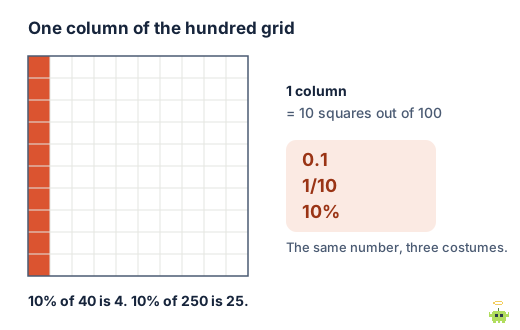
- Minutes 0 to 4: establish the whole. The grid is 100 squares. Percent means “out of a hundred”, and that is all the word means. So 100% is the entire grid. Then say it about real things until it is boring: 100% of your dinner is your dinner, 100% of 40 is 40, 100% of the money in your pocket is the money in your pocket. Do not move on until this is funny to them.
- Minutes 4 to 9: teach 10%, and only 10%. Shade one column. That is ten squares out of a hundred, which is 10%. Ten percent of 40 is 4. Ten percent of 60 is 6. Ten percent of 250 is 25. The move is: knock the last digit off, or divide by ten. Do eight of these until it is instant, because everything after this is built from it.
- Minutes 9 to 15: build everything else from 10%. This is the actual method and it is how adults work out a tip in a restaurant. 30% is three lots of 10%. 5% is half of 10%. 15% is 10% plus 5%. 70% is seven lots. Do 30% of 40, then 5% of 40, then 15% of 40, on paper, showing the steps. The child who could not do 10% ten minutes ago can now do 35%.
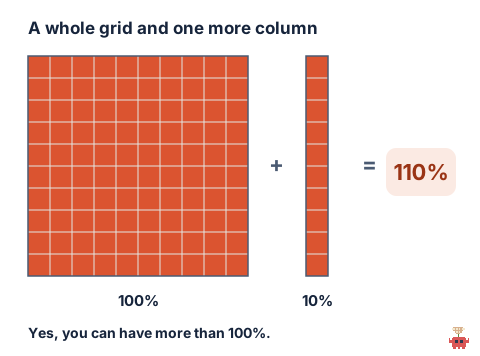
- Minutes 15 to 20: connect the three costumes. Write these three under each other and say they are the same number: 0.1, 1/10, 10%. Then do it for a half: 0.5, 1/2, 50%. Then a quarter. Then, to finish, break the cap: shade a whole grid and one more column, and ask what that is. It is 110%. Yes, you can have more than 100%. That single minute prevents years of trouble.
The thing not to do: do not start with the formula, part over whole times a hundred. It works, it is what most textbooks lead with, and it gives a child a way to produce answers without ever finding out what a percent is. The formula is worth having later, once 100% being the whole thing is obvious rather than surprising.
Three questions that tell you what to do next
Ask these cold, in this order, and stop at the first one that goes wrong.
“What is 100% of 40?”
If it is not instant: start at minute 0. The idea that 100% is everything is missing, and until it is there, nothing else about percentages can be reasoned about, only memorized.
“What is 10% of 40?”
If they freeze but 50% and 25% are fine: this is the common case. They have two memorized words and no method. Minutes 4 to 15 above is exactly the lesson, and it usually holds the first time.
If 10% is also fine but 30% is not: they have the unit and not the building. Spend the whole twenty minutes on minutes 9 to 15, doing nothing but combining lots of 10%.
“Can something be more than 100%?”
If they say no: worth fixing today even if everything else was right, because it is invisible and expensive. A child who believes percent is capped at 100 cannot make sense of a price rising 20%, a population growing 150%, or any interest calculation. The repair is one minute with the grid and one extra column.
If they say yes but cannot give an example: give them one. Something that doubles has grown by 100% and is now 200% of what it was. Say it once, with the grids on the table.
Where this sits in what schools teach
In the US standards, percent arrives with the ratio work in grade 6, and is used hard in grade 7, where the standard asks children to use proportional relationships to solve multistep ratio and percent problems.
Two things follow from that placement, and both are useful to know.
Percent is officially a ratio topic, not a new kind of number. It sits in the same domain as unit rates and proportional relationships, which is the curriculum saying exactly what the reteach above says: a percent is a comparison to a hundred, not a species of its own.
The prerequisites are grade 5, not grade 6. Percent leans on fractions and decimals being solid. If your child cannot find a quarter of a number, or thinks 0.45 is bigger than 0.5, fix those first. Percentages will not stick on top of either gap, and both of them are twenty-minute repairs.
There is one more thing waiting in grade 7 that catches adults too, so it is worth naming early. A price goes up 20% and then down 20%, and it is not back where it started: it is at 96%, because the second percent was taken from a bigger number. The way to make that obvious rather than mysterious is to treat percent change as multiplying, which is covered in the grade 7 math guide. For where the groundwork sits, see the grade 6 guide.
The short version
Ask what 100% of 40 is. If there is a pause, the problem is not percentages, it is that percent has never been connected to the idea of a whole.
Draw a hundred-square. Establish that the whole grid is 100%. Teach 10% and nothing else until it is instant, then build 30%, 5% and 15% out of it, which is how adults actually calculate. Finish by writing 0.1, 1/10 and 10% under each other, and by shading one column past the end of the grid so your child sees with their own eyes that 110% is a real thing.
Sprout Lessons builds standards-aligned lessons for grades K–12, including targeted practice on percentages. Start free.
FAQ
How do I tell whether my child understands percentages?
Ask what 100% of 40 is. A child who understands says 40 instantly and looks at you as though it were a trick question. A child who does not will pause, start calculating, or ask for a pen. That pause is the diagnosis: if 100% of something is not obviously the something, then percent is not yet a way of describing part of a whole, it is just a symbol that turns up in certain questions.
Why can my child do 50% and 25% but not 10%?
Because 50% and 25% are vocabulary rather than arithmetic. Children hear fifty percent off means half price and twenty-five percent means a quarter, constantly, from an early age, and store them as word meanings. Nothing about 10% is harder than 25%, so if 25% is fine and 10% is impossible, no calculating is happening at all: two words have been memorized and there is no method underneath them.
What is the easiest way to teach percentages at home?
Teach 10% first and build everything else from it, which is how adults actually calculate a tip. Ten percent is divide by ten. Then 30% is three lots of it, 5% is half of it, and 15% is 10% plus 5%. Do not start with the formula of part over whole times a hundred: it produces correct answers while letting a child avoid ever finding out what a percent is. The formula is worth having later.
My child says you cannot have more than 100%. Does that matter?
Yes, and it is worth fixing today because it is invisible and expensive. A child who believes percent is capped at 100 cannot make sense of a price rising 20%, a population growing 150%, or any interest calculation, and the belief sounds like common sense so nobody challenges it. The repair takes one minute: shade a full hundred-grid and one extra column, and ask what that is.
What should my child know before starting percentages?
Fractions and decimals need to be solid, because percent is built on both. If your child cannot find a quarter of a number, or thinks 0.45 is bigger than 0.5, fix those first, because percentages will not stick on top of either gap. Both are twenty-minute repairs. In the US standards percent arrives with the ratio work in grade 6 and is used heavily in grade 7.