
Your child is reading the digits after the decimal point as an ordinary whole number. Forty five is bigger than five, so 0.45 must be bigger than 0.5. That is the entire problem, and it is the most common single error in elementary math. It is not carelessness and it is not a gap in effort. It is a rule that has worked perfectly for four years being applied one step past where it stops working.
What it looks like at the kitchen table
Ask which is bigger, 0.5 or 0.45, and you get 0.45, said with confidence. The same child will tell you 0.29 beats 0.3, and that 0.100 is larger than 0.99.
Two more that come from the same place, and are worth listening for because they tell you how deep it goes:
- Ask what comes between 3.9 and 4 and you get “3.10”. The child is counting the right-hand side as a separate number that ticks over after 9.
- Ask them to read 0.34 aloud and you get “zero point thirty-four”. That sounds harmless and it is the misconception in the child’s own voice: thirty-four is a whole number, and saying it that way rehearses the wrong idea every single time.
Here is the check that shows it is not a fluke. Ask the same child which is more money, 45 cents or 50 cents. They will get it right instantly. They are not confused about size. They are confused about notation.
Why the wrong rule survives so long
Two reasons, and the second one is the one nobody warns you about.
First, the rule has never been wrong before. From kindergarten to grade 3, more digits genuinely does mean a bigger number, every time, with no exceptions. 45 beats 5. 450 beats 45. A child who generalizes that is doing exactly what we want children to do with patterns. Decimals are the first place the pattern breaks.
Second, most practice quietly hides the problem. Look at a page of decimal comparisons and you will usually find the pairs have the same number of digits: 0.34 against 0.29, 0.71 against 0.68. A child using the wrong rule gets every one of those right, because when the number of places matches, comparing the digits as whole numbers happens to give the correct answer. They can score full marks for a year with the misconception completely intact.
This is why it often surfaces late, in grade 5 or 6, looking like a sudden collapse in a child who was previously fine. Nothing collapsed. The first mixed-length comparison finally appeared.
The reteach, in twenty minutes
You need paper with a hundred-square grid on it, twice. Draw two 10 by 10 boxes if you do not have printed ones. Do not start with money, for a reason that comes at the end.
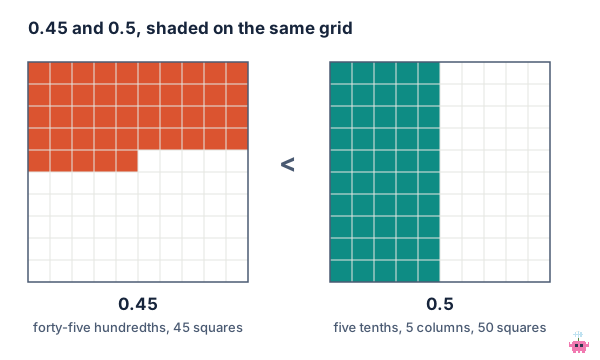
- Minutes 0 to 6: shade both. On the first grid, shade 0.45, which is 45 of the 100 squares. On the second, shade 0.5, and here is the whole lesson: 0.5 is five tenths, so it is five whole columns, which is 50 squares. Put the two grids side by side and say nothing. Let them look. The child who was certain about 0.45 will usually go quiet at this point, which is the sound of it working.
- Minutes 6 to 11: say them properly. Not “zero point forty-five” but “forty-five hundredths”, and not “zero point five” but “five tenths”, and then “fifty hundredths”. Said in those words, forty-five against fifty is not a comparison a nine-year-old needs help with. Being able to switch between “five tenths” and “fifty hundredths” is close to a proof they have understood, and it costs a minute a day to keep.
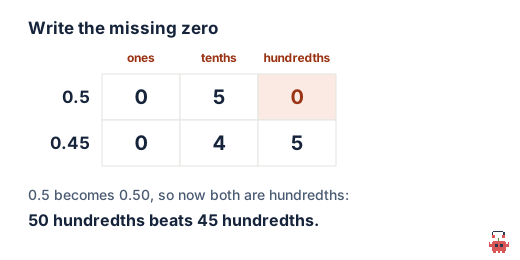
- Minutes 11 to 16: teach the one move. Make the number of places match, by writing the missing zero. 0.5 becomes 0.50. 0.3 becomes 0.30. Now the old whole-number instinct gives the right answer, which is fine: you are not trying to delete the instinct, you are giving it a legal way to run. Practice on 0.3 against 0.29, 0.6 against 0.60, 0.7 against 0.65.
- Minutes 16 to 20: a deliberately unfair mixed set. Eight comparisons where the number of places is different every time. This is the set that would have caught it a year ago, and it is the set to come back to in a week.
Now the warning about money. Money is the obvious tool and it half works. Every child gets 45 cents against 50 cents right, so it is a great confidence start. But money always has exactly two decimal places, and that quietly teaches “decimals have two digits”, which is precisely the belief you are trying to remove. Use money for the first two minutes to prove they already understand the size question, then put it away and use the grid.
Three questions that tell you what to do next
Ask these cold, in this order, and stop at the first one that goes wrong. Each wrong answer points somewhere different.
“Which is bigger, 0.5 or 0.45?”
If they say 0.45: this is the main misconception and the twenty minutes above is the fix. Nothing else is wrong.
If they say 0.5 but slowly, or count on their fingers: they have a rule they do not trust. Do the grid anyway, once. They need to see it, not be told again.
“Write 0.5 with two digits after the point.”
If they write 0.05: stop, and go back further. They are reading digits rather than positions, and the zero is not doing a job in their head. Spend a session on tenths and hundredths with the grid before touching comparisons again.
If they cannot write anything: same answer. This is the real prerequisite, and it is a week of work, not twenty minutes.
“What number is between 3.9 and 4?”
If they say 3.10: this is a related but separate repair. They think the decimal point separates two whole numbers, so the right-hand side rolls over after 9. The tool here is a number line rather than a grid: draw 3.9 and 4, ask what sits between them, and keep going until 3.95 arrives.
If they say there is nothing between them: same repair, and it is worth doing, because it is also the belief that makes decimals feel like a separate number system rather than a zoom-in on the one they already know.
Where this sits in what schools teach
This is a grade 4 topic in the US standards, and the standard that covers it is unusually blunt about the problem. It asks children to compare two decimals to hundredths by reasoning about their size and to justify the conclusions by using a visual model.
That phrase about the visual model is not a teaching suggestion, it is the point. The people who wrote the standard knew that a child can produce correct comparisons from a rule while believing something false, and that the only reliable way to tell the difference is to make them show it. The shaded grid you did above is that model.
If your child is past grade 4, this is still the right repair and it is worth doing at any age. Decimals sit underneath fractions-to-decimals conversion, percentages, and every measurement problem after grade 5, so a gap here compounds quietly rather than staying put. Twenty minutes now genuinely does save a year of confusion later.
For where it lands in the year, see the grade 4 math guide, and for what it is holding up next, the grade 5 guide, where decimals and fractions take over the year. If percentages are the thing currently going wrong, that has its own root cause: see why percentages are not landing.
The short version
Your child is comparing 45 with 5 instead of comparing forty-five hundredths with fifty hundredths. Shade two hundred-grids, say the numbers in tenths and hundredths out loud, teach the one move of writing the missing zero, and finish on a mixed set where the number of places keeps changing.
It is twenty minutes, it is not a sign of anything worrying, and the reason it lasted this long is that most worksheets are accidentally designed to let it survive.
Sprout Lessons builds standards-aligned lessons for grades K–12, including targeted practice on exactly this. Start free.
FAQ
Why does my child think 0.45 is bigger than 0.5?
They are reading the digits after the decimal point as an ordinary whole number, and 45 is bigger than 5. It is not carelessness. From kindergarten to grade 3, more digits genuinely does mean a bigger number, every time, with no exceptions, so a child who generalizes that is doing exactly what we want with patterns. Decimals are the first place the pattern breaks.
Why did nobody catch this earlier?
Because most decimal practice hides it. Look at a page of comparisons and the pairs usually have the same number of digits, like 0.34 against 0.29. A child using the wrong rule gets every one of those right, because when the number of places matches, comparing the digits as whole numbers happens to give the correct answer. They can score full marks for a year with the misconception completely intact, which is why it often surfaces in grade 5 or 6 looking like a sudden collapse.
Should I use money to teach decimals?
For about two minutes, then stop. Every child gets 45 cents against 50 cents right, so it is a great way to prove they already understand the size question and are only confused by notation. But money always has exactly two decimal places, which quietly teaches that decimals have two digits, and that is precisely the belief you are trying to remove. Switch to a shaded hundred-square grid.
My child says 3.10 comes between 3.9 and 4. What does that mean?
It is a related but separate repair. They think the decimal point separates two whole numbers, so the right-hand side rolls over after 9 the way a counter does. The tool here is a number line rather than a grid: draw 3.9 and 4, ask what sits between them, and keep going until 3.95 arrives. The same belief is why some children say nothing at all sits between them.
Why does my child read 0.34 as zero point thirty-four?
It sounds harmless and it is the misconception in the child’s own voice: thirty-four is a whole number, so saying it that way rehearses the wrong idea every single time. Insist on zero point three four, and separately on the place value reading of thirty-four hundredths. Switching between those two readings on demand is one of the clearest signs the idea has actually landed.
What grade does this belong to, and does it matter if my child is older?
It is a grade 4 topic in the US standards, and the standard is unusually blunt: it asks children to compare decimals by reasoning about their size and to justify the conclusion using a visual model. That phrase is the point, because a child can produce correct comparisons from a rule while believing something false. It is worth repairing at any age, since decimals sit underneath percentages and every measurement problem after grade 5, so the gap compounds rather than staying put.