
Fingers are not the problem. What the fingers are doing is the thing to check, and it takes one question: ask your child for 8 + 6 and watch. If they hold up eight fingers, then six more, run out of hands and start again from one, that is a child who has not yet learned to count on. If they say “eight” and put up six fingers for nine, ten, eleven, twelve, thirteen, fourteen, they are using fingers well. If they say “eight and two is ten, and four more”, they no longer need them, whether or not the hands still twitch.
Those three children are at three different points on a ladder the Common Core spells out across kindergarten to grade 2, and only one of them needs anything from you. This page shows the ladder, what the research published in 2025 says about stopping finger use too early, the one wrong answer that gives a finger counter away, and a five-question check you can do at the kitchen table.
The standards name fingers on purpose
Plenty of parents are told, or assume, that counting on fingers is something to stamp out. The kindergarten standard says the opposite. K.OA.A.1 reads:
“Represent addition and subtraction with objects, fingers, mental images, drawings, sounds (e.g., claps), acting out situations, verbal explanations, expressions, or equations.”
Fingers are the second item on that list. Grade 1 then names the next step, in 1.OA.C.5: “Relate counting to addition and subtraction (e.g., by counting on 2 to add 2).” And the deadline for leaving fingers behind for single digits is written into grade 2. 2.OA.B.2 says:
“Fluently add and subtract within 20 using mental strategies. By end of Grade 2, know from memory all sums of two one-digit numbers.”
So the standards expect fingers in kindergarten, expect counting on in grade 1, and expect memory by the end of grade 2. A six-year-old on their fingers is on schedule. A nine-year-old who still needs fingers for 7 + 5 is the case worth acting on, and even then the fingers are a symptom rather than the cause.
What the research says, and the teachers who disagree
Two studies from the same Swiss and French research group are worth knowing about, because they are the strongest evidence a parent is likely to meet on this question.
- Teaching fingers helps. Poletti and colleagues, in Child Development (2025), trained 328 kindergarteners who did not use their fingers to use them. On the addition test, the trained group went from 37.3% accurate to 77.1%. A control group that got no training went from 39.6% to 47.8% over the same period. The effect held when the researchers repeated it with a smaller group and again against an active control.
- The children who do best later used fingers first. Krenger and Thevenot, in Developmental Psychology (2025), followed 192 children from age 4½ to 7½, testing every six months. Virtually all of them used fingers at some point. By 6½ most of the children who did not use fingers were ex-finger users, and they outperformed both the children still on their fingers and the children who had never used them.
The same paper cites a survey in which 20% of French kindergarten teachers, and 30% of grade 1 teachers, saw finger use as a sign that a child struggles with math. That gap between research and classroom belief is why so many parents hear “stop using your fingers” at a parent teacher conference. The research reading is that fingers are a scaffold: used, then outgrown, not skipped. Banning them early removes the step that the best performers went through.
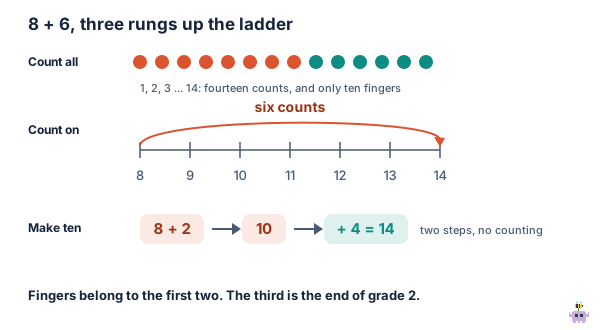
The ladder: which rung is your child on?
- Count all. 8 + 6: count out 1 to 8, count out 1 to 6, then count everything from 1 to 14. Fourteen counts, and with only ten fingers it falls apart above ten. Normal in kindergarten.
- Count on from the first number. Say 8, count six more. Six counts. This is 1.OA.C.5.
- Count on from the larger number. For 3 + 8, start at 8 and count three, not at 3 and count eight. That rests on knowing 3 + 8 is the same as 8 + 3, which is the grade 1 standard 1.OA.B.3, apply properties of operations as strategies to add and subtract.
- Use a fact you know. Doubles and near doubles: 6 + 7 is 6 + 6 + 1. Make ten: 8 + 6 is 8 + 2 + 4. Both are named, with those exact examples, in 1.OA.C.6, the grade 1 fluency standard.
- Just know it. 2.OA.B.2, by the end of grade 2.
The rung matters far more than whether fingers are visible. A child on rung 4 who taps a finger while thinking is fine. A child on rung 1 who has been told to hide their hands under the table and is now counting dots in their head is not.
The wrong answer that gives a finger counter away
Ask for 8 + 3. A child counting on who has not quite got it will say “eight, nine, ten”, putting up a finger on eight, and answer 10. The answer is always exactly one short, because they counted the starting number as one of the three.
This is the most useful error on the whole topic, because it is consistent: the same child makes it on 5 + 4 (says 8), on 9 + 2 (says 10), on every sum. It is also the one that a “stop using your fingers” instruction cannot fix, since the same off-by-one happens in their head. The fix is to say the first number with closed hands, then count the fingers going up: “eight (fist), nine (one), ten (two), eleven (three).” Two or three days of that and it is gone.
The subtraction twin is 12 − 3 answered as 10: “twelve, eleven, ten”, again counting the starting number. Same fix.
The five-question check
Do these in order, out loud, no paper. You are watching the method, not marking the answer.
- 10 + 4. Should be instant. If your child counts on from 10, or worse counts from 1, the gap is place value, not addition. A teen number is a ten and some ones (the kindergarten standard K.NBT.A.1 uses 18 = 10 + 8 as its example), and no amount of finger practice reaches that.
- 8 + 3. Watch for the off-by-one above. An answer of 10 is the diagnosis.
- 3 + 8. Do they start at 3 and count eight, or start at 8 and count three? Starting from the larger number means they understand that order does not matter.
- 6 + 6, then straight away 6 + 7. A child on rung 4 uses the first to get the second. A child who counts on from 6 again for the second has the double but not the idea of using it.
- 8 + 6. Ask afterwards, “how did you get that?” “I made a ten” is the target. “I counted” is fine before grade 2 and the thing to work on after it.
Reading it: a miss on question 1 sends you to place value. An off-by-one on 2 is a three-day fix. Counting all on question 5 in grade 2 or later is the real gap, and it is a strategy gap rather than a memory one, which is why flash cards on their own rarely close it.
Want a lesson pitched at the rung your child is on? Sprout builds a make-ten or doubles lesson from 1.OA.C.6, with the standard in the footer, around whatever your child is into. Try it free.
What to actually do
- Do not ban fingers. The research above is about as clear as education research gets. Banning them before a child has something better to use pushes the counting out of sight, where you can no longer see the errors.
- Teach the closed-fist start. Say the first number with no fingers up, then count the second number on fingers. This kills the off-by-one and is counting on, which is the grade 1 standard.
- Work the pairs that make ten until they are instant. 1 and 9, 2 and 8, 3 and 7, 4 and 6, 5 and 5. Kindergarten names this skill too (K.OA.A.4, find the number that makes 10). Hold up some fingers and ask how many are down. Make ten is impossible without these.
- Then teach the doubles. 1 + 1 to 10 + 10. Children usually find these easier than other facts, and once they are known, every near double (6 + 7, 8 + 9) is one step away.
- Use a ten-frame. Two rows of five boxes, drawn on paper. Eight counters leave two empty, which is where the 2 in 8 + 2 + 4 comes from. It is a picture of the make-ten strategy, and it is also exactly the shape of two hands.
- Five minutes a day, not thirty on Saturday. Facts move from strategy into memory through frequent short retrieval. Ten sums in the car beat a worksheet.
When it is worth a closer look
- Counting all, from 1, in grade 2 or later. That is two rungs behind where the standards put them. Work on counting on first, not on memorising.
- 10 + 4 is not instant by the end of grade 1. That points to place value, which is a different problem and the foundation for everything with two digits.
- No progress after six weeks of short daily practice. Most children move a rung in that time. If yours has not, that is worth raising with your pediatrician or a learning specialist, because persistent difficulty with number facts is one of the patterns professionals screen for.
What is not a reason to worry: fingers in kindergarten or grade 1, an off-by-one error, a child who taps a finger while clearly using a strategy, or a child who is slower than a sibling. Slow and correct with a strategy beats fast and guessing every time.
Where this sits
The grade guides that carry these standards in full:
- Kindergarten math, where fingers are written into the standard
- Grade 1 math, counting on and making ten
- Grade 2 math, where the facts move into memory
If the trouble shows up later, these pick up the same thread: subtraction with regrouping, times tables and catching up in twenty minutes a night.
The short version
Fingers are written into the kindergarten standard, counting on into grade 1, and knowing single digit sums from memory into the end of grade 2. Before then, fingers are on schedule.
The 2025 research says children who use fingers early and then drop them do best, better than children who never used them. Banning fingers early removes the scaffold.
Check the method, not the hands: does your child count all, count on, or make ten? Watch 8 + 3 for the off-by-one answer of 10, and fix it with a closed-fist start.
Sprout Lessons builds standards-aligned lessons for grades K–12, with the standard on every lesson. Start free.
How this page was checked
Standard wording was read from our copy of the Common Core dataset on 1 October 2026, not written from memory. The research figures come from the published papers: Poletti et al., Finger counting training enhances addition performance in kindergarteners (Child Development, 2025) and Krenger and Thevenot, The Role of Children’s Finger Counting History on Their Addition Skills (Developmental Psychology, 2025). Both samples were mainly White European children, in France and Switzerland.
Read the official standards at the Common Core operations and algebraic thinking standards. Common Core State Standards © 2010 National Governors Association Center for Best Practices and Council of Chief State School Officers. All rights reserved. This product is not endorsed by NGA/CCSSO. Not every state uses Common Core and some sequence these topics differently: check your state department of education for the standards that apply to you.
FAQ
Is it bad for my child to count on their fingers?
No, not in kindergarten or grade 1. The Common Core kindergarten standard K.OA.A.1 lists fingers by name as a way to represent addition and subtraction. A 2025 study in Child Development trained 328 kindergarteners who did not use their fingers to use them, and their addition accuracy rose from 37.3% to 77.1%, against 39.6% to 47.8% for a control group.
When should a child stop counting on fingers?
For sums of two single-digit numbers, by the end of grade 2. The standard 2.OA.B.2 reads: by end of Grade 2, know from memory all sums of two one-digit numbers. Grade 1 asks for counting on and strategies such as making ten. Before the end of grade 2, fingers are on schedule.
Why does my child get answers that are one too small when counting on?
They are counting the starting number. For 8 plus 3 they say eight, nine, ten with a finger up on eight, and answer 10. The error is consistent, so it is easy to fix: say the first number with a closed fist, then put up a finger for each number after it. Eight (fist), nine, ten, eleven.
Should I tell my child to stop using their fingers?
No. A 2025 study in Developmental Psychology followed 192 children from age 4.5 to 7.5 and found that children who used fingers and then stopped outperformed both those still using them and those who never had. Banning fingers before a child has a better strategy pushes the counting out of sight. Teach counting on, pairs that make ten and doubles, and the fingers drop away on their own.
How do I help my child move beyond finger counting?
Teach the closed-fist start for counting on, then the pairs that make ten (1 and 9, 2 and 8, 3 and 7, 4 and 6, 5 and 5), then doubles, then near doubles such as 6 plus 7 as 6 plus 6 plus 1. Use a drawn ten-frame. Five minutes a day works better than a long weekly session.