
Your child does not have 144 facts to learn. By the time you strip out everything they already know or can get another way, there are ten left. Ten. And they are the same ten for almost every child, which is why the ones that stick are so predictable: 6 × 7, 7 × 8, 6 × 8.
The reason times tables feel like an enormous undifferentiated wall is that they are usually presented as one. A 12 by 12 grid is 144 boxes, all apparently equal, all apparently requiring memorization. Almost none of that is true, and one part of it is not even in the standards.
Start by deleting the 11s and 12s
The grade 3 standard says: “By the end of Grade 3, know from memory all products of two one-digit numbers.”
One-digit. Zero through nine. The 11 and 12 times tables are not in Common Core at all. They are a British inheritance that arrived with the phrase “times tables” and stayed, and a great many American families are drilling 24 columns of a grid where the standard asks for a hundred products and a lot of those are trivial.
If your child is stuck and you are working to 12, stop at 9 today. It removes a fifth of the material before you do anything else, and nothing downstream depends on it.
How 144 becomes 10
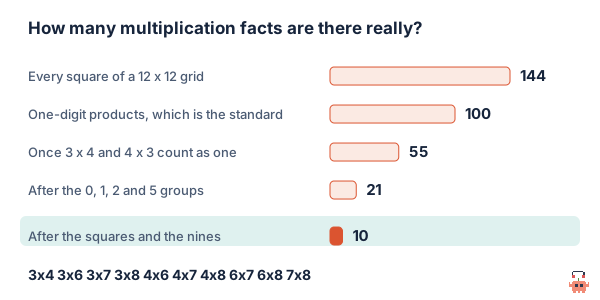
- 144 becomes 100. One-digit products only, per the standard.
- 100 becomes 55. Multiplication is commutative, so 3 × 4 and 4 × 3 are one fact, not two. This is itself a grade 3 standard and it halves the grid. Many children have never been told it, and quietly learn each product twice.
- 55 becomes 21. Take out the ×0 and ×1 groups, which are rules rather than facts. Take out ×2, which is doubling, something your child could do before they met multiplication. Take out ×5, which children get from counting by fives and from clock faces.
- 21 becomes 15. The squares: 3 × 3, 4 × 4, 6 × 6, 7 × 7, 8 × 8, 9 × 9. Learn these as a set, because they behave like a set and children find them satisfying.
- 15 becomes 10. The nines have a reliable pattern: the digits of every answer add to nine, and the tens digit is always one less than the number you multiplied by. 7 × 9 is 63, and 6 is one less than 7, and 6 plus 3 is 9.
The ten that are left: 3×4, 3×6, 3×7, 3×8, 4×6, 4×7, 4×8, 6×7, 6×8, 7×8.
Every one of them is a combination of 3, 4, 6, 7 and 8. There is no shortcut for these and there is no pattern to lean on, which is precisely why they are the ones your child cannot do. They are the actual work, and they are ten facts, which is two weeks rather than a year.
Why the wall feels bigger than it is
Three things make an easy problem look impossible, and all three are things adults do with the best intentions.
- Practicing all of them equally. A worksheet with a random mix spends most of its questions on facts your child already knows, which feels like work and teaches nothing. The ten hard ones get a couple of appearances each.
- Testing under time pressure before the facts exist. A timed test measures recall. If the fact is not yet in there, the test measures anxiety instead, and for a child who is already struggling it reliably makes recall worse.
- Treating it as memorization only. The standard actually asks the child to multiply and divide fluently within 100 “using strategies such as the relationship between multiplication and division… or properties of operations”, and only then to know the one-digit products from memory. The strategies are named first, and they are how the memory gets built.
The fix, which takes about two weeks
- Make the ten visible. Write them on a card. Ten facts on one card is a completely different psychological object from a 144-square grid, and children respond to it immediately, often with visible relief.
- Build each hard one off a neighbor they have. 6 × 7 is 5 × 7 plus 7, and they already have 5 × 7. 4 × 8 is double 2 × 8. This is the “properties of operations” clause of the standard, and it turns an unknown fact into a two-second calculation, which is what recall grows out of.
- Practice only the ten. Two or three minutes a day, on those facts and nothing else. Add a known fact occasionally so it is not relentless, but do not go back to the mixed worksheet.
- Say the division out loud with every one. 6 × 7 is 42, so 42 ÷ 7 is 6 and 42 ÷ 6 is 7. The standard pairs multiplication and division fluency in the same sentence for a reason, and doing it this way means your child is not later told that division facts are a new topic.
- Stop timing until the facts are in. Then time them if you want to, and it will be a pleasant experience rather than the thing that made your child decide they are bad at math.
Three questions that tell you where you actually are
- Ask 4 × 3, then immediately 3 × 4. If the second one takes any longer than the first, your child does not have commutativity, and they are trying to memorize twice as many facts as exist. That single conversation can halve the remaining work.
- Ask 6 × 7, and if it is wrong, ask 5 × 7. If 5 × 7 comes straight back, the problem is not memory, it is that nobody showed them how to get from a fact they have to a fact they do not.
- Ask 42 ÷ 6. A child who knows 6 × 7 and cannot do 42 ÷ 6 has been taught the two as unrelated topics. It is a five-minute repair now and a large problem later, because fractions and division fluency sit on it.
Where this sits in what schools teach
The whole of it is one grade 3 standard, and it is worth reading closely because it does more than most people notice. It asks for fluent multiplication and division within 100, names strategies as the route, and then sets the memory requirement at one-digit products by the end of grade 3.
What sits on top of it is the reason to fix this rather than work around it. Grade 4 asks for factor pairs and for prime and composite numbers, both of which are unreachable without recall. Grade 4 and 5 division leans on it entirely. Fraction equivalence needs it. A child still counting on their fingers for 6 × 7 in grade 5 is not behind on one topic, they are paying a tax on every piece of mathematics they attempt.
Which is the argument for spending two weeks on ten facts rather than a year on a grid.
The short version
The 11s and 12s are not in the standards, so stop at 9. Commutativity halves what is left. The 0s, 1s, 2s and 5s are rules or things your child could already do. The squares learn as a set and the nines have a pattern.
That leaves ten: 3×4, 3×6, 3×7, 3×8, 4×6, 4×7, 4×8, 6×7, 6×8, 7×8. Write them on a card, build each one off a fact your child already has, practice those and nothing else for two or three minutes a day, and say the division out loud every time.
If your child is behind more broadly rather than stuck on this, the twenty-minutes-a-night path is the wider plan.
Sprout Lessons builds practice around whatever your child is already into, which makes ten facts two weeks rather than a fight. Start free.
Standard wording in this guide was taken from our copy of the Common Core dataset, accessed 2026-07-16, not written from memory. Read the official text at the Common Core mathematics standards. Common Core State Standards © 2010 National Governors Association Center for Best Practices and Council of Chief State School Officers. All rights reserved. This product is not endorsed by NGA/CCSSO. Not every state uses Common Core: check your state department of education for the standards that apply to you.
FAQ
How many multiplication facts does my child actually have to memorize?
Ten, once you strip out everything they already know or can get another way. Start from 144 in a 12 by 12 grid, drop to 100 because the standard asks only for one-digit products, halve that to 55 because 3 x 4 and 4 x 3 are one fact, remove the 0s, 1s, 2s and 5s to reach 21, remove the six squares to reach 15, and remove the nines with their digit pattern to reach 10. The survivors are 3x4, 3x6, 3x7, 3x8, 4x6, 4x7, 4x8, 6x7, 6x8 and 7x8.
Do I need to teach the 11 and 12 times tables?
Not for Common Core. The grade 3 standard sets the memory requirement at all products of two one-digit numbers, which is zero through nine, so the 11s and 12s are not in the standards at all. They are a British inheritance that arrived with the phrase times tables and stayed. Nothing later in the curriculum depends on them, so if your child is struggling, stopping at nine removes a fifth of the material for free.
Why is 7 x 8 always the hard one?
Because the ten facts that survive every shortcut are all combinations of 3, 4, 6, 7 and 8, and 6x7, 6x8 and 7x8 are the largest of them. They have no pattern to lean on, no doubling route and no finger trick, so they are pure recall with the least support. That they are hard is not a sign your child is bad at math; it is the predictable shape of what is left after every other fact has been handled by a rule.
Why do mixed times tables worksheets not seem to help?
Because a random mix spends most of its questions on facts your child already knows, which feels like work and teaches nothing, while the ten hard ones get a couple of appearances each. Practise only the ten, for two or three minutes a day, adding a known fact occasionally so it is not relentless. Volume on the whole grid is the single most common way families spend a year on what should take two weeks.
Should I use timed tests?
Not until the facts are actually in there. A timed test measures recall, so if the fact has not been built yet the test measures anxiety instead, and for a child who is already struggling that reliably makes recall worse. Build the facts first with strategies, then time them if you want to, at which point it becomes a pleasant experience rather than the thing that convinced your child they are bad at math.
Why does this matter beyond grade 3?
Because almost everything sits on it. Grade 4 asks for factor pairs and for prime and composite numbers, neither of which is reachable without recall. Grade 4 and 5 division depends on it entirely, and so does fraction equivalence. A child still counting on their fingers for 6 x 7 in grade 5 is not behind on one topic, they are paying a tax on every piece of mathematics they attempt, which is the argument for spending two weeks on ten facts rather than a year on a grid.