
Read the problem out loud to them. That is the whole first test. If your child solves it the moment they hear it, the arithmetic was never the issue and you have a reading problem wearing a math problem’s clothes. A great many children who look stuck on word problems are in exactly this position, and no amount of extra math practice touches it.
If they still cannot do it when you read it aloud, you have one of two other problems, and they need completely different responses. It takes about ten minutes to find out which.
The three problems that look identical
1. They cannot get through the sentence
You read it, they solve it. Diagnosis complete. The math is fine and the reading is the blocker, which is worth knowing because it means the fix is not in the math book at all. If reading aloud is fluent but nothing comes back, the underlying issue is comprehension rather than decoding, and reads fluently but does not understand is the page for it.
2. They understood it and picked the wrong operation
They can tell you what is going on and they still wrote the wrong number sentence. This is the most common of the three, and it is almost always caused by something they were explicitly taught. More on that below, because it deserves its own section.
3. They never built a picture of the situation
Ask them to tell you what is happening in the problem, without doing any math and without using any of the numbers. Just the story. If they cannot retell it, they were never modeling a situation, they were scanning for numbers and an operation to put between them.
This one is the most fixable and the most invisible, because a child doing it can get a decent proportion of problems right by pattern matching, right up to the point where the problems get harder.
The thing that causes most of it: keyword rules
Somewhere your child was taught that certain words tell you which operation to use. Altogether means add. Left means subtract. Each means multiply. Share means divide. It is taught almost everywhere, it produces correct answers for a year or two, and it is the single biggest cause of wrong-operation errors after that.
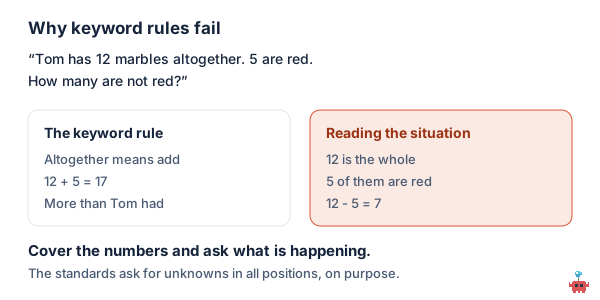
Here is the failure in one line: “Tom has 12 marbles altogether. 5 of them are red. How many are not red?” The word altogether is right there and the answer is a subtraction. A child running the keyword rule writes 12 + 5 and gets 17, which is more marbles than Tom has, and does not notice, because the rule replaced thinking rather than supporting it.
This is not an accident of that one problem. The grade 2 standard for addition and subtraction asks for one- and two-step word problems involving adding to, taking from, putting together, taking apart and comparing, “with unknowns in all positions”. Unknowns in all positions is the phrase that matters. It means the missing number is deliberately not always at the end, which is exactly the design that defeats keyword strategies. Whoever wrote the standards knew about the shortcut and wrote requirements that break it.
The reteach, in about fifteen minutes
The whole repair is one habit: understand the situation before touching the numbers. Three steps, and they work from about grade 2 upward.
- Cover the numbers. Literally, with your thumb or a sticky note. Read the problem with the numbers hidden and ask: what is happening here? Who has what? Is something being combined, or taken apart, or compared? A child cannot run a keyword rule on a problem with no numbers in it, so they have to build the model, which is the thing you are actually training.
- Ask bigger or smaller before you ask how much. Will the answer be more than 12 or less than 12? This one question catches nearly every wrong-operation error before it is written down, and it takes three seconds. It also builds the estimation habit that makes a 17-marbles answer feel wrong.
- Have them draw it, and not as a picture. Not twelve marbles. One bar with 12 written above it, a chunk of it labeled 5, and a question mark on the rest. The grade 3 multiplication and division standard asks students to solve word problems “by using drawings and equations with a symbol for the unknown number”, so the drawing is not a crutch you are adding. It is written into the standard.
Then, and only then, uncover the numbers and write the equation. Most children who have been pattern matching find the first two or three of these genuinely uncomfortable and then find them obvious, which is what a habit change feels like from the inside.
What not to do
- Do not teach more keywords. It is the intuitive fix and it makes the problem worse, because it adds rules to a child whose difficulty is that they are following rules instead of thinking.
- Do not give more word problems of the same kind. Volume trains the pattern matching. If every problem this week has the unknown at the end, your child will get faster at a strategy that is about to fail.
- Do not read the problem for them every time. Reading it aloud is a diagnostic, not a treatment. If reading is the blocker, fix the reading; do not make yourself a permanent part of the math.
- Do not accept a right answer with no reasoning. Ask why that operation, every time, especially when the answer is correct. A child pattern matching successfully is the one you most want to catch, because they look fine.
Three questions that tell you what to do next
- Can they solve it when you read it aloud? Yes means it is reading, not math. Go and work on reading and stop buying math workbooks.
- Can they retell the story with no numbers in it? No means they are not building a model of the situation, and the cover-the-numbers habit is the entire fix.
- Ask why they chose that operation. If the answer is a word (“it said altogether”) rather than a reason (“because we know the whole and one part”), you have found the keyword rule, and it will keep producing wrong answers until it is replaced rather than patched.
Where this sits in what schools teach
Word problems are not the decoration on top of the arithmetic. They are the standard. Sixteen Common Core math standards from kindergarten through grade 6 explicitly require solving word problems, and the bare calculation is generally the supporting skill rather than the goal. The grade 4 standard asks for multistep word problems using all four operations, “including problems in which remainders must be interpreted”, which cannot be done by any rule at all: whether a remainder means an extra bus, a leftover, or a rounded answer depends entirely on the situation.
That is why this matters more than it looks. A child who computes fluently and cannot model a situation is not slightly behind on one topic. They are missing the part the standards are actually asking for, and it gets steadily more visible from grade 4 onward as the problems become multistep.
The short version
Read the problem aloud. If they can suddenly do it, this was never a math problem, and the fix is in reading. If they still cannot, ask them to retell the story with no numbers, and if that fails too, they have been scanning for numbers rather than picturing a situation.
Then ask why they chose that operation. If the reason is a word, you have found a keyword rule, and keyword rules are the main reason capable children write 12 + 5 = 17 for a problem about 12 marbles.
The repair is one habit and it costs fifteen minutes: cover the numbers, ask whether the answer will be bigger or smaller, draw the relationship rather than the objects, and only then write the equation. If your child is generally behind rather than stuck on this one thing, the twenty-minutes-a-night path is the wider plan.
Sprout Lessons builds word problems around whatever your child is already into, which is the easiest way to get them picturing the situation instead of hunting for keywords. Start free.
Standard wording in this guide was taken from our copy of the Common Core dataset, accessed 2026-07-16, not written from memory. Read the official text at the Common Core mathematics standards. Common Core State Standards © 2010 National Governors Association Center for Best Practices and Council of Chief State School Officers. All rights reserved. This product is not endorsed by NGA/CCSSO.
FAQ
How do I tell whether it is a reading problem or a math problem?
Read the problem out loud to your child. If they solve it the moment they hear it, the arithmetic is fine and reading was the blocker, which matters because the fix is not in the math book at all. This catches a great many children who look stuck on word problems. If reading aloud is fluent but nothing comes back, the issue is comprehension rather than decoding, and that is a different repair again.
Why does my child add when the problem needs subtraction?
Almost always because of a keyword rule they were explicitly taught: altogether means add, left means subtract, each means multiply. Consider the problem Tom has 12 marbles altogether, 5 of them are red, how many are not red. The word altogether is right there and the answer is a subtraction. A child running the rule writes 12 + 5, gets 17, and does not notice that Tom cannot have more marbles than he started with, because the rule replaced thinking rather than supporting it.
Should I just teach my child better keywords?
No, and it is the intuitive fix that makes things worse, because it adds rules to a child whose difficulty is already that they are following rules instead of thinking. The grade 2 standard asks for word problems involving adding to, taking from, putting together, taking apart and comparing, with unknowns in all positions. That last phrase means the missing number is deliberately not always at the end, which is exactly the design that defeats keyword strategies. The standards were written knowing about the shortcut.
What is the cover-the-numbers technique?
Hide the numbers in the problem with your thumb or a sticky note, then read it and ask what is happening: who has what, and is something being combined, taken apart or compared. A child cannot run a keyword rule on a problem with no numbers in it, so they have to build a model of the situation, which is the skill that was missing. Uncover the numbers only after the situation is clear and the drawing exists.
Will more word problem practice fix this?
Not if the practice is more of the same kind, because volume trains the pattern matching. If every problem this week has the unknown at the end, your child gets faster at a strategy that is about to fail. It also does not help to read the problem for them each time: reading it aloud is a diagnostic rather than a treatment. And do not accept a correct answer with no reasoning, because a child pattern matching successfully is the one you most want to catch.
Where do word problems sit in what schools teach?
They are the standard rather than decoration on top of it. Sixteen Common Core math standards from kindergarten through grade 6 explicitly require solving word problems, and the bare calculation is generally the supporting skill. The grade 4 standard asks for multistep word problems using all four operations, including problems in which remainders must be interpreted, which no rule can handle: whether a remainder means an extra bus, a leftover or a rounded answer depends entirely on the situation.