
If your child is in grade 4 or 5, long division is not something the standards ask of them yet. The standard algorithm, the one with divide, multiply, subtract, bring down, first appears in Common Core as a grade 6 standard: “Fluently divide multi-digit numbers using the standard algorithm.”
Grades 4 and 5 ask for something different, and they say so explicitly. Both ask the child to find quotients “using strategies based on place value, the properties of operations, and/or the relationship between multiplication and division” and to “illustrate and explain the calculation by using equations, rectangular arrays, and/or area models.”
Read that twice. The explanation is the standard. Not the answer, and certainly not the algorithm. So a great many families are fighting with a grade 6 procedure two years early, while skipping the two years of reasoning that are supposed to make it survivable.
Why the algorithm fails the way it does
Long division is the only arithmetic procedure that hides place value while you use it. Every other algorithm keeps the columns honest. This one starts by asking “how many times does 6 go into 8?” when the 8 is not an 8. In 856 it is eight hundred.
That produces a predictable set of failures, and you will recognize all of them.
- Digits in the wrong columns, so the answer comes out ten times too big or too small, and your child does not notice.
- Forgetting the order of the steps. Divide, multiply, subtract, bring down is four instructions with no meaning attached, so there is nothing to reconstruct them from when one goes missing.
- No sense of whether the answer is reasonable. Ask whether 856 ÷ 6 is nearer 14 or 140 and you get a shrug, which means every arithmetic slip survives.
- Total collapse when there is a zero in the quotient. The step that has the least meaning is the one that breaks first.
What to do instead: chunking
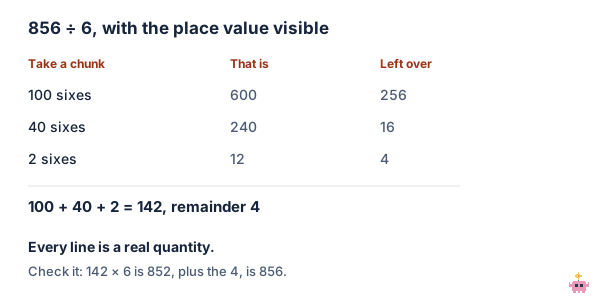
The method has several names, partial quotients or chunking most often, and the question it asks is the honest version of the one the algorithm asks: how many 6s are in 856?
- Take an easy chunk. A hundred 6s is 600. That is comfortably inside 856, so take it. 856 − 600 leaves 256.
- Take another. Forty 6s is 240. 256 − 240 leaves 16.
- And another. Two 6s is 12, leaving 4, which is smaller than 6 so it stops.
- Add the chunks. 100 plus 40 plus 2 is 142, remainder 4.
Three things this gives you that the algorithm does not. Every line is a real quantity, so place value stays visible and an answer of 14 or 1420 is immediately absurd. Any chunk works, so a child who cannot see the 40 can take 10 four times and arrive in the same place, more slowly, correctly. And it is self-checking: 142 × 6 is 852, plus the remainder of 4, is 856.
This is not a lesser method to be replaced later. It is what “strategies based on place value” means, and it is what grade 6 fluency is supposed to be compressed from.
Three questions that tell you where the problem is
- “Roughly how many 6s in 856? More than ten? More than a hundred?” Ask before any calculation. A child who cannot answer has no anchor, and no anchor means no error is ever detected. This alone is worth a week.
- “When you said 6 goes into 8, eight what?” If the answer is “eight”, place value has gone. It is eight hundred, and one hundred 6s is 600, which is exactly the first chunk.
- “What is 42 ÷ 6?” If division facts are not automatic, long division is arithmetic on top of guessing and no method will rescue it. Fix the ten facts first, and say the division out loud with each one.
What not to do
- Do not drill the algorithm harder. A procedure that fails because it has no meaning attached fails faster when repeated, and it takes your child’s confidence with it.
- Do not lean on the mnemonic. Dad, Mother, Sister, Brother encodes the order of the steps and nothing about what any of them means. It is the same failure as keyword rules in word problems: a rule standing in for thinking, and it breaks the moment the problem varies.
- Do not skip the drawing. Both grade standards say illustrate and explain, naming rectangular arrays and area models. The drawing is the requirement, not a scaffold you added for a struggling child.
- Do not move to two-digit divisors early. Grade 4 is one-digit divisors and grade 5 is two-digit. If 856 ÷ 6 is shaky, 856 ÷ 24 is not the next thing to try.
Where this sits in what schools teach
The three standards make the intended sequence unusually clear, and it is three years long.
- Grade 4: up to four-digit dividends with one-digit divisors, using place value strategies, illustrated and explained.
- Grade 5: the same, with two-digit divisors. Still strategies, still illustrate and explain.
- Grade 6: the standard algorithm, fluently. One sentence, no strategies clause, because by then the reasoning is meant to be done and the algorithm is the shorthand for it.
The practical reading: two years of understanding, then the fast method. Teach the fast method in year one and you have not saved two years, you have removed the thing the fast method was going to be built on. It is worth knowing that this is also why the method your child is bringing home may look nothing like the one you were taught. It is not a fad. It is the standard, and the one you were taught is coming, in grade 6.
The short version
The standard algorithm for long division is a grade 6 standard. In grades 4 and 5 the standards ask for place value strategies and for your child to illustrate and explain the calculation, so a struggling grade 4 child is struggling with something they have not been asked for yet.
Use chunking. How many 6s in 856? A hundred of them is 600, forty more is 240, two more is 12, which is 142 with 4 left over. Every line is a quantity your child can point at, any chunk size works, and it checks itself by multiplying back.
Before any of it, ask for an estimate and check that division facts are automatic. Without those two, long division by any method is guessing with extra steps.
Sprout Lessons builds practice around whatever your child is already into, so the division has something in it worth dividing. Start free.
Standard wording in this guide was taken from our copy of the Common Core dataset, accessed 2026-07-16, not written from memory. Read the official text at the Common Core mathematics standards. Common Core State Standards © 2010 National Governors Association Center for Best Practices and Council of Chief State School Officers. All rights reserved. This product is not endorsed by NGA/CCSSO. Not every state uses Common Core, and some state standards introduce the algorithm earlier: check your state department of education for the standards that apply to you.
FAQ
What grade is long division taught in?
The standard algorithm, the one with divide, multiply, subtract, bring down, is a grade 6 standard in Common Core: fluently divide multi-digit numbers using the standard algorithm. Grades 4 and 5 ask for division using strategies based on place value, the properties of operations and the relationship between multiplication and division, with the child illustrating and explaining the calculation. So a grade 4 child struggling with the algorithm is struggling with something the standards do not ask of them for another two years.
Why does my child keep putting the digits in the wrong place?
Because long division is the only arithmetic procedure that hides place value while you use it. It begins by asking how many times 6 goes into 8 when the 8 is not an 8: in 856 it is eight hundred. Every other algorithm keeps the columns honest and this one does not, which is why answers come out ten times too big, why a zero in the quotient causes total collapse, and why the steps are so easy to forget.
What is chunking or partial quotients?
Asking the honest version of the question: how many 6s are in 856? Take an easy chunk, a hundred 6s is 600, leaving 256. Take another, forty 6s is 240, leaving 16. Then two 6s is 12, leaving 4. Add the chunks for 142 remainder 4. Every line is a quantity the child can point at, so place value never disappears and an answer of 14 or 1420 is immediately absurd. It is also self-checking, because 142 times 6 plus 4 is 856.
Is chunking a lesser method that has to be replaced later?
No. It is what strategies based on place value means in the grade 4 and 5 standards, and it is what the grade 6 algorithm is supposed to be a compression of. The intended sequence is two years of understanding and then the fast method. Teaching the fast method in year one does not save two years; it removes the thing the fast method was going to be built on.
Should I use the Dad Mother Sister Brother mnemonic?
It is better avoided. It encodes the order of the steps and nothing about what any of them means, which is the same failure as keyword rules in word problems: a rule standing in for thinking, and it breaks the moment the problem varies. A child who has forgotten a step has nothing to reconstruct it from, whereas a child who knows they are asking how many 6s fit into 856 can rebuild the whole method from that one question.
Why does my child’s method look nothing like the one I was taught?
Because it is the standard rather than a fad. Grade 4 and grade 5 explicitly ask for place value strategies, area models and rectangular arrays, and explicitly ask the child to explain the calculation. The method you were taught is still coming, in grade 6, where the standard is one sentence with no strategies clause at all, because by then the reasoning is meant to be finished and the algorithm is the shorthand for it.