
You write the transcript. You sign it. That is the normal, expected process. The University of Texas at Austin asks homeschooled applicants for a transcript “signed by a school official, defined as the adult person who was primarily responsible for your education”. That is you. There is no accrediting body you have failed to contact and no form you have missed.
Almost all of the anxiety about this document comes from two assumptions that are worth checking early, because both are wrong. The first is that a credit is a fixed, official quantity. The second is that there is a national standard for how many of them your child needs.
What a credit actually is
A credit is a Carnegie Unit, and a Carnegie Unit is a measure of time, not of learning. The Carnegie Foundation describes it as 120 hours of study, a class meeting four or five times a week for 40 to 60 minutes across one school year. It has been the currency of American education since 1906, and it was invented to administer professors’ pensions rather than to describe what a student knows.
The Foundation that created it now argues against it. Its president, Timothy Knowles, has said that “a time-based system of education is at odds with our educational aspirations”, and the Foundation is pursuing a Skills for the Future initiative to replace seat time with demonstrated skills and competencies.
Why this matters to you specifically: you are being asked to record your child’s education in a unit whose own author thinks it measures the wrong thing, and which happens to measure the one variable homeschooling deliberately breaks. A child who covers a year of material in four months has not earned a third of a credit. Count the credit and move on. The hours are a convention for making the document legible, not a claim about your child.
How many credits: there is no national answer
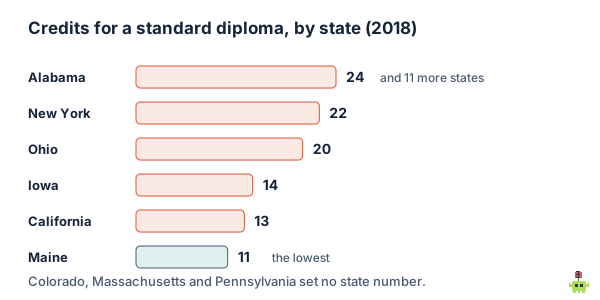
The National Center for Education Statistics recorded state course credit requirements for a standard high school diploma in 2018. The spread is wider than almost anyone expects.
- The range is 11.00 to 24.00 credits. Maine required 11. Twelve states required 24, including Alabama, Florida, New Jersey, Oregon and South Carolina.
- Three states set no number at all. Colorado, Massachusetts and Pennsylvania leave it locally determined.
- Some large states sit near the bottom. California required 13 and Iowa 14, against New York’s 22 and Ohio’s 20.
The important caveat, and it is a big one. Those are requirements for a standard diploma issued by a public school, in the default diploma option, as NCES recorded them in 2018. In most states they do not bind a homeschooling family at all. They tell you what the local benchmark looks like, not what you are required to do. Your own state’s home education law is a separate question, and it is the one that actually applies to you: check what your state requires.
What the spread is genuinely useful for is calibration. A transcript showing 24 credits is not better than one showing 20. If you are within the range of ordinary American high schools, and the four core subjects each run four years or close to it, the document will not raise an eyebrow.
What actually goes on the page
UT Austin’s requirement is a good specification to build to, because it is concrete. The transcript must list “all courses undertaken at each grade level, along with a brief description of the course content and information about the format of the course (in a classroom, online, etc.)”.
Read that as a checklist:
- Student name, date of birth, and your school’s name and address. Give your homeschool a name. It is not pretentious, it makes every form easier to fill in.
- Courses grouped by grade level, with the academic year alongside. Grade level rather than a flat list, because that is what is being asked for.
- Credit awarded and grade earned for each course, plus the format: at home, online, at a community college, in a co-op.
- A short description of each course. One or two sentences. This is where a homeschool transcript beats a school one, because you can say what was actually read and done.
- GPA and the scale you used, stated explicitly. Unweighted is simpler and harder to argue with. If you weight anything, say exactly how.
- Graduation date, your signature, and the date you signed.
Keep it to one page if you can, and put the course descriptions in a separate document if they make it spill over.
What colleges want that is not the transcript
This is where families lose ground, because the transcript is the part everyone worries about and the supporting material is the part that is actually scarce.
- A curriculum description. Stanford tells homeschooled applicants: “In addition to a transcript, we encourage you to submit a detailed description of your curriculum.” Write it as you go. Reconstructing four years of it in the autumn of grade 12 is the single most common regret.
- Recommendations from someone who is not you. Stanford asks for two teacher letters and one counselor letter, and “prefer[s] that teacher recommendation letters come from external instructors who have taught the student in an academic setting. For example, a community college professor.” A parent may stand in for the counselor letter, but not for those. This has a planning consequence years ahead of the application: your child needs at least two adults who have taught them academically and can write about it. Dual enrollment, a co-op class, an online course with a real instructor.
- A diploma. Stanford’s wording is “A high school diploma or the equivalent is required in order to begin classes… We accept any high school diploma recognized by your state.” What counts varies by state, and it is worth knowing your state’s answer before grade 12 rather than during it.
- Test scores, more often than for other applicants. Several universities that are otherwise test-optional still recommend or require scores from homeschooled applicants, precisely because the transcript is parent-issued. Check each institution rather than assuming.
The line worth pinning above the desk
Stanford, on homeschooled applicants: “We are interested in how you have gone about the learning process, not how many courses you have completed.”
That is the reframe. The credit count exists to make your child legible to an admissions system built around seat time. It is necessary and it is not the argument. The argument is the curriculum description, the depth in the subjects your child cared about, and the evidence that they can work without being pushed, which is the thing homeschooling actually produces and no transcript column has a box for.
Five mistakes worth avoiding
- Starting it in grade 12. Everything on the transcript is easy to record as it happens and painful to reconstruct. Open the file in grade 9.
- Inflating grades. A transcript of straight A’s issued by a parent invites exactly the skepticism you want to avoid, and it is why external recommendations and test scores carry extra weight here. Honest variation reads as more credible, not less.
- Inventing course names. Call it Biology, Algebra 2, US History. Save the distinctiveness for the course descriptions, where an admissions reader is actually looking for it.
- Counting hours instead of credits. Record the credit. Nobody is auditing your 120 hours, and a homeschool hour and a classroom hour are not comparable anyway.
- Leaving your child with no external academic reference. Two teacher letters from non-parents is a four-year planning problem, not a grade 12 task.
Building the four years backwards
If you want a shape to aim at, four years each of English, math, science and social studies plus electives lands comfortably inside the range every state uses, and the standards give you the content.
- High school math is 156 standards, 113 of them required, with no grade labels, so the course split is yours to make.
- High school science is 71 standards, and the usual biology, chemistry, physics sequence reaches only 48 of them.
- High school English is 41 standards a year, the same 41 as grade 6, with the escalation living in the wording.
Those three pages are the content. This page is the paperwork that makes the content countable.
The honest summary
You write and sign the transcript, and that is the expected process, not a workaround. A credit is 120 hours by convention, from a unit the Carnegie Foundation itself is now trying to retire.
There is no national credit requirement. Public school diplomas ranged from 11 to 24 credits by state in 2018 and three states set no number at all, and in most states none of it binds you anyway. Land somewhere ordinary and stop optimizing it.
Then spend the effort where it actually counts: a curriculum description written as you go, two adults who are not you and can write about your child’s academic work, and your state’s own answer on what a diploma is. Those three are scarce. Credits are not.
Sprout Lessons builds standards-aligned lessons for grades K–12, with the standard on every lesson, which makes the course descriptions almost write themselves. Start free.
Checked against the sources named, 7 September 2026. Credit requirements are from NCES Table 2.13, state course credit requirements for high school graduation, 2018, which records the default diploma option for public schools and does not describe home education law. The Carnegie Unit description is from the Carnegie Foundation. Admissions requirements are quoted from Stanford’s guidelines for homeschooled applicants and UT Austin’s transcript information, and describe those two institutions only. Requirements differ by college and by state and both change: confirm with each institution you apply to, and with your own state department of education.
FAQ
Who signs a homeschool transcript?
You do. UT Austin asks homeschooled applicants for a transcript signed by a school official, which it defines as the adult person who was primarily responsible for your education, and the University of Michigan lets parents complete the school report and act as the school official when the student is not affiliated with a district or formalized program. A parent-issued transcript is the normal, expected document, not a substitute for a real one.
How many credits does a homeschooler need to graduate?
There is no national answer, and in most states the public school number does not bind you. NCES recorded state requirements for a standard diploma in 2018 ranging from 11 credits in Maine to 24 in twelve states including Alabama, Florida and Oregon, while Colorado, Massachusetts and Pennsylvania set no state minimum at all. Use the range for calibration: four years each of English, math, science and social studies plus electives is unremarkable anywhere. Your own state home education law is the separate question that actually applies.
What is a credit, exactly?
A Carnegie Unit, which the Carnegie Foundation describes as 120 hours of study, a class meeting four or five times weekly for 40 to 60 minutes across one school year. It has been the currency of American education since 1906 and it measures seat time rather than learning. The Foundation that created it now argues against it: its president has said that a time-based system of education is at odds with our educational aspirations, and it is pursuing a Skills for the Future initiative to replace seat time with demonstrated competencies.
What do colleges want besides the transcript?
Three things that are scarcer than credits. A detailed curriculum description, which Stanford explicitly encourages and which is far easier written as you go than reconstructed in grade 12. Recommendations from adults who are not you, since Stanford prefers teacher letters from external instructors who have taught the student academically and a parent may only stand in for the counselor letter. And a diploma your state recognizes, since Stanford accepts any high school diploma recognized by your state. Several test-optional universities also still recommend scores from homeschooled applicants.
Should I give my homeschooled child straight A grades?
No. A transcript of straight A grades issued by a parent invites exactly the skepticism you are trying to avoid, and it is part of why external recommendations and test scores carry extra weight for homeschooled applicants. Honest variation reads as more credible, not less. Similarly, use ordinary course names like Biology, Algebra 2 and US History, and save what made the course distinctive for the course descriptions, where an admissions reader is actually looking for it.
When should I start the transcript?
Grade 9. Everything on it is trivial to record as it happens and painful to reconstruct later, and the same is true of the curriculum description. The other thing to start early is the external academic relationship: dual enrollment, a co-op class or an online course with a real instructor, so that by grade 12 there are at least two adults who are not you and can write about your child’s academic work.