
Ask your child to round 347 to the nearest hundred. The answer is 300. If they say 400, ask how they got it, because there are two different routes to that wrong answer and they need different fixes. One child rounded 347 to 350 first, then 350 up to 400. The other looked at the 7, saw it was five or more, and rounded up. Both learned a rule. Neither can see where 347 actually sits, which is the one thing rounding is about.
Most pages on rounding teach the rule again with a rhyme or a hill. This one starts from the other end: what the Common Core actually asks for in grades 3, 4 and 5, why the rule is the cause of most rounding errors rather than the cure, the five wrong answers worth knowing, and a check you can run in five minutes.
What the standards ask for, and the word they lead with
Rounding appears three times in the Common Core, once a year from grade 3:
- Grade 3, 3.NBT.A.1: “Use place value understanding to round whole numbers to the nearest 10 or 100.”
- Grade 4, 4.NBT.A.3: “Use place value understanding to round multi-digit whole numbers to any place.”
- Grade 5, 5.NBT.A.4: “Use place value understanding to round decimals to any place.”
All three open with the same four words: use place value understanding. None of them mentions a rule about fives. The standards treat rounding as a test of whether a child knows which two round numbers a number sits between and which one it is closer to. The “five or more, round up” rule is a shortcut for that, and a child who has the shortcut without the understanding has nothing to fall back on when the shortcut is misapplied.
The standards also say what rounding is for. Grade 3 (3.OA.D.8) and grade 4 (4.OA.A.3) both ask children to “assess the reasonableness of answers using mental computation and estimation strategies including rounding.” Rounding exists so a child can check their own work. A child who can round but never estimates has learned the procedure and skipped the point.
The five wrong answers worth knowing
1. Chain rounding: 347 becomes 400
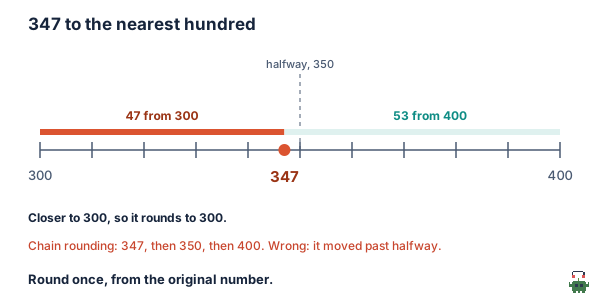
347 to the nearest ten is 350. 350 to the nearest hundred is 400. Each step is correct on its own, and the result is wrong, because the first step moved the number past the halfway point. The same thing turns 1,449 into 2,000 when rounding to the nearest thousand (it is 1,000), and 3.47 into 4 when rounding to the nearest whole number (it is 3).
The fix: round from the original number, once. On a number line, mark the two hundreds and the halfway point first, then place 347. It never reaches 350, so it cannot round past it.
2. Looking at the wrong digit: 347 becomes 400 again
A child who has “look at the digit next door” without knowing which door looks at the 7 instead of the 4 when rounding to the hundred. Same wrong answer as chain rounding, different cause.
The fix: ask which two hundreds it is between before anything else. “Between 300 and 400” puts the decision in the tens, where it belongs. The rule follows from the question, rather than the other way round.
3. Rounding to the wrong place: 347 becomes 350
Asked for the nearest hundred, the child gives the nearest ten. Usually this is a child who has practised one kind of rounding all week and defaults to it. 350 is not a hundred, which a child who understands the target sees immediately.
The fix: say the two candidates out loud every time. “Nearest hundred: 300 or 400?” The answer must be one of the two words just said.
4. The 9 that has to go up: 4,962
Round 4,962 to the nearest hundred. The answer is 5,000. A child who knows the rule but not the place value writes 4,1000, because the 9 “goes up to 10”, or retreats to 4,900. The decimal version is 2.96 to the nearest tenth, which is 3.0 and is often written 2.10.
The fix: the number line again. 4,962 is between 4,900 and 5,000. Ten hundreds is a thousand, so the next hundred after 4,900 is 5,000. This is a place value question wearing a rounding costume, which is why the place value check is worth running if it keeps happening.
5. Halfway is a convention, not a fact
35 to the nearest ten is 40. But 35 is exactly as close to 30 as it is to 40, and a child who has understood rounding properly may say so. That is not an error. It is the right observation, and the answer is that mathematicians agree to round halfway up so everyone gets the same answer.
The point for parents: if your child asks why 35 goes up, they have understood rounding better than the rule does. Tell them it is an agreement, not a law of numbers.
Want rounding practice that starts on a number line? Sprout builds a lesson from 3.NBT.A.1, 4.NBT.A.3 or 5.NBT.A.4 with the standard in the footer, set around whatever your child is into. Try it free.
The five-minute check
Out loud, in order. Ask “how did you get that?” after every answer.
- “Which two tens is 63 between? Which is it closer to?” 60 and 70, closer to 60. If this is shaky, the gap is the number line, not rounding.
- “Round 347 to the nearest hundred.” 300. If they say 400, the explanation tells you whether it is chain rounding or the wrong digit.
- “Round 347 to the nearest ten.” 350. Comparing this with question 2 catches a child who rounds to the same place whatever is asked.
- Grade 4 and up: “Round 4,962 to the nearest hundred.” 5,000.
- “About how much is 297 + 412?” About 700. This is the reason rounding is in the standards, and a child who can round but cannot do this has not connected the two.
Grade 5 adds decimals: 3.47 to the nearest tenth (3.5) and to the nearest whole number (3), which catches chain rounding in its decimal form.
What to actually do
- Draw the line before you use the rule. Two round numbers at the ends, the halfway point marked, then place the number. Do this for a week. The standards’ four words, “use place value understanding”, mean this.
- Always ask “between which two?” first. It fixes errors 2 and 3 outright, and it is the question the rule is quietly answering.
- Round once, from the original number. Say it as a family rule. It is the only fix for chain rounding.
- Do the nines on purpose. 96 to the nearest ten, 4,962 to the nearest hundred, 2.96 to the nearest tenth. Most worksheets avoid them, so most children meet them first on a test.
- Estimate before every calculation for a month. “About what will this be?” before 297 + 412. It takes five seconds, uses rounding the way the standards intend, and catches more of their own mistakes than any amount of checking afterwards.
- Use prices. “About how much is $3.89 plus $2.15?” at the store is rounding for a reason a child can see, and it is the grade 5 decimal standard in disguise.
What is not the problem
- Not knowing a rounding rhyme. A child who can place a number on a line between two round numbers does not need one.
- Asking why 5 rounds up. See error 5. It is a good question.
- Being a grade behind on decimals. Rounding decimals is grade 5. A grade 4 child who can round whole numbers to any place is on track.
Where this sits
The grade guides that carry these standards in full:
- Grade 3 math, rounding to the nearest 10 or 100
- Grade 4 math, rounding to any place
- Grade 5 math, rounding decimals
Related pages if the trouble looks a little different: place value, which is underneath every rounding error, comparing decimals and word problems, where estimating is the habit that catches a wrong operation.
The short version
The Common Core never mentions a rule about fives. All three rounding standards, in grades 3, 4 and 5, start with “use place value understanding”, and rounding is there so children can estimate and check their own answers.
347 to the nearest hundred is 300. 400 comes from chain rounding or from looking at the wrong digit, and 350 from rounding to the wrong place. 4,962 to the nearest hundred is 5,000, and 4,1000 means the place value underneath needs work.
Draw the line, ask “between which two?”, round once from the original number, and estimate before every calculation.
Sprout Lessons builds standards-aligned lessons for grades K–12, with the standard on every lesson. Start free.
Standard wording checked 1 October 2026 against our copy of the Common Core dataset, accessed 2026-07-16, not written from memory. Read the official text at the Common Core grade 4 base ten standards. Common Core State Standards © 2010 National Governors Association Center for Best Practices and Council of Chief State School Officers. All rights reserved. This product is not endorsed by NGA/CCSSO. Not every state uses Common Core and some sequence these topics differently: check your state department of education for the standards that apply to you.
FAQ
Why does my child round 347 to 400?
One of two reasons. Chain rounding: 347 to 350, then 350 to 400, which moves the number past a halfway point it never crossed. Or looking at the wrong digit: the 7 instead of the 4. The correct answer is 300. Ask which two hundreds 347 is between and which it is closer to: 47 from 300, 53 from 400.
What grade do kids learn rounding?
Grade 3 in the Common Core, rounding whole numbers to the nearest 10 or 100 (3.NBT.A.1). Grade 4 extends it to any place (4.NBT.A.3), and grade 5 to decimals (5.NBT.A.4). All three standards begin with the words use place value understanding.
What is the best way to teach rounding?
A number line. Mark the two round numbers the number sits between and the halfway point, then place the number and see which end it is closer to. Always ask between which two first, round once from the original number, and practise the nines on purpose, such as 4,962 to the nearest hundred, which is 5,000.
Why does 5 round up?
Because of an agreed convention, not a law of numbers. 35 is exactly as close to 30 as it is to 40, and rounding halfway up is simply the rule everyone uses so they get the same answer. A child who asks this has understood rounding well.
What is rounding actually for?
Estimating, so children can check whether an answer is reasonable. Common Core 3.OA.D.8 and 4.OA.A.3 both ask children to assess the reasonableness of answers using mental computation and estimation strategies including rounding. Asking about what before every calculation is the habit that makes rounding useful.