
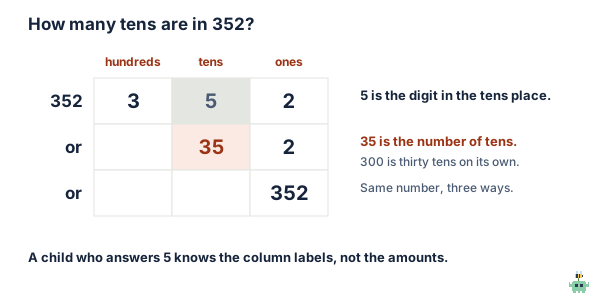
Ask your child how many tens are in 352. If the answer is 5, they can read a place value chart but do not yet understand place value. The 5 is the digit in the tens place. The number of tens in 352 is 35, because 300 is thirty tens on its own. That gap, between naming a column and knowing what the number is made of, is behind most of the trouble parents eventually see as something else: subtraction that falls apart at zeros, long division that never makes sense, decimals that compare backwards.
Most help pages on this topic are a list of activities: bundle straws, use blocks, play a game. Those are fine, and you will find them below. But an activity only helps if it is aimed at the right gap, and there are four distinct ones. This page names each by the wrong answer it produces, shows where it sits in the Common Core from kindergarten to grade 5, and gives you a six-question check to find out which one is yours.
What place value actually is, in the standards’ words
The idea is built in steps, and the wording of each step is worth reading, because it shows that “knowing the columns” was never the goal.
- Kindergarten, K.NBT.A.1: “Compose and decompose numbers from 11 to 19 into ten ones and some further ones”, with the example 18 = 10 + 8. A teen number is a ten and some ones.
- Grade 1, 1.NBT.B.2: “Understand that the two digits of a two-digit number represent amounts of tens and ones.” Note the word amounts.
- Grade 2, 2.NBT.A.1: “Understand that the three digits of a three-digit number represent amounts of hundreds, tens, and ones; e.g., 706 equals 7 hundreds, 0 tens, and 6 ones.”
- Grade 4, 4.NBT.A.1: “Recognize that in a multi-digit whole number, a digit in one place represents ten times what it represents in the place to its right.”
- Grade 5, 5.NBT.A.1: the same idea run both ways, ten times the place to its right and “1/10 of what it represents in the place to its left”. This is the standard that carries place value into decimals.
Every one of those is about amounts and the ten-times relationship between places. None of them is about naming columns. A child can label hundreds, tens and ones perfectly and still miss all five.
The four gaps, and the wrong answer each one gives
1. Columns without amounts
The wrong answer: “how many tens in 352?”, answered 5. Or “what is the 3 in 352 worth?”, answered 3.
The child has learned a labelling routine. They can tell you the 3 is “in the hundreds” without connecting that to it being worth three hundred. This is the most common gap and the one that hides longest, because worksheets that ask “which digit is in the tens place?” reward it.
The reteach: stop asking which digit is where and start asking what it is worth, and how many of each unit the whole number contains. Build 352 with blocks or drawn squares, then trade the 3 hundreds for 30 tens and count the tens. It is 35. Do it with 240 (24 tens) and 507 (50 tens) the same day.
2. Writing what they hear
The wrong answer: “one hundred thirty-four” written as 10034, or “three hundred four” written as 3004.
The child writes the words in order: 100 for “one hundred”, then 34. It is logical, and it shows they do not yet know that the hundreds digit already carries the hundred. 2.NBT.A.3 asks children to read and write numbers to 1000 “using base-ten numerals, number names, and expanded form”, and it is the expanded form that fixes this.
The reteach: write 134 as 100 + 30 + 4 and then stack the three cards on top of each other, the 4 card over the 0 of the 30, the 30 over the 00 of the 100. Arrow cards, which you can make from index cards in five minutes, do exactly this, and the moment the zeros disappear under the next digit is usually the moment it lands.
3. Zero as nothing, rather than as a place holder
The wrong answer: 706 read as “seventy-six”, or written as 76 when dictated.
The Common Core uses this exact number as its grade 2 example: 706 equals 7 hundreds, 0 tens and 6 ones. The zero is not empty space. It is a statement that there are no tens, which keeps the 7 in the hundreds. A child who drops it has not yet seen that position is what gives a digit its value.
The reteach: build 706 and 76 side by side with blocks and ask which is more. Then ask what the 0 is telling you. This gap is the direct ancestor of the zero trouble in subtraction across zeros, so it is worth fixing now rather than in grade 3.
4. Comparing by digits, not by size
The wrong answer: 89 is bigger than 102, “because 8 and 9 are big and 1, 0 and 2 are small.”
The child is comparing the digits as separate numbers. 1.NBT.B.3 and 2.NBT.A.4 both ask for comparisons “based on meanings of the” digits in each place, which is precisely what this child is not doing. The same error comes back in grade 4 as thinking 0.45 is bigger than 0.5, because 45 is bigger than 5.
The reteach: compare the biggest place first, out loud. “102 has one hundred. 89 has no hundreds.” Done. Then a number line from 0 to 200 with both marked, so the child can see the distance.
The six-question check
Out loud, in this order, no paper unless the question says so.
- “What is 10 more than 47? 10 less?” 1.NBT.C.5 asks for this mentally, “without having to count”. A child who counts on ten ones has the answer and not the idea.
- “How many tens are in 352?” The answer is 35. An answer of 5 is gap 1.
- Dictate “one hundred thirty-four” and “seven hundred six” to be written down. 10034 is gap 2. 76 or 7006 for the second is gap 3.
- “Which is bigger, 89 or 102?” 89 is gap 4.
- “What is 100 more than 295?” 2.NBT.B.8 asks children to add 10 or 100 mentally to numbers from 100 to 900. 395 is right. 296 or 305 means they changed the wrong digit, which is gap 1 under time pressure.
- Grade 4 and up: “the 4 in 4,000 is worth how many times the 4 in 400?” Ten. This is 4.NBT.A.1, and a child who says “one more zero” without being able to say ten times has the pattern but not the reason.
Most children miss one or two, not all six, and the ones they miss tell you which reteach to use. A child who gets everything but question 6 is on track for their grade if they are in grade 3 or below.
Want practice aimed at the exact gap? Sprout builds a lesson from 2.NBT.A.1 or 1.NBT.B.2 with the standard in the footer, set around something your child already cares about. Try it free.
What to actually do, whichever gap it is
- Make the units physical before they are written. Ten loose straws, one bundle of ten, ten bundles in a bag for a hundred. Base ten blocks are the same thing. The grade 1 and grade 2 standards both name concrete models or drawings for adding and subtracting, so this is the curriculum, not a step back from it.
- Trade both ways. Ten ones into a ten, and a ten back into ten ones. Children who only ever bundle never learn to unbundle, and unbundling is the whole of regrouping.
- Ask “how many tens”, not “which digit”. It is a small change of wording, and it forces the amount instead of the label.
- Use money. Dimes and pennies are tens and ones you can hold, and dollar bills are hundreds. “How many dimes make $3.50?” is “how many tens in 350” in a form many children find easier.
- Count across the boundaries. 97, 98, 99, 100, 101, and 197 to 203, and 990 to 1010. 2.NBT.A.2 asks for counting within 1000 and skip counting by 5s, 10s and 100s, and the crossings are where gaps show up.
- Ten minutes a day for two weeks, then recheck. Place value gaps close fast once they are named. If the same wrong answer is still there after two weeks, change the representation (blocks to money, or money to a number line) rather than repeating the same activity.
What is not the problem
- Not knowing the word “place value”. Plenty of children who understand it perfectly have never been asked to name it.
- Using blocks or fingers in grade 1 or 2. That is what the standards ask for.
- Being slow on the check. A child who reasons “three hundreds is thirty tens, plus five is thirty-five” and gets there in ten seconds has it.
Where this sits
The grade guides that carry these standards in full:
- Grade 1 math, tens and ones as amounts
- Grade 2 math, hundreds and the zero in 706
- Grade 4 math, ten times the place to the right
Place value gaps usually surface later under another name. If yours already has, these pages pick up from there: rounding, long division and counting on fingers, which is where “10 + 4 is not instant” points back here.
The short version
Place value is about amounts, not column labels. The test is “how many tens in 352?”: 35 means your child has it, 5 means they have the labels only.
There are four gaps, each with its own wrong answer: 5 tens in 352, 10034 for one hundred thirty-four, 76 for 706, and 89 bigger than 102. Each has a different fix.
Make units physical, trade both ways, ask “how many” rather than “which digit”, and recheck in two weeks. The gaps close quickly once they are named.
Sprout Lessons builds standards-aligned lessons for grades K–12, with the standard on every lesson. Start free.
Standard wording checked 1 October 2026 against our copy of the Common Core dataset, accessed 2026-07-16, not written from memory. Read the official text at the Common Core grade 2 base ten standards. Common Core State Standards © 2010 National Governors Association Center for Best Practices and Council of Chief State School Officers. All rights reserved. This product is not endorsed by NGA/CCSSO. Not every state uses Common Core and some sequence these topics differently: check your state department of education for the standards that apply to you.
FAQ
How do I know if my child understands place value?
Ask how many tens are in 352. The answer is 35, because 300 is thirty tens on its own. A child who answers 5 has learned to name the column but not what the number is made of. Also dictate one hundred thirty-four and seven hundred six to be written down, and ask which is bigger, 89 or 102.
Why does my child write 10034 for one hundred thirty-four?
They are writing the words in order: 100 for one hundred, then 34. It shows they do not yet see that the hundreds digit already carries the hundred. Write 134 as 100 plus 30 plus 4 on separate cards and stack them so the zeros are covered. Common Core 2.NBT.A.3 asks for reading and writing numbers in expanded form for this reason.
What grade should a child understand place value?
It builds from kindergarten, where teen numbers are a ten and some ones, to grade 1 (tens and ones as amounts, 1.NBT.B.2), grade 2 (hundreds, tens and ones, with the example 706 equals 7 hundreds, 0 tens and 6 ones), grade 4 (each place is ten times the place to its right) and grade 5, which extends it to decimals.
What are the best place value activities at home?
Bundling straws or craft sticks into tens and hundreds, then unbundling them again; using dimes, pennies and dollar bills; arrow cards for expanded form; and counting across boundaries such as 97 to 103 and 990 to 1010. Ask how many tens rather than which digit is in the tens place.
Why does my child think 89 is bigger than 102?
They are comparing digits as separate numbers instead of comparing the largest place first. Have them say it out loud: 102 has one hundred, 89 has no hundreds. Then mark both on a number line from 0 to 200. The same error reappears later as thinking 0.45 is bigger than 0.5.