
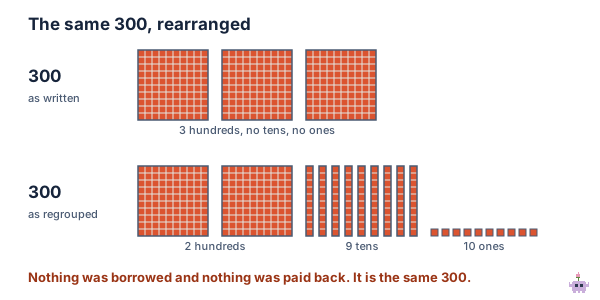
Write 300 − 148 and watch. If your child crosses out the 3, writes 2, and then stalls because the middle column is still a zero, the problem is the word borrowing. Borrowing implies something is taken and later returned, and nothing is. The number does not change at all. It is rearranged.
This matters more than it sounds, because a child who believes something is being borrowed has no way to reason about what to do when the place they are borrowing from is empty. A child who knows the number is being rearranged can work it out. The Common Core never uses the word borrow. It says compose and decompose.
What is actually happening
The grade 2 standard says it plainly. 2.NBT.B.7 asks students to add and subtract within 1000 and then explains what that involves:
“Understand that in adding or subtracting three-digit numbers, one adds or subtracts hundreds and hundreds, tens and tens, ones and ones; and sometimes it is necessary to compose or decompose tens or hundreds.”
Decompose is the word. One hundred is decomposed into ten tens; one of those tens is decomposed into ten ones. The 300 is still 300 the entire time, which is why you can check it at every step and why a child who understands it never gets stuck on zeros.
The ladder, and the surprise at the top of it
- Grade 1: adding within 100, including composing a ten, and subtracting multiples of 10 from multiples of 10. Concrete models or drawings, with the strategy related to a written method.
- Grade 2: fluently add and subtract within 100 (2.NBT.B.5), add and subtract within 1000 with composing and decomposing (2.NBT.B.7), and explain why the strategies work using place value (2.NBT.B.9). The explaining is a standard in its own right.
- Grade 3: fluently add and subtract within 1000 (3.NBT.A.2), using strategies and algorithms based on place value.
- Grade 4: the standard algorithm, by name. 4.NBT.B.4 reads “fluently add and subtract multi-digit whole numbers using the standard algorithm”. This is the first standard in the whole sequence to name it.
That last point is the one that reframes the problem. For three years the standards ask for place value strategies that the child can explain, and only in grade 4 do they ask for the stacked method as a required fluency. So a second grader being drilled on borrowing is being taught the grade 4 procedure without the grade 2 understanding it is supposed to sit on. That is the shape of most of the trouble.
Why zeros are the killer
300 − 148, 5006 − 2318, 40 − 17. These are the ones that produce tears, and they produce them for a specific reason: the rearranging has to pass through an empty column, which a borrowing story cannot describe.
The grade 2 place value standard already covers the case. 2.NBT.A.1 gives the example directly: 706 equals 7 hundreds, 0 tens and 6 ones. A child who can say that fluently in both directions can see that 300 is also 2 hundreds, 9 tens and 10 ones, and the zeros stop being an obstacle.
The one sentence that fixes most of it: “There are no tens, so take a hundred and turn it into ten tens. Now there are tens.” Said while moving actual blocks or drawing actual squares, it lands in about two minutes.
The five-minute check
Four questions in this order. Each one fails differently, and you want to know which, because the fixes are different.
- “What is 300 made of?” The answer you want is 3 hundreds, and the follow-up is “what else?”. If your child cannot offer 2 hundreds and 10 tens, or 30 tens, the place value idea underneath is the gap and no amount of subtraction practice will reach it.
- Set 62 − 27. One decomposition, no zeros. If this works and 300 − 148 does not, the method is fine and the zero case is the gap, which is a twenty-minute fix.
- Set 300 − 148 and ask them to talk while they do it. Listen for the words. “Borrow one” with no idea where from is the diagnosis. “Take a hundred and make it ten tens” means they have it.
- “Is 152 a sensible answer?” Ask it about whatever they got. Grade 3 onwards asks for the reasonableness of answers to be assessed by estimating, and 300 minus 150 is about 150. A child who cannot estimate cannot catch their own mistakes, which is the thing that makes an error permanent.
What to actually do
- Stop saying borrow. Say trade, or change, or break up. The word is doing damage in a way no worksheet can undo, and it costs nothing to change.
- Use blocks or draw squares for a week. Hundreds as squares, tens as sticks, ones as dots. Do the trade physically before writing anything. This is the grade 2 standard, which names concrete models or drawings, so it is the curriculum rather than a remedial detour.
- Do the zero cases on purpose. 40 − 17, then 300 − 148, then 5006 − 2318. Most books hide these at the end of the chapter, so plenty of children meet three of them in a year.
- Try the expanded form once. Write 300 as 200 + 90 + 10 and subtract each column. It is not the algorithm, and it is not meant to be: it shows a child who is convinced the answer comes out of a procedure that it comes out of the number.
- Ask for the estimate first, every time. Before the calculation, not after. “About what?” takes four seconds and is the only habit that catches place value errors.
- Check by adding. 152 + 148 should be 300. The standards lean on the relationship between addition and subtraction in every grade from 1 to 3, and using it as a check makes that relationship real rather than stated.
What is not the problem
- Not using the stacked method in grade 2 or 3 is not a gap. The standard algorithm is named for the first time in grade 4. Before that the standards ask for strategies based on place value that the child can explain.
- Being slow is not being stuck. A child who decomposes out loud and gets there in twenty seconds is doing the standard. Speed comes after.
- It is usually not careless. Errors in this topic are almost always systematic: the same child makes the same mistake in the same column every time. That is a rule being applied consistently, which is good news, because a consistent wrong rule is findable.
- Subtracting the small digit from the big one is the classic bug. A child who answers 248 to 300 − 148 has done 8 − 0 and 4 − 0 rather than 0 − 8 and 0 − 4. It is not carelessness. It is a rule they invented to survive a column that looked impossible, and it is fixed by making the column possible.
Where this sits
The year-by-year guides for the grades that carry this work:
- Grade 2 math, where composing and decomposing is written down
- Grade 3 math, fluency within 1000
- Grade 4 math, where the standard algorithm is named
Two related pages if the symptom is a bit different: word problems and long division, which is the same place value idea two operations later.
The short version
Borrowing is the wrong word and it is most of the problem. Nothing is borrowed and nothing is returned; 300 is rearranged into 2 hundreds, 9 tens and 10 ones, and it is still 300. The standards say compose and decompose, which is both accurate and teachable.
Zeros are hard because the rearranging has to pass through an empty column, and a borrowing story cannot describe that. The sentence that fixes it is “there are no tens, so take a hundred and turn it into ten tens”, said while moving blocks.
Check four things: what 300 is made of, whether 62 − 27 works, what your child says out loud while doing 300 − 148, and whether they can tell you the answer is about 150 before they start.
And check the grade before worrying. The standard algorithm for addition and subtraction is named for the first time in grade 4. Everything before that asks for strategies the child can explain.
Sprout Lessons builds standards-aligned lessons for grades K–12, with the standard on every lesson. Start free.
Standard wording checked 21 September 2026 against our copy of the Common Core dataset, accessed 2026-07-16, not written from memory. Read the official text at the Common Core base ten standards. Common Core State Standards © 2010 National Governors Association Center for Best Practices and Council of Chief State School Officers. All rights reserved. This product is not endorsed by NGA/CCSSO. Not every state uses Common Core and some sequence these topics differently: check your state department of education for the standards that apply to you.
FAQ
Why does my child get stuck subtracting across zeros?
Because the rearranging has to pass through an empty column, and the borrowing story cannot describe that. If nothing is there to borrow from, a child who believes something is being borrowed has nowhere to go. A child who knows 300 is the same as 2 hundreds, 9 tens and 10 ones can see the way through. The sentence that fixes most of it is: there are no tens, so take a hundred and turn it into ten tens, now there are tens.
Is borrowing the right word for regrouping?
No, and it causes real damage. Borrowing implies something is taken and later returned, and nothing is. The number does not change at all, it is rearranged. The Common Core never uses the word: 2.NBT.B.7 says that in adding or subtracting three-digit numbers one adds or subtracts hundreds and hundreds, tens and tens, ones and ones, and that it is sometimes necessary to compose or decompose tens or hundreds. Say trade, change or break up instead.
When are children supposed to use the standard subtraction algorithm?
Grade 4. 4.NBT.B.4 reads fluently add and subtract multi-digit whole numbers using the standard algorithm, and it is the first standard in the whole sequence to name it. Grades 1 to 3 ask for strategies based on place value that the child can explain, with grade 2 carrying an explicit standard, 2.NBT.B.9, for explaining why the strategies work. A second grader being drilled on borrowing is being taught the grade 4 procedure without the grade 2 understanding it sits on.
My child answers 248 to 300 minus 148. What is going wrong?
They are subtracting the small digit from the big one in each column: 8 minus 0 and 4 minus 0 rather than 0 minus 8 and 0 minus 4. It is not carelessness. It is a rule they invented to survive a column that looked impossible, and it is fixed by making the column possible rather than by telling them to be careful. Errors in this topic are almost always systematic, which is good news, because a consistent wrong rule is findable.
How do I teach regrouping at home?
Stop saying borrow. Use blocks or drawn squares for a week and do the trade physically before writing anything, since the grade 2 standard names concrete models or drawings. Do the zero cases on purpose rather than leaving them to the end of the chapter: 40 minus 17, then 300 minus 148, then 5006 minus 2318. Try expanded form once, writing 300 as 200 plus 90 plus 10. Ask for an estimate before every calculation, and check the answer by adding it back.
Is being slow at this a problem?
No. A child who decomposes out loud and gets there in twenty seconds is doing exactly what the standard describes, and speed comes afterwards. Not using the stacked method in grade 2 or 3 is also not a gap, because the standard algorithm is not named until grade 4.