
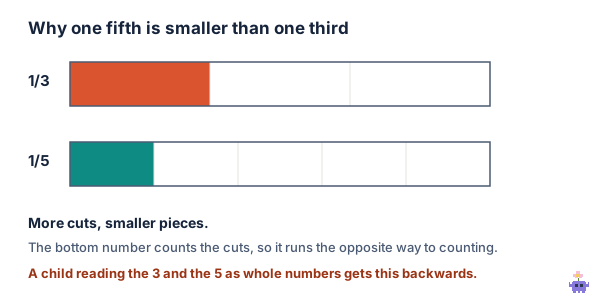
Ask your child which is bigger, one third or one fifth. If they say one fifth, you have found the problem in about four seconds, and it is not a fractions problem. It is that they are still reading a fraction as two whole numbers stacked up, and 5 is bigger than 3.
Almost everything that goes wrong with fractions comes back to that one thing. A fraction is one number, and your child is seeing two. Until that flips, every procedure you teach sits on sand, which is why the extra worksheets do not help and why the same child can get twenty questions right on Monday and be lost on Thursday.
The idea that is actually missing
The grade 3 standard that carries the whole idea is 3.NF.A.1, and it is worth reading slowly because it is not written the way fractions are usually taught:
“Understand a fraction 1/b as the quantity formed by 1 part when a whole is partitioned into b equal parts; understand a fraction a/b as the quantity formed by a parts of size 1/b.”
Read what that says about three quarters. It is not three out of four. It is three things, each of which is one quarter. The unit fraction is the object, and a/b is a count of them. That single reframing fixes more fraction confusion than any amount of practice, because it makes a fraction behave like every other number your child already trusts.
The other half of the idea is 3.NF.A.2, which is the most skipped standard in elementary math: “Understand a fraction as a number on the number line; represent fractions on a number line diagram.” Most children meet fractions as pizza, cake and pie charts for three straight years. Those models show a fraction as a piece of a thing. The number line shows it as a place, which is the thing you need when you later want to add it, compare it, or find it between 0 and 1.
The standards said the hard part in grade 1
This surprises people. The antidote to the whole-number confusion is written into a grade 1 geometry standard, five years before it becomes an emergency. 1.G.A.3 asks children to partition circles and rectangles into halves and fourths, and then says:
“Understand for these examples that decomposing into more equal shares creates smaller shares.”
More pieces, smaller pieces. Grade 2 extends it to thirds and adds a second thing worth noticing, that “equal shares of identical wholes need not have the same shape”, which is how a child learns that half of a square folded corner to corner is still a half.
If your fourth grader says one fifth is bigger, the missing piece is a grade 1 one. That is good news, not bad. It means the fix is paper and folding rather than a year of remediation.
The rule nobody mentions: same whole
The grade 4 comparison standard, 4.NF.A.2, carries a clause most worksheets quietly drop:
“Recognize that comparisons are valid only when the two fractions refer to the same whole.”
Half of a family-size chocolate bar is not half of a snack bar. The decimal standard in the same grade, 4.NF.C.7, repeats the clause word for word for decimals, which tells you the authors thought it mattered enough to say twice.
This is a live source of confusion at the kitchen table, because adults compare fractions of different wholes all day and never say so out loud. Half the class, a quarter of the pizza, three quarters of an hour. A child who has never been asked “half of what?” has no reason to think the question exists.
Why this is worth more of your attention than it looks
In a 2012 paper in Psychological Science, Siegler and colleagues used two large longitudinal data sets, one American and one British, and found that knowledge of fractions and of whole-number division in elementary school predicted algebra and overall math achievement in high school five or six years later. That prediction held after controlling for whole-number addition, subtraction and multiplication, for general intellectual ability and working memory, and for family income and education.
It is a correlational finding rather than proof that teaching fractions better causes better algebra, and it is worth saying that plainly. But the size of it is unusual, and it matches what algebra teachers say without being asked: the students who struggle are the ones for whom 3/4 was never a number.
The five-minute check
Four questions. You are listening to the explanation, not grading the answer, and any of them can be done on the back of an envelope.
- “Which is bigger, one third or one fifth?” The whole-number bias test. If the answer is one fifth, stop here: that is the thing to fix, and nothing further down the page will work until it is fixed.
- Draw a line, mark 0 and 1, and ask them to put 3/4 on it. This is 3.NF.A.2 and it separates children who know a fraction is a number from children who know a fraction is a shaded picture. A child who hesitates, or who tries to count four tick marks past 1, has never been shown the second thing.
- “What is 3/4 made of?” The answer you want is three one-quarters. “Three over four” is a description of the writing, not the number. This one is 4.NF.B.3, and it is the whole basis of grade 5 fraction arithmetic.
- Hold up two different-sized pieces of paper and ask whether half of one is the same as half of the other. The same-whole rule. Most children say yes, confidently, and are interested rather than upset when you fold both.
What to actually do
- Fold paper before you write anything. Strips of paper, folded in half, then half again, then in thirds. Ten minutes of folding does what three worksheets cannot, because the child makes the pieces and can see that more folds give smaller pieces.
- Say the unit fraction out loud, every time. Three one-fourths, not three over four. Five one-thirds, not five thirds. It sounds fussy for about two days and then it does the work on its own.
- Draw the number line as well as the pizza. Same fraction, both ways, in the same sitting. The pizza says how much; the line says where. Children need both and are usually only given one.
- Name the whole, out loud, in real life. Half of what? A quarter of what? This costs nothing and it heads off a misconception that survives into high school.
- Hold off on the rules. Cross-multiplying to compare, and flipping the second fraction to divide, both produce right answers from a child who does not know what a fraction is. That is precisely the state you are trying to get out of, so the rule makes the problem harder to see rather than easier.
- Twenty minutes a night, not a weekend blitz. The wider plan is here, and fractions reward spacing more than most topics because the idea has to settle.
What is not the problem
- Your child is not bad at math. Fractions are the first number they have met that does not behave like counting, and the confusion is a sign of having learned whole numbers well rather than badly.
- Not being able to add unlike denominators is not a gap before grade 5. Grade 4 is same-denominator only. 5.NF.A.1 is where unlike denominators arrive.
- Multiplying a fraction by a fraction is grade 5, and dividing by a fraction is grade 6. Grade 4 stops at fraction times whole number. The rest of the not yet list is here.
- Slow is not the same as stuck. A child who reasons their way to the right answer through a drawing is doing the standard. A child who is fast because they have a rule may not be.
Where the fraction work actually sits
Three years of it, and the year-by-year guides say what each one asks for:
- Grade 3: three fraction standards, and the number line
- Grade 4: seven, the joint-largest domain of the year
- Grade 5: seven more, where the arithmetic finally arrives
Two related pages, if the symptom is slightly different: halving works but quartering does not and 0.5 looks smaller than 0.45, which is the same whole-number bias wearing a decimal point.
The short version
One question tells you most of it: which is bigger, one third or one fifth. If the answer is one fifth, your child is reading a fraction as two whole numbers, and the bottom number is counting cuts rather than counting things.
The fix is the grade 3 standard read literally. A fraction is a count of unit fractions, so 3/4 is three one-quarters, and it is a number with a place on the number line rather than a picture of a shaded shape. Fold paper, say the unit fraction out loud, draw the line as well as the pizza, and ask “half of what?” until it stops being a strange question.
Hold off on cross-multiplying and on flipping to divide. Those produce correct answers from a child who still does not know what a fraction is, which hides the problem instead of solving it.
Sprout Lessons builds standards-aligned lessons for grades K–12, with the standard on every lesson. Start free.
Standard wording checked 19 September 2026 against our copy of the Common Core dataset, accessed 2026-07-16, not written from memory. Read the official text at the Common Core mathematics standards. Common Core State Standards © 2010 National Governors Association Center for Best Practices and Council of Chief State School Officers. All rights reserved. This product is not endorsed by NGA/CCSSO. The longitudinal finding is Siegler et al., Psychological Science, 2012; the publisher’s own site blocks automated fetches, so the PubMed record is linked and the full text opens normally in a browser. Not every state uses Common Core and some sequence fractions differently: check your state department of education for the standards that apply to you.
FAQ
Why does my child think one fifth is bigger than one third?
Because they are reading the fraction as two whole numbers, and 5 is bigger than 3. This is called whole-number bias and it is the single most common fraction error at every age. The bottom number counts the cuts, so it runs the opposite way to counting: more cuts means smaller pieces. The Common Core says this in a grade 1 geometry standard, 1.G.A.3, which asks children to understand that decomposing into more equal shares creates smaller shares. If a fourth grader has the confusion, the missing piece is a grade 1 one, which means the fix is folding paper rather than a year of remediation.
What is the fastest way to explain fractions to a child?
Read the grade 3 standard literally. 3.NF.A.1 says to understand a fraction 1/b as the quantity formed by 1 part when a whole is partitioned into b equal parts, and a/b as the quantity formed by a parts of size 1/b. So three quarters is not three out of four, it is three things each of which is one quarter. Say the unit fraction out loud every time, fold paper so the child makes the pieces, and draw the number line as well as the pizza.
Why do fractions matter more than other math topics?
A 2012 paper in Psychological Science by Siegler and colleagues used two large longitudinal data sets, one American and one British, and found that elementary school knowledge of fractions and of whole-number division predicted algebra and overall math achievement in high school five or six years later, after controlling for whole-number addition, subtraction and multiplication, general intellectual ability, working memory, and family income and education. It is correlational rather than proof of cause, but the size of the effect is unusual.
What is the same-whole rule?
The grade 4 comparison standard, 4.NF.A.2, says comparisons are valid only when the two fractions refer to the same whole, and 4.NF.C.7 repeats the clause word for word for decimals. Half of a family-size chocolate bar is not half of a snack bar. Adults compare fractions of different wholes all day without saying so, and a child who has never been asked half of what has no reason to think the question exists.
Should I teach cross-multiplying to compare fractions?
Not while the underlying idea is missing. Cross-multiplying to compare, and flipping the second fraction to divide, both produce correct answers from a child who does not know what a fraction is. That is precisely the state you are trying to get out of, so the rule hides the problem rather than solving it. Teach the rule once the child can place a fraction on a number line and say what it is made of.
Is my child behind if they cannot add fractions with different denominators?
Not before grade 5. Grade 4 is same-denominator only, and unlike denominators arrive at 5.NF.A.1. Multiplying a fraction by a fraction is also grade 5, and dividing by a fraction is grade 6. Grade 4 stops at fraction times whole number.