
Grade 4 has one hinge, and it is fractions. Everything else that year is either a continuation or a warm-up for grade 5. Of the 28 Common Core math standards for grade 4, seven are Number and Operations with Fractions, which ties it with Measurement and Data as the largest domain of the year and makes it the thing to watch.
The rest of this page is the specific version: what the standards actually ask for, a five-minute check you can run at the kitchen table, and, just as usefully, the list of things people expect in grade 4 that do not arrive until grade 5 or 6.
Grade 4 by the numbers
Three subjects, three counts, all read from the standards rather than estimated.
- Math: 28 standards. Fractions 7, Measurement and Data 7, Number and Operations in Base Ten 6, Operations and Algebraic Thinking 5, Geometry 3.
- English: 43 standards. Writing 10, Informational Reading 10, Literature 9, Language 6, Speaking and Listening 6, and Foundational Skills 2.
- Science: 17. Fourteen grade 4 standards plus three engineering design standards published for the grades 3 to 5 band rather than for a single year, which is why a grade-level search misses them.
The Foundational Skills 2 is worth a pause. Phonics and fluency standards are still formally present in grade 4, and in grade 5, before disappearing at grade 6. A fourth grader who is still working on decoding is not off the map.
Six things a fourth grader should be able to do by June
Phrased as a parent would check them rather than as the standards phrase them.
- Say why two fractions are equal, using a picture. The standard asks them to explain why a/b equals (n×a)/(n×b) using visual fraction models. Explain is the operative word. A rule produces right answers and does not meet it.
- Add fractions with the same denominator, and see a fraction as a sum of unit fractions. Three quarters is one quarter plus one quarter plus one quarter. This is the idea grade 5 builds all of its fraction arithmetic on.
- Multiply a fraction by a whole number. Three lots of two fifths. Not fraction by fraction, which is next year.
- Multiply up to four digits by one digit, and two two-digit numbers, using place value strategies and able to explain the calculation.
- Divide four-digit numbers by one digit, again by strategy, and explain it with equations, arrays or area models.
- Solve multistep word problems, including ones where the remainder has to be interpreted. Whether a remainder means an extra bus, a leftover or a rounded answer depends entirely on the situation, and no rule handles it.
What does not arrive until grade 5 or 6
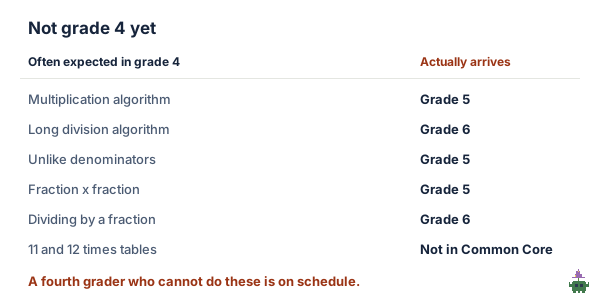
This is the half of the question nobody answers, and it prevents a great deal of unnecessary worry.
- The standard multiplication algorithm is grade 5. Grade 4 asks for multiplying by strategies based on place value and for explaining the calculation. Fluency with the familiar stacked method is 5.NBT.B.5.
- The standard long division algorithm is grade 6. Two years away. Why that matters, and what to do instead, is its own page.
- Adding fractions with unlike denominators is grade 5. Grade 4 is same-denominator only.
- Multiplying a fraction by a fraction is grade 5. Grade 4 stops at fraction times whole number.
- Dividing by a fraction is grade 6. Grade 5 does unit fractions with whole numbers; the general case waits.
- The 11 and 12 times tables are not in Common Core at all. The requirement is products of two one-digit numbers, set in grade 3, and there are only about ten genuinely hard facts in it.
If your fourth grader cannot do the things on this list, they are not behind. They are on schedule.
The five-minute check
Four questions, in this order. Each one tells you something different, and you are listening to the reasoning rather than grading the answer.
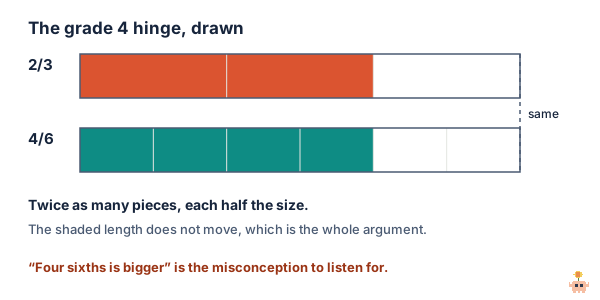
- “Is two thirds the same as four sixths? How do you know?” The fraction hinge. “Times the top and bottom by two” is a rule; drawing or folding two equal strips is the standard. If four sixths is declared bigger because the numbers are bigger, that is the single most common grade 4 misconception and it needs materials, not repetition.
- “What is 6 times 7?” Should be immediate by grade 4. Grade 4 asks for factor pairs and for prime and composite numbers, and neither is reachable without recall.
- “23 children, 4 to a table. How many tables?” The remainder question. Six is wrong; the answer is six tables with three children left over, so seven tables. A child who says six has done the arithmetic and not the problem.
- Have them read a paragraph of nonfiction and tell you what it said. Informational reading carries ten standards at grade 4, as many as writing. If reading aloud is fluent but nothing comes back, that is a specific and fixable problem and it is not a reading-speed one.
If something is missing
- Fix the fraction idea before the fraction procedures. Everything in grade 5 fractions assumes equivalence is understood rather than performed, so time spent here pays for itself twice.
- Fix recall before anything that depends on it. A child counting on their fingers for 6 × 7 pays a tax on every piece of math they attempt.
- Do not accelerate into grade 5 content to catch up. The order in the standards is load-bearing, and skipping the explaining step is precisely what produces a child who can multiply fractions and cannot say what the answer means.
- Twenty minutes a night is the realistic dose. The wider plan is here.
Where to go next
Full standard-by-standard guides, with teaching order and the misconceptions each topic produces:
The short version
Grade 4 is 28 math standards, 43 English and 17 science, and the hinge of the year is fractions, which is the joint-largest math domain. The things to check are fraction equivalence explained rather than performed, multiplication recall, multistep problems where the remainder has to be interpreted, and whether nonfiction reading is understood as well as decoded.
Just as important is what is not grade 4 work. The multiplication algorithm is grade 5, long division is grade 6, unlike denominators and fraction times fraction are grade 5, dividing by a fraction is grade 6, and the 11 and 12 times tables are not in the standards at all. A child who cannot do those is exactly where they should be.
Sprout Lessons builds standards-aligned lessons for grades K–12, with the standard on every lesson. Start free.
Counts and standard wording checked 16 September 2026 against our copy of the Common Core and NGSS datasets, accessed 2026-07-16, not written from memory. Read the official text at the Common Core mathematics standards. Common Core State Standards © 2010 National Governors Association Center for Best Practices and Council of Chief State School Officers. All rights reserved. This product is not endorsed by NGA/CCSSO. Not every state uses Common Core and some sequence these topics differently: check your state department of education for the standards that apply to you.
FAQ
What math should a 4th grader know?
Grade 4 is 28 Common Core math standards: fractions 7, measurement and data 7, base ten 6, operations and algebraic thinking 5, geometry 3. Fractions ties as the largest domain, which makes it the hinge of the year. By June a fourth grader should be able to explain why two fractions are equivalent using a picture, add fractions with the same denominator, multiply a fraction by a whole number, multiply up to four digits by one digit and two two-digit numbers by strategy, divide four-digit numbers by one digit by strategy, and solve multistep word problems where the remainder has to be interpreted.
Should my 4th grader be doing long division?
No. The standard algorithm for long division is a grade 6 standard. Grade 4 asks for whole-number quotients with up to four-digit dividends and one-digit divisors using strategies based on place value, and for the child to illustrate and explain the calculation with equations, arrays or area models. The explanation is the standard rather than the answer, so a fourth grader who cannot do formal long division is two years ahead of the requirement, not behind it.
When do children learn the standard multiplication algorithm?
Grade 5. The grade 4 standard asks students to multiply up to four digits by one digit, and two two-digit numbers, using strategies based on place value and the properties of operations, and to explain the calculation. Fluency with the familiar stacked method is 5.NBT.B.5, the following year. This surprises most parents, because the stacked method is what they were taught and they assume it belongs earlier.
What fractions should a 4th grader be able to do?
Equivalence explained with a visual model, seeing a fraction as a sum of unit fractions so that three quarters is one quarter three times, adding and subtracting with the same denominator, and multiplying a fraction by a whole number. What is not grade 4: adding fractions with unlike denominators and multiplying a fraction by a fraction are both grade 5, and dividing by a fraction is grade 6. Fix the equivalence idea before any procedure, because everything in grade 5 assumes it is understood rather than performed.
How do I know if my 4th grader is behind?
Run four questions and listen to the reasoning rather than grading the answer. Is two thirds the same as four sixths and how do you know. What is 6 times 7. Twenty-three children four to a table, how many tables. And read a paragraph of nonfiction and tell me what it said. Before worrying, check the list of things that are not grade 4 work at all, because several of the things parents most often test are grade 5 or grade 6 standards.
What should I do if something is missing?
Fix the fraction idea before the fraction procedures, since grade 5 assumes equivalence is understood. Fix multiplication recall before anything that depends on it. Do not accelerate into grade 5 content to catch up, because the order in the standards is load-bearing and skipping the explaining step is exactly what produces a child who can multiply fractions and cannot say what the answer means. Twenty minutes a night is the realistic dose.