
Grade 6 is where everything the earlier grades kept saying “that is grade 6” about actually arrives, all at once. Long division, dividing by a fraction, ratios, negative numbers, exponents and letters standing for numbers are all this year. It is 29 math standards, the largest count anywhere in K–8.
There is also a structural change nobody warns parents about, and it explains most of the feeling that grade 6 is a wall. Four of the five math domain names end at grade 5 and four new ones begin. Only Geometry carries across.
The year the labels change
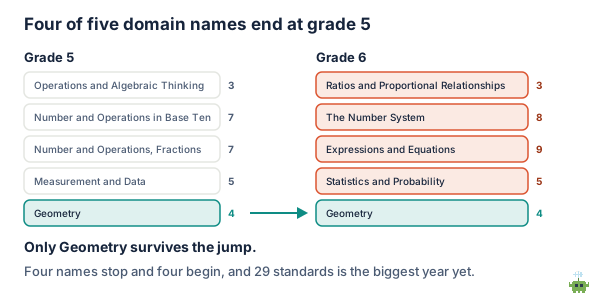
This is worth sitting with for a second, because it is the honest answer to “why did it get hard so suddenly”. Base ten, fractions as a domain, and measurement and data all stop being headings. In their place: ratios, the number system, expressions and equations, and statistics and probability. The content connects, of course, but the shape of the year does not look like anything your child has seen.
Grade 6 by the numbers
- Math: 29 standards. Expressions and Equations 9, The Number System 8, Statistics and Probability 5, Geometry 4, Ratios and Proportional Relationships 3. That is the largest math count in K–8, ahead of grade 8 at 28 and grade 4 at 28.
- English: 41 standards. Informational Reading 10, Writing 10, Literature 9, Language 6, Speaking and Listening 6. Two fewer than grade 5, and the reason matters: Foundational Skills drops to zero for the first time. Phonics and fluency were formally on the curriculum in every year up to grade 5 and are not here.
- Science: there is no grade 6 science. NGSS publishes middle school as a grades 6 to 8 band, 59 standards in total, with no split by year. Schools divide them differently, so a parent searching for grade 6 science standards finds nothing, correctly. How the 6 to 8 band is usually sequenced is its own page.
Everything that arrives this year
Grouped by what a parent would recognize rather than by domain. If you have read our grade 3, 4 or 5 pages, this is the list they kept deferring.
- The long division algorithm. 6.NS.B.2, worded as fluently dividing multi-digit numbers using the standard algorithm. This is the first and only time it is required. What to do if it is not landing is its own page.
- Dividing a fraction by a fraction. 6.NS.A.1, and the standard asks for word problems and visual fraction models, not just the flip-and-multiply rule.
- All four decimal algorithms. 6.NS.B.3 asks for fluent addition, subtraction, multiplication and division of multi-digit decimals, each by the standard algorithm.
- Ratios, unit rates and percent problems. A whole new domain, 6.RP, and the ratio idea is the one grade 7 proportional reasoning is built on.
- Negative numbers. 6.NS.C.5 to C.8: opposite directions, rational numbers as points on the line, ordering and absolute value, and graphing in all four quadrants. Grade 5 coordinates were first quadrant only.
- Exponents, variables, equations and inequalities. 6.EE is the biggest domain of the year at nine standards. Whole-number exponents, letters standing for numbers, solving x + p = q and px = q, and writing inequalities of the form x > c.
- Greatest common factor and least common multiple. 6.NS.B.4, both capped at numbers up to 100 and 12 respectively.
- Statistics as a way of thinking. 6.SP starts with recognizing a statistical question as one that anticipates variability, then distributions, center and spread, and dot plots, histograms and box plots.
- Area of triangles, nets and surface area. 6.G, including volume of a prism with fractional edge lengths.
What is still not grade 6
The reassuring half, and it is shorter this year but still useful.
- Operating with negative numbers is grade 7. Grade 6 understands, orders and locates them. Adding, subtracting, multiplying and dividing them is 7.NS.A.1 and 7.NS.A.2. A sixth grader who freezes on −7 − −3 is a year early, not behind.
- Proportional relationships as a formal topic are grade 7. 7.RP.A.2. Grade 6 does ratio and rate reasoning with tables, tape diagrams and double number lines.
- Square roots and scientific notation are grade 8. 8.EE.A.2 and 8.EE.A.4.
- Functions are grade 8. 8.F.A.1. Grade 6 writes an equation relating two quantities, which is the groundwork rather than the thing.
- The Pythagorean theorem is grade 8. 8.G.B.7.
The five-minute check
Four questions. You are listening to the reasoning rather than grading the answer, and each one targets a different arrival.
- “What is 3 divided by one half?” The answer is 6, and the useful follow-up is “why is it bigger?”. A child who says one and a half has applied the rule that dividing makes things smaller, which was true for five years and stops being true here. 6.NS.A.1.
- “The recipe is 2 cups of flour to 3 of milk. How much milk for 6 cups of flour?” Ratio reasoning, 6.RP. Listen for whether they scale both sides or add 4 to each.
- “Which is colder, minus 7 or minus 3?” 6.NS.C.7. Minus 7. If the answer is minus 3 because 3 is smaller, the ordering idea has not landed, and it is the same shape of error as thinking 0.45 is bigger than 0.5.
- “If n is 4, what is 3n + 2?” 6.EE.A.2. Fourteen. A child who says 34 has read 3n as a digit next to a letter rather than as multiplication, which is the single most common first-algebra misreading and takes one sentence to fix.
If something is missing
- Go back to fractions before going forward. Dividing by a fraction, ratios and rate all assume a fraction is a number rather than a pair of numbers. If it is not, that is the thing to fix first, and it is a grade 3 idea.
- Say the two broken rules out loud. Multiplying can make things smaller and dividing can make things bigger. Both stop being true this year, and no amount of practice fixes a child who has not been told.
- Treat the vocabulary change as real. Your child is meeting expression, equation, variable, coefficient, ratio, rate, distribution and absolute value in one year. Ask them to define three of those a week, out loud. It is cheaper than reteaching the math.
- Do not assume the long division algorithm is revision. Grades 4 and 5 asked for division by strategy with an explanation. Grade 6 is the first time the algorithm itself is required, so if it looks new, it is new.
- Twenty minutes a night is still the realistic dose. The wider plan is here.
Where to go next
- Grade 6 math, all 29 standards
- Middle school English, grades 6 to 8
- Middle school science, and why there is no grade 6 list
- The same page for grade 5, for grade 4, and for grade 3
The short version
Grade 6 is 29 math standards, the largest count in K–8, and 41 English. There is no grade 6 science: NGSS publishes 59 standards for the grades 6 to 8 band and leaves the split to schools. Foundational Skills drops to zero in English for the first time.
Four of the five math domain names end at grade 5, which is the honest reason the year feels abrupt. Long division, dividing by a fraction, decimal algorithms, ratios, negative numbers, exponents, variables, equations, inequalities and statistics all arrive together.
Check four things: 3 divided by one half, a ratio scaled up, whether minus 7 is colder than minus 3, and what 3n + 2 is when n is 4. Then remember what is still ahead. Operating with negatives and proportional relationships are grade 7; square roots, scientific notation, functions and Pythagoras are grade 8.
Sprout Lessons builds standards-aligned lessons for grades K–12, with the standard on every lesson. Start free.
Counts and standard wording checked 21 September 2026 against our copy of the Common Core and NGSS datasets, accessed 2026-07-16, not written from memory. Read the official text at the Common Core mathematics standards. Common Core State Standards © 2010 National Governors Association Center for Best Practices and Council of Chief State School Officers. All rights reserved. This product is not endorsed by NGA/CCSSO. Next Generation Science Standards © 2013 Achieve, Inc.; NGSS is a registered trademark of WestEd and this product is not endorsed by WestEd or the lead states. Not every state uses Common Core and some sequence these topics differently: check your state department of education for the standards that apply to you.
FAQ
What math should a 6th grader know?
Grade 6 is 29 Common Core math standards: expressions and equations 9, the number system 8, statistics and probability 5, geometry 4, ratios and proportional relationships 3. That is the largest math count in K-8. The year brings the long division algorithm, dividing a fraction by a fraction, all four decimal algorithms, ratios and unit rates, negative numbers and all four quadrants, exponents, variables, equations and inequalities, greatest common factor and least common multiple, statistical questions and box plots, and the area of triangles plus nets and surface area.
Why is 6th grade math so much harder?
Partly because of what arrives and partly because of a structural change nobody warns parents about. Four of the five math domain names end at grade 5 and four new ones begin: operations and algebraic thinking, base ten, fractions and measurement and data are replaced by ratios and proportional relationships, the number system, expressions and equations, and statistics and probability. Only Geometry carries across, so the shape of the year does not look like anything the child has seen.
Where are the grade 6 science standards?
There are none. NGSS publishes middle school as a grades 6 to 8 band, 59 standards in total, with no split by year, and schools divide them differently. A parent searching for grade 6 science standards correctly finds nothing. Look at the middle school band as a whole and check how your school or program sequences it.
Is long division new in grade 6?
Yes, as a required fluency. 6.NS.B.2 asks students to fluently divide multi-digit numbers using the standard algorithm, and it is the first and only time the standards require it. Grades 4 and 5 asked for division by strategies based on place value, illustrated and explained. So if the algorithm looks new to your sixth grader, it is new rather than forgotten.
What is not grade 6 math?
Operating with negative numbers is grade 7 at 7.NS.A.1 and 7.NS.A.2: grade 6 understands, orders and locates them but does not add, subtract, multiply or divide them. Proportional relationships as a formal topic are 7.RP.A.2. Square roots and scientific notation are grade 8 at 8.EE.A.2 and 8.EE.A.4, functions are 8.F.A.1, and the Pythagorean theorem is 8.G.B.7.
Does phonics still appear in grade 6 English?
No. Grade 6 English is 41 standards and Foundational Skills drops to zero for the first time. Phonics, word analysis and fluency were formally on the curriculum in every year up to grade 5. If decoding is still the issue for your sixth grader, the standards no longer carry it, so it has to be addressed deliberately rather than assumed.