
Grade 3 asks for something no year before it does: knowing something from memory. 3.OA.C.7 ends with the sentence “By the end of Grade 3, know from memory all products of two one-digit numbers.” There are exactly two standards in the whole of Common Core math that use the phrase “know from memory”. The other is addition facts in grade 2. That is the year in one line.
It is also the year three separate things start at once: multiplication, fractions and area. The rest of this page is what the standards actually ask for, a five-minute check you can run at the kitchen table, and the list of things people expect in grade 3 that do not arrive until grade 4 or later.
Grade 3 by the numbers
Three subjects, three counts, read from the standards rather than estimated.
- Math: 25 standards. Operations and Algebraic Thinking 9, Measurement and Data 8, Number and Operations in Base Ten 3, Fractions 3, Geometry 2. Multiplication and division are more than a third of the year on their own.
- English: 42 standards. Informational Reading 10, Literature 9, Writing 9, Language 6, Speaking and Listening 6, Foundational Skills 2. One fewer than grade 4, and the missing one is in writing: drawing evidence from texts to support analysis arrives in grade 4.
- Science: 18. Fifteen grade 3 standards plus three engineering design standards published for the grades 3 to 5 band rather than for a single year, which is why a grade-level search misses them.
Foundational Skills still has two standards, phonics and word analysis, and fluency sufficient to support comprehension. They are present in grade 3, 4 and 5 and disappear at grade 6. A third grader still working on decoding is squarely inside the curriculum.
The idea the whole year turns on
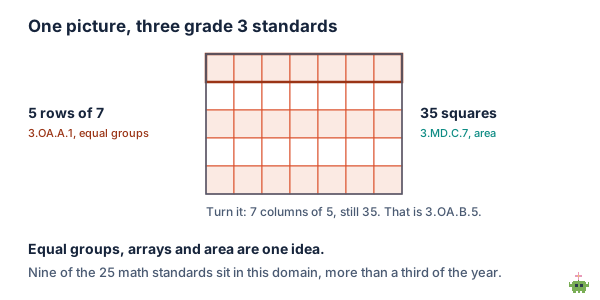
3.OA.A.1 asks students to interpret 5 × 7 as the total number of objects in 5 groups of 7. 3.OA.B.5 asks them to apply the properties of operations, which is where turning the array and getting the same answer comes from. 3.MD.C.7 asks them to relate area to multiplication. Those are three standards and one drawing.
This matters practically, because a child who only ever meets multiplication as a column of facts to chant has nothing to fall back on when the fact will not come. A child who can draw it can rebuild 6 × 7 from 5 × 7 plus 7 in about four seconds, which is what fluency actually looks like on the way to recall.
Six things a third grader should be able to do by June
Phrased as a parent would check them rather than as the standards phrase them.
- Know the multiplication facts from memory, and the division facts with them. 3.OA.C.7 covers both, and the division half is the one that gets skipped. Knowing 8 × 5 is 40 is supposed to make 40 ÷ 5 immediate. There are only about ten genuinely hard facts in the set.
- Understand division as an unknown-factor problem. 3.OA.B.6, and it is the reason grade 3 does not teach a division procedure. 56 ÷ 8 is the question “8 times what is 56”.
- Solve two-step word problems, writing a letter for the unknown, and check whether the answer is reasonable by estimating. 3.OA.D.8. The estimate is part of the standard, not an extra.
- Place a fraction on a number line. 3.NF.A.2 asks students to understand a fraction as a number on the number line and to represent it on a number line diagram. Most children meet fractions as pizza for three years and never as a number, which is where most later fraction trouble comes from.
- Tell time to the nearest minute, and work out how long something takes. 3.MD.A.1. Both halves. The second half, measuring intervals in minutes, is the harder one and the standard names a number line diagram as the way to represent it.
- Measure area by counting unit squares, and see why it is multiplication. Three standards, 3.MD.C.5 to 3.MD.C.7, plus perimeter at 3.MD.D.8. Area and perimeter both start here, and confusing them is the single most common grade 3 measurement error.
One more that is easy to miss: fluently add and subtract within 1000 (3.NBT.A.2). The word is fluently, and the standard offers strategies and algorithms based on place value, so a child who is accurate by a method they can explain has met it.
What does not arrive until grade 4 or later
This is the half nobody answers, and in grade 3 it is unusually long, because grade 3 starts three topics and finishes none of them.
- Adding fractions is grade 4. Grade 3 does not add fractions at all. It has three fraction standards and they are about what a fraction is, where it sits on a line, and comparing them.
- Equivalent fractions in general are grade 4. 3.NF.A.3 asks for equivalence in special cases only. The general principle is 4.NF.A.1.
- Multi-digit multiplication is grade 4. Grade 3 goes as far as one-digit numbers times multiples of 10, such as 9 × 80. Four digits by one digit is 4.NBT.B.5.
- The standard multiplication algorithm is grade 5, and the long division algorithm is grade 6. Both are years away.
- Decimals are grade 4. They first appear at 4.NF.C.6, as another way of writing tenths and hundredths.
- Interpreting remainders is grade 4. 4.OA.A.3 is where a remainder has to be turned into an answer about the situation. Grade 3 division stays inside 100 with no remainder work.
- The 11 and 12 times tables are not in Common Core at all. The requirement is products of two one-digit numbers, and that is the whole of it.
If your third grader cannot do the things on this list, they are not behind. They are on schedule, and in several cases a full year early.
The five-minute check
Four questions, in this order. You are listening to the reasoning rather than grading the answer.
- “What is 6 times 7?” By June this should be immediate, because the standard says from memory. If it is reconstructed in four seconds from 5 × 7 plus 7, that is a child on the way and doing it correctly. If it is counted on fingers, that is the thing to fix, and it is worth fixing before anything else because every later topic charges rent on it.
- “And 42 divided by 7?” Ask it straight after. The standard pairs them deliberately. A long pause here means the facts were learned as a chant rather than as a relationship.
- Draw a line, mark 0 and 1, and ask them to put one quarter on it. 3.NF.A.2. A child who draws a pizza instead, or who cannot start, has met fractions only as pictures of shaded shapes.
- “It is 2:15. Soccer starts at 3:05. How long until then?” The second half of 3.MD.A.1, and the part of the year most likely to be quietly missing. If the clock itself is the problem rather than the arithmetic, that is a different and very fixable thing.
If something is missing
- Fix recall before anything that depends on it. Grade 4 asks for factor pairs, prime and composite numbers, and multi-digit multiplication, and none of it is reachable while 6 × 7 is being counted out.
- Draw the array when a fact will not come. It is faster than looking it up, it is the actual standard, and it stops the child learning that the answer lives somewhere outside their own head.
- Separate area from perimeter out loud. Area is how much carpet; perimeter is how much skirting board. Children mix them because both are introduced in the same term with the same shapes.
- Do not accelerate into grade 4 to catch up. Grade 3 starts three topics and finishes none of them on purpose. Skipping the start is what produces a fourth grader who can multiply fractions and cannot say what the answer means.
- Twenty minutes a night is the realistic dose. The wider plan is here.
A word about the grade 3 reading pressure
Grade 3 carries more official weight than the years around it in many US states, which attach a reading assessment or a promotion rule to it. Those rules differ by state and change, so check your own state department of education rather than any national summary, this page included.
What the standards themselves say is calmer. Grade 3 is the top of the grades 2 to 3 text complexity band, so it is a boundary year by design, and Foundational Skills still carries two standards here and in grades 4 and 5. If your child reads aloud fluently but nothing comes back, that is a specific and fixable problem and it is not a reading-speed one.
Where to go next
Full standard-by-standard guides, with teaching order and the misconceptions each topic produces:
- Grade 3 math, all 25 standards
- Grade 3 English, all 42
- Grade 3 science, and the band standards
- The same page for grade 4, and for grade 5
The short version
Grade 3 is 25 math standards, 42 English and 18 science. Multiplication and division are nine of the 25, more than a third of the year, and the year ends with the only recall deadline in elementary math after grade 2 addition: know the products of two one-digit numbers from memory.
Check four things. Six times seven. Forty-two divided by seven, straight afterwards. One quarter on a number line. And how long from 2:15 to 3:05.
Then check what is not grade 3. Adding fractions, equivalent fractions in general, multi-digit multiplication, decimals and interpreting remainders are all grade 4; the multiplication algorithm is grade 5; long division is grade 6; and the 11 and 12 times tables are not in the standards at all. Grade 3 starts three topics and finishes none of them, which is the design rather than a gap.
Sprout Lessons builds standards-aligned lessons for grades K–12, with the standard on every lesson. Start free.
Counts and standard wording checked 20 September 2026 against our copy of the Common Core and NGSS datasets, accessed 2026-07-16, not written from memory. Read the official text at the Common Core mathematics standards. Common Core State Standards © 2010 National Governors Association Center for Best Practices and Council of Chief State School Officers. All rights reserved. This product is not endorsed by NGA/CCSSO. Next Generation Science Standards © 2013 Achieve, Inc.; NGSS is a registered trademark of WestEd and this product is not endorsed by WestEd or the lead states. Third-grade promotion and reading rules are set by each state, change often, and are not described here: check your state department of education. Not every state uses Common Core and some sequence these topics differently.
FAQ
What math should a 3rd grader know?
Grade 3 is 25 Common Core math standards: operations and algebraic thinking 9, measurement and data 8, base ten 3, fractions 3, geometry 2. By June a third grader should know the multiplication facts from memory along with the related division facts, understand division as an unknown-factor problem, solve two-step word problems writing a letter for the unknown and check the answer by estimating, place a fraction on a number line, tell time to the nearest minute and measure intervals, measure area by counting unit squares and relate it to multiplication, and fluently add and subtract within 1000.
Should a 3rd grader know their times tables?
Yes, by the end of the year. 3.OA.C.7 ends with the sentence know from memory all products of two one-digit numbers, and it is one of only two standards in the whole of Common Core math to use that phrase; the other is addition facts at the end of grade 2. That means products up to 9 times 9. The 11 and 12 times tables are not in the standards at all.
Do 3rd graders add fractions?
No. Grade 3 does not add fractions at all. It has three fraction standards and they cover what a fraction is as a count of unit fractions, where it sits on the number line, and comparing fractions and explaining equivalence in special cases. Adding fractions with the same denominator is grade 4, unlike denominators are grade 5, and the general equivalence principle is 4.NF.A.1.
Why do multiplication, arrays and area all appear in grade 3?
Because they are the same idea. 3.OA.A.1 asks students to interpret 5 times 7 as the total in 5 groups of 7, 3.OA.B.5 asks them to apply the properties of operations, which is where turning an array and getting the same answer comes from, and 3.MD.C.7 asks them to relate area to multiplication. Three standards, one drawing. A child who can draw it can rebuild a fact they have forgotten instead of being stuck.
Is my 3rd grader behind if they cannot do long division?
No, by three years. The standard long division algorithm is 6.NS.B.2. Grade 3 division stays within 100 and is taught as an unknown-factor problem rather than as a procedure, and interpreting remainders does not arrive until 4.OA.A.3. Multi-digit multiplication is grade 4 and the standard multiplication algorithm is grade 5.
What about third grade reading requirements?
Grade 3 carries more official weight than the years around it in many US states, which attach a reading assessment or a promotion rule to it. Those rules differ by state and change, so check your own state department of education rather than a national summary. What the standards themselves say is calmer: grade 3 is the top of the grades 2 to 3 text complexity band, and Foundational Skills still carries two standards in grades 3, 4 and 5 before disappearing at grade 6, so a third grader still working on decoding is inside the curriculum.