
Set an analog clock to 3:55 and ask your child what it says. If the answer is 4:55, you have found the problem in one question, and it is not that they are bad at time. The hour hand is nearly on the 4, so they read the 4. Nobody ever told them the rule, which is that the hour is the number the hand has passed, not the number it is nearest.
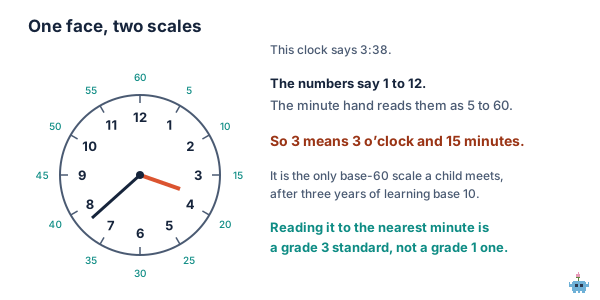
Telling time is unusual among the things children struggle with, because the difficulty is almost entirely in the instrument rather than in the child. A clock face carries two different scales printed on one set of numbers, and it runs in base 60 after three years of practice in base 10. Nothing else a child meets works that way.
Why the clock is genuinely hard
Four real reasons, in the order they usually bite.
- Two scales, one set of numbers. The face shows 1 to 12. The minute hand reads those same marks as 5 to 60. Adults stopped noticing this decades ago; a seven-year-old has to hold both at once.
- Base 60. Sixty minutes in an hour, sixty seconds in a minute, and the numbers on the face go up in fives. This is the first and for years the only non-decimal system a child meets, and it arrives while they are still consolidating place value in tens.
- The hour hand is almost never on a number. Most of the time it sits between two, and the rule is not rounding: 3:55 is three o’clock, even though the hand is much closer to the 4. Almost no worksheet says this out loud.
- There is barely any incidental practice left. A generation ago a child saw an analog clock in every room and read it a hundred times a week without being taught. That is simply gone, and it has to be replaced deliberately rather than assumed.
What the standards actually ask, and when
This is worth knowing before you worry, because the thing most parents test for is a full two years ahead of where they think it is.
- Grade 1: hours and half-hours. 1.MD.B.3 asks students to tell and write time in hours and half-hours, and it names analog and digital clocks explicitly. So analog is in the standards from the start; it is not an optional extra.
- Grade 2: to the nearest five minutes, with a.m. and p.m. 2.MD.C.7. This one quietly depends on skip counting by fives, which is a grade 2 standard of its own, 2.NBT.A.2. A child who cannot skip count by fives cannot read the minute scale, and that is a counting problem wearing a clock costume.
- Grade 3: to the nearest minute, and intervals. 3.MD.A.1 asks students to tell and write time to the nearest minute, measure time intervals in minutes, and solve word problems involving adding and subtracting those intervals. The standard names a number line diagram as the representation, which is the single most useful sentence in the whole sequence and almost nobody uses it.
- Grade 4: conversions and elapsed-time word problems. 4.MD.A.1 covers the relative sizes of hours, minutes and seconds and expressing a larger unit in a smaller one. 4.MD.A.2 puts it into word problems.
Reading a clock to the minute is a grade 3 standard. A six-year-old who can do o’clock and half past is exactly where the standards put them, and a second grader who cannot do 3:38 is two years inside the requirement, not behind it.
The five-minute check
Four questions on a real clock with hands. Each one fails differently, which is the point: you want to know which thing is missing, not whether something is.
- “Point to the minute hand.” Not what time is it. If they point at the short one, nothing after this will work, and the fix is one sentence: the long hand has further to go because it has more to count.
- Set it to 3:15 and ask. If you get “three three” or “three and a quarter past”, the minute scale is missing: they are reading the 3 as a 3. This is the most common failure and the most quickly fixed.
- Set it to 3:55 and ask. If you get 4:55, the hour-hand rule is missing. This is a different problem from the one above and needs a different sentence.
- “It is 2:15. Dinner is at 3:05. How long?” Elapsed time, which is grade 3 work and is a separate skill from reading a clock. Many children who read a clock perfectly cannot do this, and many who can do this still stumble on 3:55.
What to actually do
- One hand at a time. Cover the minute hand with a sticky note for a week and only ask roughly what hour it is. Then cover the hour hand and only ask the minutes. Almost all the confusion is the two hands interfering, and separating them removes it without explaining anything.
- Write the second scale on. Take a cheap clock or a printed face and write 5, 10, 15 and so on next to each number in a different color. You are not cheating: you are making visible the thing the instrument expects a child to memorize. Take the numbers off later.
- Skip count by fives around the face, out loud, pointing. It is the grade 2 prerequisite, it takes twenty seconds, and doing it on the clock rather than on a number chart is what connects the two.
- Say the hour-hand rule as a rule. “The hour is the number it has gone past.” Then set 3:55, 8:50 and 11:58 and let them apply it three times. This is a two-minute fix for something that otherwise persists for years.
- Do elapsed time on a number line, not on the clock. 2:15 to 3:05 is a jump of 45 minutes to 3:00 and then 5 more. Draw it. The standard itself names the number line diagram, and trying to do it by counting around a dial is what makes it feel impossible.
- Put an analog clock where they actually look, and ask at random moments rather than at practice time. The incidental repetition is the thing that has been lost, and it is the thing that made it easy for everybody who found it easy.
What is not the problem
- Being fine on digital and lost on analog is normal. The standards treat them as two things, name both, and only expect analog fluency to the minute by grade 3.
- It is not a sign of a math problem. The clock is an instrument with a strange design, and reading it is closer to reading a map than to arithmetic. Plenty of strong mathematicians were slow with clocks.
- Quarter past, half past and quarter to are a separate vocabulary. A child can read 3:15 perfectly and not know it is called quarter past, and that is a language gap rather than a time one. It also leans on knowing what a quarter is, which is its own topic.
- Slow is not stuck. A child who works it out in eight seconds by skip counting is doing exactly what the standard describes. Speed comes from repetition afterwards.
Where this sits in the year
Time is a small part of a large domain. Measurement and Data is 8 of the 25 grade 3 math standards, and time is one of them; in grade 2 the same domain is 10 of 26. The full standard-by-standard guides:
- Grade 1 math, where hours start
- Grade 2 math, five minutes and a.m./p.m.
- Grade 3 math, to the minute and intervals
- What a third grader should know, all three subjects
The short version
The clock is the hard part, not the child. One face carries two scales on the same numbers, it runs in base 60, and the hour hand spends almost all of its time between two numbers with a rule nobody says out loud.
Ask four things on a real clock. Point to the minute hand. Read 3:15. Read 3:55. Then work out how long from 2:15 to 3:05. Each one fails differently and tells you which sentence your child is missing.
Then fix it with the instrument rather than with worksheets: cover one hand for a week, write the minute numbers onto the face, skip count by fives around it out loud, say the hour-hand rule as a rule, and do elapsed time on a number line because the standard itself says to.
And check the year before worrying. Hours and half-hours are grade 1, five minutes and a.m./p.m. are grade 2, and to the nearest minute is grade 3.
Sprout Lessons builds standards-aligned lessons for grades K–12, around whatever your child is actually into. Start free.
Standard wording checked 20 September 2026 against our copy of the Common Core dataset, accessed 2026-07-16, not written from memory. Read the official text at the Common Core measurement and data standards. Common Core State Standards © 2010 National Governors Association Center for Best Practices and Council of Chief State School Officers. All rights reserved. This product is not endorsed by NGA/CCSSO. Not every state uses Common Core and some sequence these topics differently: check your state department of education for the standards that apply to you.
FAQ
At what age should a child be able to tell the time?
By the standards rather than by age: hours and half-hours are grade 1 at 1.MD.B.3, which names analog and digital clocks explicitly; to the nearest five minutes with a.m. and p.m. is grade 2 at 2.MD.C.7; and to the nearest minute, plus measuring time intervals in minutes, is grade 3 at 3.MD.A.1. So a six-year-old who can do o-clock and half past is exactly where the standards put them, and a second grader who cannot read 3:38 is inside the requirement rather than behind it.
Why does my child say 4:55 instead of 3:55?
Because the hour hand is nearly on the 4 and nobody has told them the rule. The hour is the number the hand has passed, not the number it is nearest, which is not rounding and is almost never said out loud on a worksheet. It is a two-minute fix: state the rule, then set 3:55, 8:50 and 11:58 and have them apply it three times.
Why is telling the time so hard for children?
Four reasons. The face carries two scales on one set of numbers, so the 3 means both 3 and 15. It runs in base 60, which is the first non-decimal system a child meets and it arrives while they are still consolidating place value in tens. The hour hand is almost never on a number and the rule for reading it is counterintuitive. And there is barely any incidental practice left, because analog clocks are no longer in every room.
How do I teach elapsed time?
On a number line, not on a clock face. 3.MD.A.1 names a number line diagram as the representation, which is the single most useful sentence in the whole sequence and almost nobody uses it. From 2:15 to 3:05 is a jump of 45 minutes to 3:00 and then 5 more, so 50 minutes. Counting around a dial is what makes it feel impossible.
Does my child need to read an analog clock at all?
Yes, if you are following Common Core. 1.MD.B.3 names analog and digital clocks explicitly from grade 1, so analog is in the standards from the start rather than being an optional extra. Being fluent on digital and lost on analog is normal and expected; the standards treat them as two things.
Is trouble with clocks a sign of a math problem?
Not usually. The clock is an instrument with a strange design, and reading it is closer to reading a map than to arithmetic. A child who works out the time in eight seconds by skip counting is doing exactly what the standard describes, and speed comes from repetition afterwards. Quarter past and quarter to are also a separate vocabulary, so a child can read 3:15 perfectly and not know what it is called.