
Year 4 has one hard deadline in the whole of the Australian Curriculum, and it is the times tables. AC9M4A02 asks students to “recall and demonstrate proficiency with multiplication facts up to 10 x 10 and related division facts”. Nothing else in primary maths is worded that firmly, and nothing else in Year 4 matters as much.
The rest of this page is what Version 9 actually asks of a Year 4 student across maths, English and science, a five-minute check you can run at the kitchen table, and the list of things people expect in Year 4 that are not Year 4 at all. That second list is longer than anyone expects and it heads off most of the worry.
Year 4 by the numbers
Three learning areas, three counts, read from the curriculum rather than estimated. These are content descriptions, which is the unit a teacher plans from.
- Maths: 23 content descriptions. Number 9, Measurement 4, Space 3, Statistics 3, Algebra 2, Probability 2. Number is nearly half the year on its own.
- English: 28. Language 12, Literacy 11, Literature 5. English carries more content descriptions than maths in Year 4, which surprises most parents, and the Language strand is the biggest single block in the year across either subject.
- Science: 12. Science Inquiry 6, Science Understanding 4, Science as a Human Endeavour 2. Half of Year 4 science is about how you find things out rather than what is known.
The thing that makes Year 4 different
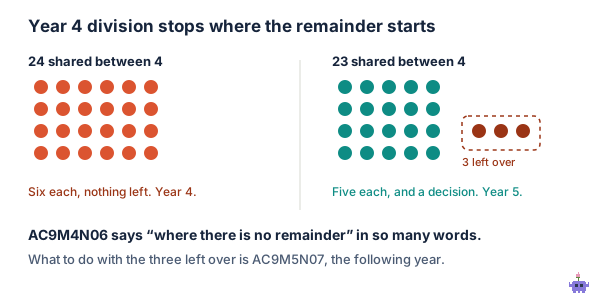
That clause is easy to miss and it explains a lot. A Year 4 student who divides 24 by 4 without hesitating and then stalls completely on 23 divided by 4 has not developed a gap. Interpreting a remainder is AC9M5N07, the following year, where the curriculum asks students to interpret it according to the context and express the result as a whole number, decimal or fraction. Three left over means an extra bus, or a leftover, or 5.75, depending entirely on the situation, and no rule handles it.
Seven things a Year 4 student should manage by December
Phrased as a parent would check them rather than as the curriculum phrases them.
- Recall the multiplication facts to 10 x 10, and the division facts with them. AC9M4A02, and the division half is the one that gets skipped. Knowing 7 x 8 is 56 is supposed to make 56 divided by 7 immediate. Which tables are due in which year, and why 10 x 10 is the ceiling, is its own page.
- Read and write decimals to tenths and hundredths. AC9M4N01. Decimals arrive in Year 4, as an extension of place value rather than as a new topic, which is exactly how they should be taught.
- Find equivalent fractions with related denominators, and connect them to decimals. AC9M4N03. Related means one denominator is a multiple of the other, and that restriction runs until Year 6.
- Count by fractions, including mixed numerals, on a number line. AC9M4N04. The number line is named in the descriptor, and it is the part most home practice never reaches.
- Multiply and divide by multiples and powers of 10, without a calculator. AC9M4N05, using the multiplicative relationship between place values rather than a rule about moving the decimal point.
- Solve duration problems, including am and pm and unit conversions. AC9M4M03. How long from 2:15 pm to 3:05 pm is Year 4 work in this country. If the clock itself is the problem rather than the arithmetic, that is a separate and very fixable thing.
- Find an unknown value in an addition or subtraction equation. AC9M4A01. This is the first quiet step towards algebra and it is usually the least noticed descriptor in the year.
What is not Year 4
The half nobody answers. Several of these are the exact things a worried parent reaches for as a test.
- Remainders. AC9M4N06 says “where there is no remainder”. Interpreting a remainder is AC9M5N07, in Year 5.
- The formula for the area of a rectangle is Year 6. This one genuinely surprises people. AC9M6M02 is where students establish it. Year 4 recognises ways of measuring and approximating perimeter and area using formal and informal units, AC9M4M02, and Year 5 solves practical perimeter and area problems in metric units. Length times width as a formula is two years away.
- Adding and subtracting fractions is Year 5. AC9M5N05, and even then only with the same or related denominators.
- Percentages are Year 5. AC9M5N04, starting from 100% as the complete whole.
- Multiplying and dividing fractions is Year 7. There is no primary content description for either; both sit inside AC9M7N06.
- Negative numbers are Year 6. AC9M6N01 is where integers first appear.
- The 11 and 12 times tables are not in the curriculum at all. The ceiling is 10 x 10, stated in AC9M4A02, and that is the whole requirement.
- No formal written algorithm is ever mandated. Not for multiplication and not for division, in any year. What the curriculum actually says about long division is considerably less than almost everyone assumes.
If your Year 4 child cannot do the things on this list, they are not behind. They are on schedule, and in several cases two or three years early.
The five-minute check
Four questions, in this order. You are listening to the reasoning rather than marking the answer.
- “What is 7 times 8?” By the end of Year 4 this should be immediate, because the descriptor says recall. A child who rebuilds it in a few seconds from 7 x 4 doubled is on the way and doing it correctly. A child counting on their fingers is paying a tax on every piece of maths they attempt, and this is the thing to fix before anything else.
- “And 56 divided by 7?” Ask it straight afterwards. The descriptor pairs the two deliberately, and the division half is where a chanted table falls apart.
- “Which is bigger, 0.7 or 0.65?” Decimals arrive this year at AC9M4N01, and 0.65 is a common wrong answer because the number is longer. That misconception has its own page.
- “It is 2:15 pm. Training starts at 3:05 pm. How long until then?” AC9M4M03. Fifty minutes, and the useful way to get there is a jump of 45 to 3:00 and then 5 more, drawn on a line rather than counted around a dial.
If something is missing
- Fix recall before anything that depends on it. Year 5 asks for factors and multiples, comparing fractions using them, and division with remainders, and none of it is reachable while 7 x 8 is being worked out.
- Practise the division facts as facts, not as a separate topic. Say them in pairs out loud: seven eights are fifty-six, fifty-six divided by seven is eight. The descriptor treats them as one thing, so learning them as two is doing twice the work.
- Use the number line for fractions and for time. Both descriptors name it, and it is the representation most home practice skips in favour of pictures of pizzas and pictures of clocks.
- Do not accelerate into Year 5 to catch up. The order is load-bearing: remainder-free division is what makes remainders make sense next year, and skipping it produces a child with a procedure and no estimate.
- Short and often beats a weekend blitz. The plan for doing this at home without a tutor is its own page.
A note on which curriculum applies to you
Everything above is Version 9 of the Australian Curriculum, which most states and territories use. Victoria does not. Victorian schools follow the Victorian Curriculum F–10 Version 2.0, which is derived from the Australian Curriculum but is a separate document with its own codes, and the differences are set out here. New South Wales runs its own K–10 syllabuses organised by stage rather than year, so a Year 4 student there is in Stage 2, covered in our NSW explainer. Check your state before you check your child.
Where to go next
The full descriptor-by-descriptor guides for Year 4:
- Year 4 maths, all 23 content descriptions
- Year 4 English, all 28
- Year 4 science, all 12
- The Victorian version, if you are in Victoria
- The NSW Stage 2 version, if you are in New South Wales
The short version
Year 4 is 23 maths content descriptions, 28 English and 12 science. The one deadline that matters is AC9M4A02: recall the multiplication facts to 10 x 10 and the related division facts. Decimals arrive this year, fractions reach equivalence with related denominators, and duration problems with am and pm are Year 4 work.
Check four things. Seven times eight. Fifty-six divided by seven, straight afterwards. Whether 0.7 beats 0.65. And how long from 2:15 pm to 3:05 pm.
Then check the other list. Remainders are Year 5, adding fractions is Year 5, percentages are Year 5, the area formula is Year 6, negative numbers are Year 6, multiplying and dividing fractions is Year 7, the 11 and 12 times tables are nowhere, and no written algorithm is ever required. A Year 4 student who cannot do those is exactly where they should be.
Sprout Lessons builds curriculum-aligned lessons for Foundation to Year 10, with the code on every lesson. Start free.
Codes, counts and descriptor wording checked 20 September 2026 against our copy of the Machine Readable Australian Curriculum Version 9, accessed 2026-06-24, not written from memory. Read the official text at the Australian Curriculum Year 4 mathematics page. Australian Curriculum content © ACARA, licensed under CC BY 4.0. Counts are of content descriptions and exclude achievement standards and elaborations. Victoria and New South Wales run their own documents: check the one that applies to you.
FAQ
What should a Year 4 student know in maths?
Year 4 is 23 maths content descriptions in Version 9 of the Australian Curriculum: Number 9, Measurement 4, Space 3, Statistics 3, Algebra 2, Probability 2. By December a Year 4 student should recall the multiplication facts to 10 x 10 and the related division facts, read and write decimals to tenths and hundredths, find equivalent fractions with related denominators, count by fractions including mixed numerals on a number line, multiply and divide by multiples and powers of 10 without a calculator, solve duration problems involving am and pm, and find an unknown value in an addition or subtraction equation.
Which times tables should a Year 4 student know?
All of them up to 10 x 10, and the related division facts with them. AC9M4A02 asks students to recall and demonstrate proficiency with multiplication facts up to 10 x 10 and related division facts, and to extend and apply those facts to develop efficient mental strategies for larger numbers without a calculator. The ceiling is 10 x 10: the 11 and 12 times tables are not in the Australian Curriculum at all.
Should a Year 4 student be able to do division with remainders?
No. AC9M4N06 asks for efficient strategies for addition and subtraction, and multiplication and division, where there is no remainder. That clause is in the descriptor. Interpreting a remainder is AC9M5N07 in Year 5, which asks students to interpret it according to the context and express the result as a whole number, decimal or fraction. A child who divides 24 by 4 without hesitating and stalls on 23 divided by 4 is on schedule.
When do Australian students learn the formula for the area of a rectangle?
Year 6. AC9M6M02 is where students establish the formula for the area of a rectangle and use it to solve practical problems. Year 4 recognises ways of measuring and approximating perimeter and area using formal and informal units at AC9M4M02, and Year 5 solves practical perimeter and area problems in metric units at AC9M5M02. Length times width as a formula is two years after Year 4, which surprises most parents.
How many content descriptions does Year 4 have?
Maths 23, English 28 and science 12. English carries more than maths in Year 4, with Language 12, Literacy 11 and Literature 5, and the Language strand is the biggest single block in the year across either subject. Science splits into Science Inquiry 6, Science Understanding 4 and Science as a Human Endeavour 2, so half of Year 4 science is about how you find things out rather than what is known.
Does this apply in Victoria and New South Wales?
Not directly. Victoria follows the Victorian Curriculum F-10 Version 2.0, which is derived from the Australian Curriculum but is a separate document with its own codes. New South Wales runs its own K-10 syllabuses organised by stage rather than by year, so a Year 4 student there is in Stage 2. The sequence is broadly similar in both, but the codes and the exact wording differ, so check the document that applies to your state.