
Year 4 Maths in the Australian Curriculum Version 9 is 23 content descriptions, AC9M4A01 through AC9M4ST03, unchanged in count from Year 3 but very different in weight. The single biggest shift is AC9M4N01: decimals arrive. Everything a student does with decimals from Year 5 onwards, comparing, ordering, adding, converting to percentages, rests on whether this one descriptor lands properly. Alongside it, multiplication facts push to 10 × 10, and Probability moves from words to numbers.
This is a working guide to all 23 codes: what changes from Year 3, the three descriptors that decide whether Year 5 goes well, a term-by-term order, and the checks that tell you whether a child is ready to move on.
What changes this year
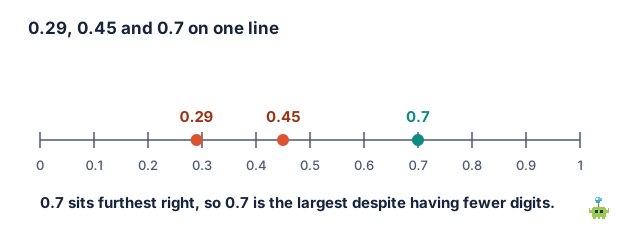
Year 3 treated fractions as numbers for the first time, halves, thirds, quarters, fifths and tenths, named and combined. Year 4 takes that same idea and extends it one more step: AC9M4N01 asks students to recognise and extend the application of place value to tenths and hundredths, and use the conventions of decimal notation to name and represent decimals. A decimal is not a new kind of number, it is the same place-value rule that governs hundreds, tens and ones, continued past the ones column. Students who treat it as a new system rather than an extension are the ones who believe 0.45 is bigger than 0.7 because it has more digits. We cover the descriptor in full, including the four misconceptions that reliably derail it, in the dedicated AC9M4N01 guide.
Multiplication makes a parallel jump. AC9M4A02 pushes fact recall from Year 3’s 3, 4, 5 and 10 to the full set up to 10 × 10, and asks for efficient mental strategies for larger numbers without a calculator. This is the year times tables stop being a Year 3 subset and become the complete set a student is expected to carry into Year 5’s multi-digit computation.
And Probability grows up. Year 3’s AC9M3P01 and AC9M3P02 dealt in words, likely, unlikely, certain, impossible. AC9M4P01 keeps the words but adds ordering outcomes by likelihood and distinguishing independent from dependent events, the first hint of numerical probability that becomes explicit fractions and percentages by Year 6.
The year at a glance
| Strand | Codes | What it covers |
|---|---|---|
| Number | 9 (AC9M4N01–09) | Decimal place value to hundredths, odd and even numbers, fraction equivalence and the fraction-decimal connection, counting by fractions, multiplying and dividing by powers of 10, computation strategies, estimation, financial modelling, and algorithms |
| Algebra | 2 (AC9M4A01–02) | Finding unknown values in equations using number properties, and multiplication facts to 10 × 10 with related division facts |
| Measurement | 4 (AC9M4M01–04) | Measuring with unmarked and partial units, perimeter and area, duration including am and pm, and naming angles beyond a right angle |
| Probability | 2 (AC9M4P01–02) | Ordering outcomes by likelihood and identifying independent or dependent events, and observing relationships between outcomes across repeated experiments |
| Space | 3 (AC9M4SP01–03) | Composite shapes from combinations of familiar shapes, grid reference systems, and line and rotational symmetry |
| Statistics | 3 (AC9M4ST01–03) | Acquiring categorical and discrete numerical data with digital tools, analysing the effectiveness of different displays, and conducting statistical investigations |
Number carries nine of the twenty-three codes, two more than Year 3’s seven, mostly because decimals (AC9M4N01) and odd-and-even properties (AC9M4N02) are new arrivals inside the strand rather than extensions of existing Year 3 descriptors.
Reading the codes
The pattern is unchanged from Year 3: AC9M + year + strand + number, so AC9M4N01 is Year 4 Number, position 1. Strand letters remain N Number, A Algebra, M Measurement, P Probability, SP Space, ST Statistics.
Strand by strand
Number (AC9M4N01 to AC9M4N09)
AC9M4N01, decimal place value, is covered above. AC9M4N02 is new this year, explaining and using the properties of odd and even numbers. AC9M4N03 finds equivalent representations of fractions using related denominators and connects fractions to decimal notation, the direct partner to AC9M4N01, best taught in the same unit rather than as separate topics. AC9M4N04 extends fraction work to counting by fractions including mixed numerals, locating and representing them on number lines. AC9M4N05 covers multiplying and dividing natural numbers by multiples and powers of 10, using the multiplicative relationship between place-value columns rather than a “move the point” trick. AC9M4N06 develops efficient strategies and digital tools for the four operations where division has no remainder. AC9M4N07 covers estimation and rounding to check reasonableness, including financial transactions. AC9M4N08 is the applied pair, modelling additive and multiplicative situations including financial contexts. AC9M4N09 covers following and creating algorithms using addition or multiplication to generate number sets and describe emerging patterns.
Algebra (AC9M4A01 to AC9M4A02)
AC9M4A01 asks students to find unknown values in numerical equations involving addition and subtraction, using the properties of numbers and operations, extending Year 3’s inverse-operations work into equation-solving language. AC9M4A02, covered above, is the multiplication facts to 10 × 10 descriptor, the year’s computational centrepiece.
Measurement (AC9M4M01 to AC9M4M04)
AC9M4M01 extends Year 3’s labelled-instrument measuring to interpreting unmarked and partial units across length, mass, capacity, duration and temperature, using scaled and digital instruments. AC9M4M02 is new, recognising ways of measuring and approximating perimeter and area with formal and informal units. AC9M4M03 extends time work to duration problems including am and pm and unit conversions. AC9M4M04 extends Year 3’s right-angle comparison to naming angles, acute, obtuse, straight, reflex and revolution, against that same right-angle reference.
Probability (AC9M4P01 to AC9M4P02)
AC9M4P01, covered above, adds ordering by likelihood and independent versus dependent events to Year 3’s describing-and-naming work. AC9M4P02 extends repeated chance experiments to observing relationships between outcomes, not just recording that variation exists.
Space (AC9M4SP01 to AC9M4SP03)
AC9M4SP01 covers representing and approximating composite shapes from combinations of familiar shapes. AC9M4SP02 extends Year 3’s landmark-locating maps into formal grid reference systems with directions. AC9M4SP03 is new, recognising line and rotational symmetry and creating symmetrical patterns, including with dynamic geometric software.
Statistics (AC9M4ST01 to AC9M4ST03)
AC9M4ST01 extends data acquisition to digital tools and many-to-one pictographs alongside column graphs. AC9M4ST02 is new, analysing the effectiveness of different displays and discussing the shape of distributions and variation, a genuine step up from Year 3’s compare-and-interpret work. AC9M4ST03 extends guided investigations into full statistical investigations, from survey design through to communicating results.
The three codes that decide Year 5
AC9M4N01: place value continues past the ones column, it does not restart
The misconception: that a decimal is a different kind of number to a whole number, so more digits after the point means a bigger value, 0.45 read as larger than 0.7.
What you will see: asked to order 0.7, 0.45 and 0.29, a student sorts them as if comparing whole numbers, placing 0.45 above 0.7. Asked to build 0.3 with base-ten materials, the same student may reach for three ones rather than three tenths. The full breakdown, including four separate misconceptions and a five-step teaching sequence, is in the dedicated AC9M4N01 guide.
The fix: extend the bundling language used for whole-number place value in the other direction, ten tenths make one whole, the same relationship as ten ones make one ten, so a decimal place is one more column on a familiar chart rather than a different kind of number.
AC9M4A02: multiplication facts as a relationship, not a memorised chant
The misconception: that knowing facts to 10 × 10 means having them recited in order, independent of understanding what multiplication represents or how it connects to division.
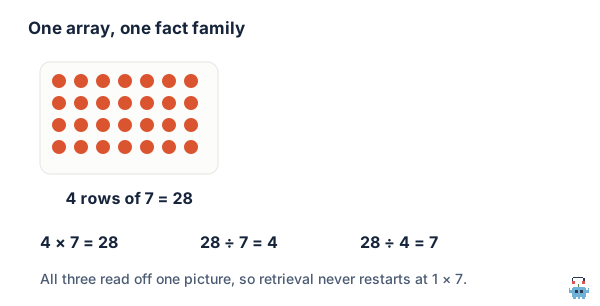
What you will see: a student who can chant the sevens fluently but, given 4 × 7 out of sequence, has to restart from 1 × 7 to get there. The same student, given a word problem about sharing 63 stickers among 9 friends, may not recognise it as a division problem at all.
The fix: build every new fact family from an array or equal-groups model before drilling recall, and always pair a multiplication fact with its two related division facts as one family, so retrieval does not depend on reciting a sequence from the start.
AC9M4N03: a fraction, a decimal and a percentage are the same number in different clothes
The misconception: that fractions and decimals are unrelated topics that happen to be taught in the same term, so a student can compute 3/10 and 0.3 correctly in isolation but cannot say they are the same number.
What you will see: shown 0.3 and asked to write it as a fraction, a student hesitates or guesses 1/3, confusing the digit with the fraction name rather than reading the place value.
The fix: teach AC9M4N01 and AC9M4N03 in the same unit, and require every decimal task to be answered three ways, as a fraction, as a decimal, and located on a number line, so the equivalence is practised as a habit rather than asserted as a rule.
What students need to arrive with
Year 4 leans on two Year 3 codes directly. AC9M3N02 (unit fractions, understood as numbers rather than shapes) is the prerequisite for both AC9M4N01 decimals and AC9M4N03 fraction equivalence. AC9M3A03 (multiplication facts for 3, 4, 5 and 10) is the prerequisite for extending to the full set to 10 × 10 in AC9M4A02. A child who arrives without a secure sense of a fraction as a number, not just a folded shape, should not start decimal place value; the fix is a short return to Year 3’s unit fractions work rather than pushing ahead into tenths and hundredths.
What this year sets up
- AC9M4N01 (decimal place value to hundredths) becomes Year 5’s decimals beyond two places, and the foundation for Year 6’s percentages.
- AC9M4A02 (multiplication facts to 10 × 10) becomes Year 5’s multi-digit multiplication and division, computed on facts that should already be automatic.
- AC9M4N03 (fraction-decimal equivalence) becomes Year 5’s work converting between fractions, decimals and percentages fluently.
- AC9M4P01 (ordering outcomes by likelihood, independent versus dependent events) becomes Year 5’s numerical representations of probability.
Victorian families following VC2 instead should note Level 4 covers the same territory under a different code prefix; NSW families should see Stage 2 Maths, which bundles this Year 4 content with Year 3 into one syllabus stage. Our guide to which curriculum your state uses is worth checking if you are unsure which applies to your child.
A term-by-term order
- Term 1: extend and consolidate. AC9M4A01 unknown values in equations, AC9M4SP01 composite shapes, AC9M4N02 odd and even properties, and AC9M4M01 measuring with unmarked and partial units, confirming Year 3 held before adding new structure.
- Term 2: decimals and fraction equivalence. AC9M4N01 decimal place value as the centrepiece, taught in the same unit as AC9M4N03 fraction-decimal connections and AC9M4N04 counting by fractions on a number line.
- Term 3: multiplication to 10 by 10, algorithms and probability. AC9M4A02 facts to 10 × 10, AC9M4N05 multiplying and dividing by powers of 10, AC9M4N09 algorithms, and AC9M4P01 and AC9M4P02 ordered likelihood and repeated experiments.
- Term 4: apply and extend. AC9M4N06 to AC9M4N08 computation strategies, estimation and financial modelling, AC9M4M02 to AC9M4M04 perimeter, area, duration and angles, AC9M4SP02 and AC9M4SP03 grid references and symmetry, and AC9M4ST01 to AC9M4ST03 data acquisition, display analysis and statistical investigations.
Decimals and fraction equivalence sit together in Term 2, deliberately before multiplication facts get pushed to their full range in Term 3, because a student who already trusts that 0.3 and 3/10 are the same number has an easier time trusting that 4 × 7 and 7 × 4 are too.
Assessment checkpoints
- Number: ask which is bigger, 0.7 or 0.45, and why. A place-value explanation confirms AC9M4N01; a digit-count guess means reteach decimals as an extension of the bundling model before moving on.
- Algebra: ask for 7 × 4 out of sequence, then the related division fact, 28 divided by 4. Confident recall of both confirms AC9M4A02; needing to restart the sequence means reteach the fact families as related, not memorised in isolation.
- Measurement: hand the child a shape made from two rectangles and ask for its perimeter and area. Correct working for both confirms AC9M4M02; confusing the two measures means reteach perimeter and area as separate, named questions before combining them.
- Probability: ask the child to order three events by likelihood and explain whether drawing two cards without replacement makes the second draw independent or dependent. A correct order and explanation confirms AC9M4P01; confusion between the two events means reteach independence with a concrete example, replacing versus not replacing a card.
- Statistics: show the child two different displays of the same dataset and ask which communicates the data better and why. A reasoned comparison confirms AC9M4ST02; a preference with no justification means reteach comparing displays against the question being asked.
Recording the alignment
Whether you are programming for a class or building evidence for a homeschool registration review, record the code on the activity as you go. “Maths worksheet” tells a reviewer nothing; “AC9M4N01, tenths and hundredths on a number line, 12 May” answers the question before it is asked. Our guide to state-by-state registration requirements covers what reviewers actually ask for, and teaching maths through interests covers how to wrap these codes around whatever your child is currently into.
Sprout Lessons builds a full interactive lesson from any of these codes, pitched at Year 4 and wrapped in whatever your student is into, with self-checking practice that hints rather than just marking wrong, and the exact AC9 code recorded in the lesson footer. Try it free and generate a Year 4 Maths lesson in about a minute. You can also browse ready-made Year 4 Maths lessons against these codes directly.
Australian Curriculum content descriptions are © ACARA and licensed under CC BY 4.0. Quoted here unmodified. ACARA does not endorse this product. Always verify against the current content descriptions and achievement standards at australiancurriculum.edu.au.
FAQ
How many maths codes are there in Year 4 of the Australian Curriculum?
Twenty-three: nine in Number (AC9M4N01 to AC9M4N09), two in Algebra (AC9M4A01 and AC9M4A02), four in Measurement (AC9M4M01 to AC9M4M04), two in Probability (AC9M4P01 and AC9M4P02), three in Space (AC9M4SP01 to AC9M4SP03) and three in Statistics (AC9M4ST01 to AC9M4ST03).
What is new in Year 4 maths that was not in Year 3?
Decimals arrive for the first time (AC9M4N01), multiplication facts push from Year 3’s 3, 4, 5 and 10 to the full set to 10 × 10 (AC9M4A02), and probability moves from describing outcomes in words to ordering them by likelihood and identifying independent versus dependent events (AC9M4P01).
What is the most important Year 4 maths code?
AC9M4N01, decimal place value to hundredths. Almost everything a student does with decimals from Year 5 onwards, comparing, ordering, adding and converting to percentages, rests on whether this descriptor actually landed. See the dedicated AC9M4N01 guide for the four misconceptions that reliably derail it.
Why does my child think 0.45 is bigger than 0.7?
This is the standard misconception behind AC9M4N01: applying whole-number logic, where more digits means a bigger value, to decimals. The fix is extending the same bundling language used for whole-number place value in the other direction, ten tenths make one whole, so a decimal place is one more column on a familiar chart, not a different kind of number.
How do I check if my child is ready to move from Year 4 to Year 5 maths?
Ask them to order 0.7, 0.45 and 0.29 from smallest to largest and explain their reasoning. A place-value explanation confirms decimal place value (AC9M4N01) is secure; sorting by digit count means the concept needs reteaching before Year 5 extends decimals past two places.