
Stage 2 Mathematics in NSW is 20 outcomes, MA2-2DS-01 through MA2-RN-02, and it covers two full years, Year 3 and Year 4, in one syllabus stage. Where the Australian and Victorian curricula split that span into two separate year-level code sets, each with its own headline change (Probability arrives in Year 3, decimals arrive in Year 4), NSW folds both shifts into the same 20 outcomes and leaves the pacing to the teacher.
This guide covers all 20 outcomes by focus area, what the two-year grain means for planning across a stage that contains two genuinely different leaps, the three outcomes that decide whether Stage 3 goes well, a term-by-term-across-two-years order, and five checks before moving on.
What a two-year stage that spans two big leaps actually means
Stage 2 outcomes describe what a student can do by the end of Year 4, not partway through Year 3. NSW splits each outcome into a Year A and Year B focus area label internally, but this is a content-organisation device, not a promise that A is Year 3 content and B is Year 4. That matters more at this stage than most, because it contains two of the biggest conceptual jumps in primary maths: chance reasoning moving from words to repeated experiments, and fractions turning into decimals. A teacher used to the national curriculum’s year-by-year split has to decide, without the syllabus telling them, whether to spread those two leaps across the stage or tackle them back to back.
The coarser grain also means each outcome bundles more territory than its AC9 or VC2 counterpart. MA2-PF-01, for example, covers halves, quarters, thirds and fifths as lengths on a number line, and the related fractions formed by halving them, eighths, sixths and tenths, which is roughly the combined territory of the fraction descriptors nationally split across Year 3 and part of Year 4. One NSW outcome can cover what takes two separate year-level posts under AC9 or VC2. See the NSW syllabuses explained for the wider structure, and Year 3 Maths and Year 4 Maths under the Australian Curriculum for how the same two years look when split by year.
The stage at a glance
| Focus area | Outcomes | What it covers |
|---|---|---|
| Representing numbers using place value | MA2-RN-01, MA2-RN-02 | Place value and the role of zero to tens of thousands; representing and comparing decimals to two places |
| Additive relations | MA2-AR-01, MA2-AR-02 | Mental and written strategies for addition and subtraction with 2- and 3-digit numbers; missing values in number sentences |
| Multiplicative relations | MA2-MR-01, MA2-MR-02 | The structure of multiplication and division to 10 × 10; missing values in multiplication and division number sentences |
| Partitioned fractions | MA2-PF-01 | Halves, quarters, thirds and fifths as lengths on a number line, and related fractions formed by halving |
| Geometric measure | MA2-GM-01, MA2-GM-02, MA2-GM-03 | Grid maps and directional language; length in metres, centimetres and millimetres; angles compared to a right angle |
| Non-spatial measure | MA2-NSM-01, MA2-NSM-02 | Mass in kilograms and grams; analog and digital time to the second |
| 2D spatial structure | MA2-2DS-01, MA2-2DS-02, MA2-2DS-03 | Comparing shape features; combining and splitting shapes by transformation; area in square centimetres and square metres |
| 3D spatial structure | MA2-3DS-01, MA2-3DS-02 | Models and nets of prisms and pyramids; capacity in litres and millilitres, volume in cubic centimetres |
| Chance | MA2-CHAN-01 | Recording and comparing the results of chance experiments |
| Data | MA2-DATA-01, MA2-DATA-02 | Collecting discrete data and constructing scaled graphs; interpreting tables, dot plots and column graphs |
Decimals appear for the first time at Stage 2 (MA2-RN-02), the same conceptual arrival point as Year 4 under the Australian Curriculum, but bundled here with the whole of Year 3 rather than isolated to its own year-level document.
Reading the codes
NSW outcome codes run learning area, stage, focus area, number: MA2-RN-01 is Mathematics, Stage 2, Representing numbers using place value, outcome 1. Stage 1 used the digit 1 where Stage 2 uses 2; Stage 3 will use 3. Two focus areas are new at this stage and have no Stage 1 equivalent: MR Multiplicative relations, replacing Stage 1’s Forming groups, and PF Partitioned fractions, replacing the fraction content folded into Stage 1’s Geometric measure outcomes.
Focus area by focus area
Representing numbers using place value (MA2-RN-01, MA2-RN-02)
MA2-RN-01 covers applying an understanding of place value and the role of zero to represent numbers to at least tens of thousands, extending Stage 1’s work to thousands. MA2-RN-02 is the stage’s headline arrival, representing and comparing decimals to two decimal places, the same conceptual leap that gets a whole dedicated blog post under AC9 and VC2 at Year 4, here folded into the same outcome pair that also carries Year 3’s whole-number place value.
Additive relations (MA2-AR-01, MA2-AR-02)
MA2-AR-01 covers selecting and using mental and written strategies for addition and subtraction with 2- and 3-digit numbers. MA2-AR-02 asks students to complete number sentences involving addition and subtraction by finding missing values, the NSW version of naming addition and subtraction as inverse operations.
Multiplicative relations (MA2-MR-01, MA2-MR-02)
MA2-MR-01 is the stage’s load-bearing outcome: representing and using the structure of multiplicative relations to 10 × 10 to solve problems, structure before recall. MA2-MR-02 is the multiplication-and-division parallel to MA2-AR-02, completing number sentences by finding missing values. We have a full single-outcome guide to MA2-MR-01 and why structure has to come before times-table recall.
Partitioned fractions (MA2-PF-01)
One outcome doing the work of two AC9 year-levels: representing and comparing halves, quarters, thirds and fifths as lengths on a number line, and the related fractions formed by halving them, eighths, sixths and tenths. The number-line framing is deliberate and distinct from a shape-based approach; a fraction here is a position, not a slice.
Geometric measure (MA2-GM-01 to MA2-GM-03)
MA2-GM-01 covers using grid maps and directional language to locate positions and follow routes. MA2-GM-02 covers measuring and estimating length in metres, centimetres and millimetres, extending Stage 1’s metres-and-centimetres work down to the millimetre. MA2-GM-03 covers identifying angles and classifying them by comparison to a right angle.
Non-spatial measure (MA2-NSM-01, MA2-NSM-02)
MA2-NSM-01 covers estimating, measuring and comparing mass in kilograms and grams. MA2-NSM-02 covers representing and interpreting analog and digital time in hours, minutes and seconds, pushing Stage 1’s half- and quarter-hour reading down to the second.
Spatial structure (MA2-2DS, MA2-3DS)
MA2-2DS-01 covers comparing two-dimensional shapes and describing their features. MA2-2DS-02 covers performing transformations by combining and splitting shapes. MA2-2DS-03 covers estimating, measuring and comparing area in square centimetres and square metres, extending Stage 1’s informal-unit array work to formal units. MA2-3DS-01 covers making and sketching models and nets of three-dimensional objects including prisms and pyramids. MA2-3DS-02 covers estimating, measuring and comparing capacity in litres and millilitres, and volume in cubic centimetres.
Chance (MA2-CHAN-01)
Recording and comparing the results of chance experiments, the direct extension of Stage 1’s vocabulary-only chance outcome into repeated trials with recorded results, the same conceptual move the national curriculum makes at Year 3.
Data (MA2-DATA-01, MA2-DATA-02)
MA2-DATA-01 covers collecting discrete data and constructing graphs using a given scale. MA2-DATA-02 covers interpreting data in tables, dot plots and column graphs, a comparison-and-explanation outcome that goes beyond building a display into drawing a conclusion from one.
The three outcomes that decide Stage 3
MA2-RN-02: decimals as an extension of place value, not a new number system
The misconception: that a decimal is a different kind of number to a whole number, so a longer decimal must be bigger, 0.45 read as larger than 0.5 because 45 has more digits than 5.
What you will see: asked to order 0.5, 0.45 and 0.6, a student sorts them as if comparing whole numbers, placing 0.45 above 0.6. Asked to build 0.3 with base-ten materials, the same student may reach for three ones rather than three tenths.
The fix: extend the same bundling language used for whole-number place value in the other direction, ten tenths make one whole, the same relationship as ten ones make one ten, so a decimal place is one more column on a familiar chart rather than a different kind of number.
MA2-MR-01: the structure behind the times tables
The misconception: that knowing multiplication facts to 10 × 10 means having them memorised as a chant, independent of understanding what multiplication represents or how it connects to division.
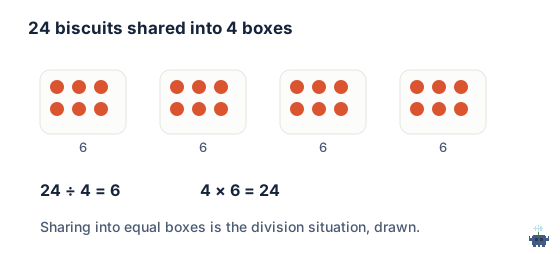
What you will see: a student who can recite the sixes fluently but, given a word problem about sharing 24 biscuits into 4 boxes, cannot identify it as a division problem at all. See the full guide to MA2-MR-01 for the misconception in detail and a fact-building order that puts structure first.
The fix: build every new fact family from an array or equal-groups model before drilling recall, and deliberately practise identifying multiplication and division situations in word problems separately from computing the answer.
MA2-PF-01: a fraction is a position on a number line, not a slice of a shape
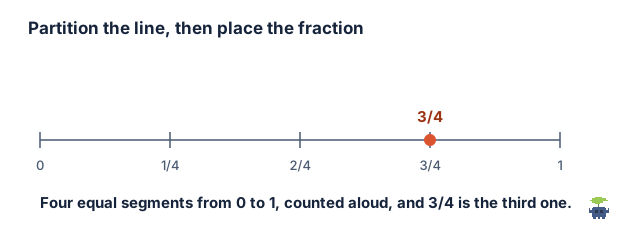
The misconception: that fractions only exist as pieces of a pizza or a cake, so a student cannot place 3/4 on a number line between 0 and 1 without a shape to anchor it to.
What you will see: a student correctly shades 3/4 of a circle but, shown a blank number line from 0 to 1, cannot mark where 3/4 sits, or marks it closer to 1 than the correct position because they are estimating rather than partitioning.
The fix: physically partition a number line into equal segments before asking a student to place a fraction on it, counting the segments aloud each time, so the number-line representation is built the same deliberate way as the shape representation rather than treated as a separate, harder skill.
What students need to arrive with
Stage 2 leans on three Stage 1 outcomes directly. MA1-RWN-01 and MA1-RWN-02 (place value to 1000) are the prerequisite for extending place value to tens of thousands in MA2-RN-01. MA1-GM-03 (halves, quarters and eighths of a length) is the direct prerequisite for MA2-PF-01’s number-line fractions. MA1-FG-01 (equal groups for multiplication and division) is the prerequisite for the structural work in MA2-MR-01. A student without secure place value to 1000 should not start extending to tens of thousands; the fix is a short return to Stage 1’s place value work rather than pushing ahead.
What this stage sets up
- MA2-RN-02 (decimals to two places) becomes Stage 3’s decimal operations and conversions between fractions, decimals and percentages.
- MA2-MR-01 (multiplicative structure to 10 × 10) becomes Stage 3’s multi-digit multiplication and division built directly on secure fact recall.
- MA2-PF-01 (fractions on a number line) becomes Stage 3’s comparing and ordering fractions with different denominators.
- MA2-CHAN-01 (recording chance experiment results) becomes Stage 3’s numerical probability, moving from recorded frequencies to fractions as a measure of chance.
Our guide to which curriculum your state uses is worth checking if you are unsure whether AC9, VC2 or a NSW syllabus applies to your child.
A term-by-term order across two years
- Year 3, Terms 1–2: extend and structure. MA2-RN-01 place value to thousands, MA2-GM-01 grid maps and directional language, MA2-2DS-01 and MA2-3DS-01 shape features and 3D models, and MA2-AR-01 mental and written strategies for 2-digit addition and subtraction.
- Year 3, Terms 3–4: chance and fractions on a line. MA2-CHAN-01 recording chance experiments, alongside the first half of MA2-PF-01, halves and quarters as number-line positions, plus MA2-GM-02 length in metres and centimetres.
- Year 4, Terms 1–2: multiplicative structure and decimals. MA2-MR-01 as the centrepiece, structure before recall, alongside MA2-RN-02 decimals to two places, taught with the same bundling language used for whole-number place value.
- Year 4, Terms 3–4: apply and extend. MA2-AR-02 and MA2-MR-02 missing-value number sentences, the remainder of MA2-PF-01 thirds and fifths, MA2-NSM-01 and MA2-NSM-02 mass and time to the second, MA2-2DS-02 and MA2-2DS-03 transformations and area, MA2-3DS-02 capacity and volume, and MA2-DATA-01 and MA2-DATA-02 collecting and interpreting data.
This is a suggested split, not an NSW requirement, since the syllabus deliberately does not assign outcomes to a specific year within the stage. Multiplicative structure sits deliberately before decimals in Year 4 because MA2-RN-02’s tenths-and-hundredths reasoning leans on the same partitioning instinct MA2-MR-01 has just spent a term building.
Five checks before Stage 3
- Place value: ask the student to order 0.5, 0.45 and 0.6 from smallest to largest. A correct order confirms MA2-RN-02; treating the decimals like whole numbers means reteach tenths and hundredths as an extension of the bundling model.
- Multiplicative relations: pose the biscuit-sharing word problem, 24 biscuits into 4 boxes, and ask the student to identify and solve it. Correct identification as division confirms MA2-MR-01; a guess or a request for the operation to be named means reteach structure separately from fact recall.
- Partitioned fractions: hand the student a blank number line from 0 to 1 and ask them to mark 3/4. An accurate position from partitioning confirms MA2-PF-01; an estimate with no partitioning means reteach number-line fractions from equal segments.
- Chance: after a set of dice-roll trials, ask the student to compare the recorded results to what they expected. A results-based comparison confirms MA2-CHAN-01; no reference to the recorded data means reteach recording before comparing.
- Data: from a class-collected dataset, ask the student to build a scaled column graph and explain one thing it shows. A correctly scaled graph with an interpretive comment confirms MA2-DATA-01 and MA2-DATA-02 together; an unscaled graph or a description with no conclusion means reteach scale and interpretation separately.
Recording the alignment
Whether you are programming for a class or building evidence for a NESA home education review, record the outcome code on the activity as you go, and note where in the two-year stage the student sits since the syllabus itself will not tell a reviewer that. “Maths worksheet” tells nobody anything; “MA2-RN-02, ordering decimals with base-ten blocks, Year 4 Term 1” answers the question before it is asked. Our guides to state-by-state registration requirements and which curriculum your state uses cover what NSW reviewers ask for and which code set applies if you have moved states.
Sprout Lessons builds a full interactive lesson from any of these outcomes, pitched at Stage 2 and wrapped in whatever your student is into, with self-checking practice that hints rather than just marking wrong, and the exact NSW outcome code recorded in the lesson footer. Try it free.
Outcome codes reference NSW syllabuses © NSW Education Standards Authority (NESA) for and on behalf of the Crown in right of the State of New South Wales, accessed viacurriculum.nsw.edu.au. NESA does not endorse this product. Always verify against the current syllabus outcomes and content.
FAQ
How many maths outcomes are there in Stage 2 of the NSW syllabus?
Twenty, covering Year 3 and Year 4 together: two in Representing numbers using place value (MA2-RN-01, MA2-RN-02), two in Additive relations, two in Multiplicative relations, one in Partitioned fractions, three in Geometric measure, two in Non-spatial measure, three in 2D spatial structure, two in 3D spatial structure, one in Chance and two in Data.
Which year does each Stage 2 maths outcome belong to, Year 3 or Year 4?
The NSW syllabus does not say. Stage 2 outcomes describe what a student can do by the end of Year 4, and NSW deliberately leaves the split between Year 3 and Year 4 to the teacher, unlike the Australian and Victorian curricula which publish separate code sets for each year.
When do NSW students learn decimals?
MA2-RN-02, representing and comparing decimals to two decimal places, sits inside Stage 2, the same conceptual arrival point as Year 4 under the Australian Curriculum. NSW bundles it with Year 3 content in the same outcome pair rather than dedicating a separate year-level document to it.
What is the most important Stage 2 maths outcome?
MA2-MR-01, the structure of multiplicative relations to 10 × 10. It decides whether times-table recall is built on real understanding of multiplication and division or just memorised as a chant, and it is the direct prerequisite for Stage 3’s multi-digit multiplication.
Why does my child order decimals like whole numbers, putting 0.45 above 0.6?
This is the standard misconception behind MA2-RN-02: treating a decimal as a longer whole number rather than an extension of place value into tenths and hundredths. The fix is extending the same bundling language used for ones, tens and hundreds in the other direction, ten tenths make one whole, so a longer decimal is not automatically a bigger one.