
Stage 1 Mathematics in NSW is 16 outcomes, MA1-2DS-01 through MA1-RWN-02, and it covers two full years, Year 1 and Year 2, in one syllabus stage. That is the single biggest difference from the national and Victorian curricula, which split the same two years into separate Year 1 and Year 2 code sets. NSW deliberately does not tell you which outcome belongs to which year.
This guide covers all 16 outcomes by focus area, what the two-year grain means for planning, the three outcomes that decide whether the stage goes well, a term-by-term-across-two-years order, and five checks before Stage 2.
What a two-year stage actually means
Stage 1 outcomes describe what a student can do by the end of Year 2, not what they should be doing partway through Year 1. NSW splits some outcomes into a Year A and Year B focus area label internally (you will see “Combining and separating quantities A” and “…B” in the syllabus metadata), but this is a content-organisation device, not a promise that A is Year 1 content and B is Year 2. In practice a Kindergarten-trained teacher moving to Stage 1, or a homeschooling parent used to year-by-year national curriculum documents, has to make their own call about pacing across the two years. That is more planning freedom than the Australian or Victorian curricula give you, and also more room to under-pace a struggling student or over-pace a capable one without a document telling you either way.
The coarser grain also means each outcome bundles more territory than its AC9 or VC2 counterpart. MA1-CSQ-01, for example, covers using number bonds and the addition and subtraction relationship to solve partitioning problems, which is roughly the combined territory of AC9M1N04 and part of AC9M2N04 nationally. One NSW outcome can cover what takes two AC9 codes across two separate year-level posts. See the NSW syllabuses explained for the wider structure.
The stage at a glance
| Focus area | Outcomes | What it covers |
|---|---|---|
| Representing whole numbers | MA1-RWN-01, MA1-RWN-02 | Place value and the role of zero in two- and three-digit numbers; reasoning about representations to 1000 |
| Combining and separating quantities | MA1-CSQ-01 | Number bonds and the addition-subtraction relationship, solving partitioning problems |
| Forming groups | MA1-FG-01 | Equal groups for multiplication, sharing and grouping for division |
| Geometric measure | MA1-GM-01, MA1-GM-02, MA1-GM-03 | Position; length and distance with informal units, metres and centimetres; halves, quarters and eighths as part measures of length |
| Non-spatial measure | MA1-NSM-01, MA1-NSM-02 | Mass with informal units; duration and half- and quarter-hour time |
| 2D spatial structure | MA1-2DS-01, MA1-2DS-02 | Shapes including quadrilaterals and polygons; area with uniform informal units in rows and columns |
| 3D spatial structure | MA1-3DS-01, MA1-3DS-02 | Familiar three-dimensional objects; volume and capacity with uniform informal units |
| Chance | MA1-CHAN-01 | The element of chance in everyday events |
| Data | MA1-DATA-01, MA1-DATA-02 | Gathering, organising and displaying data; reasoning about and interpreting displays |
Chance appears for the first time at Stage 1 (MA1-CHAN-01). Nationally, Probability does not start until Year 3, so NSW students meet the idea of chance a full stage earlier than their AC9 and VC2 peers.
Reading the codes
NSW outcome codes run learning area, stage, focus area, number: MA1-RWN-01 is Mathematics, Stage 1, Representing whole numbers, outcome 1. Early Stage 1 used E where Stage 1 uses the digit 1; Stage 2 will use 2. The focus area letters carry over from Early Stage 1, with two additions this stage: CHAN Chance, which has no Early Stage 1 equivalent.
Focus area by focus area
Representing whole numbers (MA1-RWN-01, MA1-RWN-02)
MA1-RWN-01 covers applying an understanding of place value and the role of zero to read, write and order two- and three-digit numbers. MA1-RWN-02 covers reasoning about representations of whole numbers to 1000, partitioning numbers to use and record quantity values. Between them they carry the full national Year 1 to Year 2 place value journey, tens and ones through to hundreds, tens and ones, inside two outcomes rather than four.
Combining and separating quantities (MA1-CSQ-01)
One outcome, doing the work of a full year of additive reasoning: using number bonds and the relationship between addition and subtraction to solve problems involving partitioning. Symbols and recorded strategies are expected here, a shift from the materials-only work of Early Stage 1.
Forming groups (MA1-FG-01)
Using the structure of equal groups to solve multiplication problems, and sharing or grouping to solve division problems. This is where the seed planted at Early Stage 1 (equal sharing, MAE-FG-02) becomes explicitly multiplicative language, ahead of formal times tables which arrive at Stage 2.
Geometric measure (MA1-GM-01 to MA1-GM-03)
MA1-GM-01 is representing and describing positions of objects in familiar locations. MA1-GM-02 covers measuring, recording, comparing and estimating lengths and distances, moving from informal units through to metres and centimetres inside the one outcome, which nationally is split across two separate year-level codes. MA1-GM-03 extends Early Stage 1’s halving outcome (MAE-GM-03) to halves, quarters and eighths as part measures of a whole length, the clearest single-outcome fraction progression in the syllabus.
Non-spatial measure (MA1-NSM-01, MA1-NSM-02)
MA1-NSM-01 is measuring, recording, comparing and estimating mass with informal units. MA1-NSM-02 covers describing, comparing and ordering durations, and reading half- and quarter-hour time, a direct extension of Early Stage 1’s hour-time outcome (MAE-NSM-02).
Spatial structure (MA1-2DS, MA1-3DS)
Each dimension pairs a shape or object outcome with a measurement one, exactly as at Early Stage 1: MA1-2DS-01 recognising and representing shapes including quadrilaterals and other polygons, paired with MA1-2DS-02 measuring area with uniform informal units arranged in rows and columns, the beginning of array thinking. MA1-3DS-01 recognising and representing familiar three-dimensional objects, paired with MA1-3DS-02 measuring internal volumes (capacities) and volumes with uniform informal units.
Chance (MA1-CHAN-01)
Recognising and describing the element of chance in everyday events. New this stage, and entirely oral and observational: no probability language beyond likely, unlikely, certain and impossible is expected yet.
Data (MA1-DATA-01, MA1-DATA-02)
MA1-DATA-01 is gathering and organising data, and displaying it in lists, tables and picture graphs. MA1-DATA-02 is reasoning about representations of data to describe and interpret results, a comparison-and-explanation outcome that goes beyond Early Stage 1’s single data outcome by asking students to draw a conclusion, not just build a display.
The three outcomes that decide Stage 2
MA1-RWN-01: place value across two years
The misconception: that a two- or three-digit number is a collection of individually meaningful digits rather than a structured value, the same misconception AC9M1N02 targets nationally, but here it has to be resolved across both two-digit and three-digit numbers inside a single outcome rather than split across two.
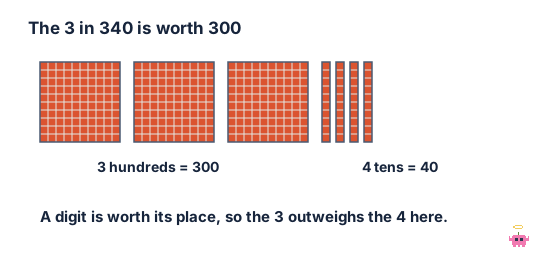
What you will see: a student who reads 340 correctly but, asked to build it with base-ten blocks, reaches for three hundred separate units, or who says the 4 in 340 is worth more than the 3 because it is a bigger digit.
The fix: bundle and unbundle continuously through Year 1 and into Year 2, moving from ones-to-tens bundling early in the stage to tens-to-hundreds bundling later, using the same physical model both times so the extension feels like more of the same rule rather than a new topic.
MA1-CSQ-01: number bonds carrying two years of additive work
The misconception: that addition and subtraction are unrelated operations, each solved by its own counting procedure, rather than two views of the same number bond.
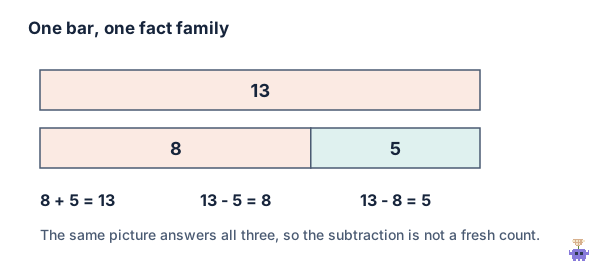
What you will see: a student who can solve 8 + 5 but, given 13 − 5, starts again from scratch counting backwards rather than recognising it as the same fact family as 8 + 5 = 13.
The fix: always teach an addition fact alongside its two related subtraction facts as one family, using ten-frames or bar models that make the part-whole relationship visible rather than treating addition and subtraction as separate units of work.
MA1-GM-03: halves, quarters and eighths of a length
The misconception: that halving is a one-step operation that stops once you have two pieces, so quartering means “halve it again, however that comes out. ”
What you will see: a student who can fold a strip in half accurately but, asked for quarters, folds it into four visually similar but unequal sections rather than halving the half.
The fix: always build quarters and eighths as repeated halving, fold in half, check equality, fold in half again, check equality again, so the process stays anchored to the equal-parts idea from MAE-GM-03 rather than becoming a separate skill for each new fraction name.
What students need to arrive with
Stage 1 leans on Early Stage 1 directly. MAE-CSQ-02 (part-whole relations within 10) is the prerequisite for MA1-CSQ-01. MAE-RWN-01 and MAE-RWN-02 (quantity and numerals to 20) are the prerequisite for MA1-RWN-01 and MA1-RWN-02. MAE-GM-03 (halving a length) is the direct prerequisite for MA1-GM-03. A student without secure part-whole knowledge to 10 should not be starting number-bond work; the fix is a short return to Early Stage 1 part-whole work rather than pushing ahead into Stage 1 addition and subtraction.
What this stage sets up
- MA1-RWN-01 and MA1-RWN-02 become Stage 2’s place value work extended to numbers beyond 1000 and to decimal notation, the same structural idea applied further.
- MA1-CSQ-01 becomes Stage 2’s more efficient mental and written strategies for addition and subtraction with larger numbers.
- MA1-FG-01 becomes Stage 2’s formal multiplication facts and related division, building directly on the equal-groups structure.
- MA1-GM-03 (halves, quarters, eighths of a length) becomes Stage 2’s work on fractions as numbers in their own right, including on a number line.
See Stage 2 Maths for the full breakdown of where this leads, including the arrival of decimals.
A term-by-term order across two years
- Year 1, Terms 1–2: extend and structure. MA1-RWN-01 place value to two digits, MA1-GM-01 position, MA1-2DS-01 and MA1-3DS-01 shapes and objects, and MA1-CHAN-01 chance vocabulary introduced early and revisited often rather than taught as a block.
- Year 1, Terms 3–4: number bonds and length. MA1-CSQ-01 as the centrepiece for the second half of Year 1, alongside MA1-GM-02 length with informal units moving toward centimetres, and MA1-GM-03 halving introduced through paper folding.
- Year 2, Terms 1–2: extend place value and groups. MA1-RWN-01 and MA1-RWN-02 extended to three digits, MA1-FG-01 equal groups for multiplication and division, and MA1-GM-03 extended from halves to quarters and eighths.
- Year 2, Terms 3–4: measurement and data. MA1-NSM-01 mass, MA1-NSM-02 duration and half- and quarter-hour time, MA1-2DS-02 and MA1-3DS-02 area and volume with informal units, and MA1-DATA-01 and MA1-DATA-02 gathering and interpreting data, drawing on a full two years of comparing and counting skills.
This is a suggested split, not an NSW requirement, since the syllabus deliberately does not assign outcomes to a specific year within the stage. The logic mirrors the AC9 and VC2 sequences: place value and number bonds early, because everything measurement-heavy in the second half leans on the counting and comparing fluency they build.
Assessment checkpoints
- Representing whole numbers: ask the student to build 340 with base-ten blocks. Three hundreds, four tens confirms MA1-RWN-01; individual units mean reteach place value with bundling before moving on.
- Combining and separating quantities: given 8 + 5 = 13, ask for 13 − 5 without recalculating from scratch. An immediate answer confirms MA1-CSQ-01 fact families; starting over means reteach addition and subtraction as one family, not two skills.
- Geometric measure: ask the student to fold a strip into quarters and explain how they know each piece is equal. A halve-then-halve method confirms MA1-GM-03; four uneven guesses mean reteach repeated halving.
- Forming groups: ask the student to solve a small sharing problem (12 shared among 3) and explain it using groups rather than one-by-one dealing. A groups-based explanation confirms MA1-FG-01; dealing one at a time with no grouping language means more work on equal groups before formal multiplication.
- Data: from a class-collected picture graph, ask what the display shows and why. An interpretive answer confirms MA1-DATA-02; a description of the picture with no conclusion means reteach reasoning about displays, not just building them.
Recording the alignment
Whether you are programming for a class or building evidence for a NESA home education review, record the outcome code on the activity as you go, and note where in the two-year stage the student sits since the syllabus itself will not tell a reviewer that. “Maths worksheet” tells nobody anything; “MA1-CSQ-01, number bonds to 20 with bar models, Year 1 Term 4” answers the question before it is asked. Our guides to state-by-state registration requirements and which curriculum your state uses cover what NSW reviewers ask for and which code set applies if you have moved states.
Sprout Lessons builds a full interactive lesson from any of these outcomes, pitched at Stage 1 and wrapped in whatever your student is into, with self-checking practice that hints rather than just marking wrong, and the exact NSW outcome code recorded in the lesson footer. Try it free.
Outcome codes reference NSW syllabuses © NSW Education Standards Authority (NESA) for and on behalf of the Crown in right of the State of New South Wales, accessed viacurriculum.nsw.edu.au. NESA does not endorse this product. Always verify against the current syllabus outcomes and content.
FAQ
How many maths outcomes are there in Stage 1 in NSW?
Sixteen, across nine focus areas: Representing whole numbers (2), Combining and separating quantities (1), Forming groups (1), Geometric measure (3), Non-spatial measure (2), Two-dimensional spatial structure (2), Three-dimensional spatial structure (2), Chance (1) and Data (2).
What years does Stage 1 cover in NSW?
Year 1 and Year 2 together, in one syllabus stage. This is the biggest structural difference from the Australian and Victorian curricula, which each split those two years into separate Year 1 and Year 2 code sets. NSW outcomes describe what a student can do by the end of Year 2, not a specific point partway through.
How do I know which Stage 1 outcomes to teach in Year 1 versus Year 2?
The syllabus does not assign outcomes to a specific year within the stage, which is deliberate. A reasonable split puts place value fundamentals, number bonds and shape and position vocabulary in Year 1, and extends place value to three digits, formalises equal groups toward multiplication, and adds measurement and data work in Year 2, since those lean on the counting fluency built earlier in the stage.
Why does NSW introduce Chance at Stage 1 when the Australian Curriculum waits until Year 3?
NSW structures its syllabus by stage rather than by year, and places Chance (MA1-CHAN-01) a full stage earlier than the Australian Curriculum introduces Probability. It is entirely oral and observational at this stage: likely, unlikely, certain and impossible, with no numerical probability expected yet.
What is the most important Stage 1 maths outcome in NSW?
MA1-CSQ-01, using number bonds and the relationship between addition and subtraction to solve partitioning problems. It carries a full two years of additive reasoning in one outcome and is the direct prerequisite for Stage 2 mental and written strategies with larger numbers.