
Year 3 Maths in the Victorian Curriculum F–10 Version 2.0, officially Level 3, is 24 content descriptions, VC2M3A01 through VC2M3ST03, one more than the national Year 3 curriculum. That single extra code is not padding. Victoria splits the Number strand differently to the Australian Curriculum: odd and even numbers get their own descriptor for the first time, and the dollars-and-cents relationship moves out of Measurement and into Number, so the two curricula land on nearly the same territory by two different routes.
This guide covers all 24 codes, exactly where Victoria’s structure diverges from the national curriculum, the three descriptors that decide whether Level 4 goes well, a term-by-term order, and five checks before moving on.
What Victoria does differently at Level 3
Twenty-two of the twenty-four codes match the national Year 3 curriculum descriptor for descriptor, sometimes with a slightly different code number because of how the strand is organised. Two changes are genuine, not cosmetic.
- VC2M3N01 names odd and even numbers as their own idea. The Australian Curriculum folds this kind of number-property reasoning into other Year 3 Number descriptors without a dedicated code. Victoria makes it explicit: identify, explain and use the properties of odd and even numbers. Practically, that means a Victorian Level 3 program should include a lesson that is just about odd and even, sorting, explaining why a number is odd or even from its last digit, and predicting whether a sum of two numbers will be odd or even, separate from the place value and fraction work that follows it.
- Money moves from Measurement into Number. The Australian Curriculum keeps “recognise the relationship between dollars and cents” inside its Measurement strand. Victoria’s equivalent, VC2M3N07, sits inside Number instead. The content is the same relationship, but the placement signals that Victoria treats money primarily as a number-and-place-value idea (100 cents make one dollar, the same structure as 100 units make one hundred) rather than a measurement idea. It is worth teaching money straight after three-digit place value for this reason, not alongside length and mass.
Everything else, the arrival of Probability, formal metric units and instruments, unit fractions as numbers you can name and combine, matches the national curriculum at this level. For the wider comparison of how the two frameworks diverge and where they agree, see the Victorian Curriculum versus the Australian Curriculum, and for the equivalent national-curriculum coverage of this exact year level, see Year 3 Maths under the Australian Curriculum.
The level at a glance
| Strand | Codes | What it covers |
|---|---|---|
| Number | 9 (VC2M3N01–09) | Odd and even numbers, numbers beyond 10 000, unit fractions and combining them to a whole, addition and subtraction with place value, multiplication and division of one- and two-digit numbers, estimation, money, financial modelling, and algorithms |
| Algebra | 3 (VC2M3A01–03) | Addition and subtraction as inverse operations, mental strategies for larger numbers, and multiplication and division facts for 3, 4, 5 and 10 |
| Measurement | 5 (VC2M3M01–05) | Choosing and estimating with metric units, measuring with labelled instruments, formal units of time, reading a clock to the minute, and angles as turns |
| Probability | 2 (VC2M3P01–02) | Describing everyday events by likelihood, and running repeated chance experiments to observe variation |
| Space | 2 (VC2M3SP01–02) | Classifying objects by key features and their uses, and interpreting and creating two-dimensional representations of familiar environments |
| Statistics | 3 (VC2M3ST01–03) | Acquiring categorical and discrete numerical data, creating and comparing graphical representations, and conducting guided statistical investigations |
Number carries nine of the twenty-four codes, two more than the national curriculum’s seven, entirely because of the odd-and-even descriptor and the relocated money descriptor. Measurement drops to five codes for the matching reason.
Reading the codes
Victorian Maths codes run VC2 + M + level + strand + number, so VC2M3N01 is Level 3 Number, position 1. In primary school the level number matches the year number, so Level 3 is the same cohort as Year 3. Strand letters are N Number, A Algebra, M Measurement, P Probability, SP Space, ST Statistics, with P appearing for the first time at this level, the same point at which it enters the national curriculum.
Strand by strand
Number (VC2M3N01 to VC2M3N09)
VC2M3N01, odd and even numbers, is covered above and is this level’s standout new descriptor. VC2M3N02 extends counting and ordering beyond 10 000. VC2M3N03 introduces unit fractions, halves, thirds, quarters, fifths and tenths, and their multiples, asking students to combine fractions with the same denominator to complete the whole, numbers you can name and reason about rather than folded paper. VC2M3N04 extends addition and subtraction to two- and three-digit numbers using place value to partition and regroup. VC2M3N05 covers multiplying and dividing one- and two-digit numbers with diagrams, arrays and number sentences. VC2M3N06 asks students to estimate quantities and check whether an answer is reasonable. VC2M3N07, the relocated money descriptor, covered above. VC2M3N08 is the applied pair, modelling additive and multiplicative situations including financial contexts. VC2M3N09 covers following and creating algorithms, a sequence of steps and decisions, to investigate numbers and describe emerging patterns.
Algebra (VC2M3A01 to VC2M3A03)
VC2M3A01 names addition and subtraction as inverse operations explicitly, using that relationship to find unknown values in number sentences. VC2M3A02 extends Level 2’s facts to 20 into efficient mental strategies for larger numbers without a calculator. VC2M3A03 extends Level 2’s twos facts (VC2M2A03 and VC2M2A04) to multiplication and division facts for 3, 4, 5 and 10.
Measurement (VC2M3M01 to VC2M3M05)
VC2M3M01 and VC2M3M02 cover formal metric units and instruments with labelled markings for length, mass and capacity, the same jump from informal to formal measuring as the national curriculum. VC2M3M03 extends time work to formal units, days, hours, minutes and seconds. VC2M3M04 pushes clock reading from Level 2’s quarter-hour to the nearest minute. VC2M3M05 turns Level 2’s quarter and half turns into angles as measures of turn, comparing them against a right angle for the first time. Note there is no separate money descriptor here, unlike the national curriculum’s AC9M3M06, because Victoria places it in Number as VC2M3N07 instead.
Probability (VC2M3P01 to VC2M3P02)
VC2M3P01 asks students to identify chance events in everyday life and describe outcomes as likely, unlikely, certain or impossible, with reasoning. VC2M3P02 moves from describing to doing: conducting repeated chance experiments, recording results, and discussing the variation between trials.
Space (VC2M3SP01 to VC2M3SP02)
VC2M3SP01 extends shape classification and asks why an object’s features suit its use, moving past naming into functional reasoning. VC2M3SP02 extends Level 2’s two-dimensional representations into locating landmarks and objects relative to each other, a genuine step toward reading and creating simple maps.
Statistics (VC2M3ST01 to VC2M3ST03)
VC2M3ST01 extends data collection to discrete numerical variables alongside categorical ones, recording with frequency tables and spreadsheets. VC2M3ST02 asks for comparison across different graphical representations and interpretation in context. VC2M3ST03 covers guided statistical investigations that carry a question through collection, representation and interpretation as one connected process.
The three codes that decide Level 4
VC2M3N03: unit fractions, and why bigger bottom numbers mean smaller pieces
The misconception: that a bigger denominator means a bigger fraction, because 5 is bigger than 2, so a child assumes 1/5 must be more than 1/2.
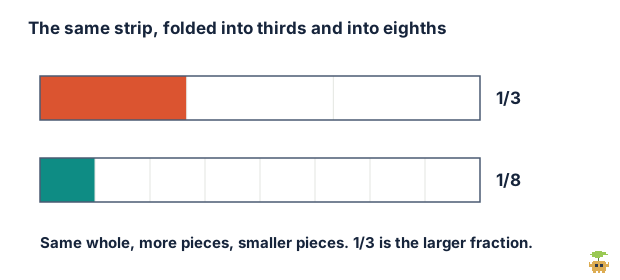
What you will see: asked to circle the larger fraction, 1/3 or 1/8, many children pick 1/8 on digit size alone. Asked to cut a cake for 8 people versus 3 people and say who gets more, the same child may correctly say the group of 3 gets more, but cannot connect that everyday reasoning to the written fractions.
The fix: always compare fractions with the same physical whole side by side, the same-sized paper strip folded into thirds and eighths, so the child sees the eighths are smaller pieces before any digit comparison happens. Naming the denominator as “how many pieces the whole was cut into” rather than just “the bottom number” keeps the physical meaning attached to the symbol.
VC2M3M01 and VC2M3M02: reading a scale, not just holding a ruler
The misconception: that measuring means lining an object up with the edge of the ruler and reading off whatever number is at the other end, regardless of where the zero mark actually is.
What you will see: a child lines an object up with the physical end of the ruler, which is often a few millimetres before the zero mark, and reads the far end as the measurement, producing an answer that is consistently slightly too large. On a scale with marks every two units, the same child may read every mark as one unit and get answers that are roughly half what they should be.
The fix: before any measuring task, have the child find and point to the zero mark on the instrument and state what each small interval is worth. Deliberately use an instrument where zero is not at the physical edge, so this becomes a checked habit rather than an assumption.
VC2M3N01: odd and even is a property of the last digit, not the whole number
The misconception: that deciding whether a large number is odd or even requires checking the whole number somehow, rather than just its last digit, so a child either guesses or refuses to answer for anything past two-digit numbers.
What you will see: asked if 3427 is odd or even, a child tries to count by twos from zero, or says they cannot tell without a calculator, because they have never connected “even” to the last digit specifically.
The fix: build a stack of two-digit and three-digit numbers with materials, group in twos, and have the child notice that only the last group, the ones digit, ever has a leftover. Once that rule is explicit, extend it straight to numbers too large to physically group, and check with predictions before addition: two evens make an even, two odds make an even, one of each makes an odd.
What students need to arrive with
Level 3 leans on three Level 2 codes directly. VC2M2N02 (hundreds, tens and ones) is the prerequisite for extending numbers beyond 10 000 in VC2M3N02. VC2M2N03 and VC2M2M02 (halves, quarters and eighths through repeated halving) are the prerequisite for unit fractions in VC2M3N03. VC2M2A03 and VC2M2A04 (multiplication facts for twos, and repetition in arithmetic operations) are the prerequisite for the 3, 4, 5 and 10 facts in VC2M3A03. A child who arrives without secure fraction-as-a-relationship understanding should not start comparing unit fractions symbolically; the fix is a short return to Level 2’s halving work rather than pushing ahead into thirds and fifths.
What this level sets up
- VC2M3N03 (unit fractions) becomes Level 4’s decimal place value, the direct next step once a fraction is understood as a number rather than a picture.
- VC2M3M01 and VC2M3M02 (formal metric units) become Level 4’s conversions between units, once the units themselves are secure.
- VC2M3A03 (multiplication facts for 3, 4, 5 and 10) becomes Level 4’s remaining fact families and multi-digit multiplication built on them.
- VC2M3P01 and VC2M3P02 (chance description and experiments) become Level 4’s numerical probability, moving from words like “likely” to fractions and percentages.
Our guide to which curriculum your state uses is worth checking if you are unsure whether AC9, VC2 or a NSW syllabus applies to your child.
A term-by-term order
- Term 1: extend, consolidate and sort. VC2M3N02 numbers beyond 10 000, VC2M3N01 odd and even numbers, VC2M3SP01 and VC2M3SP02 shape classification and maps, and VC2M3A01 addition and subtraction as inverse operations, confirming Level 2 held before adding new structure.
- Term 2: formal units and unit fractions. VC2M3M01 and VC2M3M02 metric measuring as the centrepiece, alongside VC2M3N03 unit fractions taught with the same same-whole comparison method.
- Term 3: multiplication, algorithms and probability. VC2M3A03 facts for 3, 4, 5 and 10, VC2M3N05 multiplying and dividing one- and two-digit numbers, VC2M3N09 following algorithms, and VC2M3P01 and VC2M3P02 chance vocabulary and repeated experiments.
- Term 4: apply and extend. VC2M3N04, VC2M3N06 and VC2M3N08 larger-number addition, subtraction, estimation and financial modelling, VC2M3N07 money, VC2M3M03 to VC2M3M05 time and angles, and VC2M3ST01 to VC2M3ST03 data collection, representation and guided investigation.
Odd and even numbers sit in Term 1 deliberately, before the term-2 fraction work, because the same “check the last digit” habit of mind (attend to structure, not just magnitude) is exactly what makes unit fraction comparison click a few weeks later.
Five checks before Level 4
- Number: ask which is bigger, 1/3 or 1/8, using same-sized paper strips to check. A correct answer with reasoning about piece size confirms VC2M3N03; a digit-based guess means reteach fraction comparison with a shared physical whole.
- Number: ask whether 3427 is odd or even and how the child knows. An answer that checks only the last digit confirms VC2M3N01; counting from zero or guessing means reteach the last-digit rule with grouped materials first.
- Algebra: ask for 4 × 5 and the related division fact, 20 divided by 4, without hesitation. Confident recall confirms VC2M3A03; a long pause means reteach through the doubling-style connections used for the twos facts last year.
- Measurement: hand the child a ruler where zero is not at the physical edge and ask them to measure a pencil. A correct reading from the zero mark confirms VC2M3M02; measuring from the edge means reteach reading the scale before the number.
- Probability: after five real or simulated coin flips landing the same way, ask what the sixth flip will show. “I don’t know, could be either” confirms VC2M3P01; confident prediction of the opposite result means address the gambler’s fallacy directly with a running tally.
Capabilities and record keeping
Victoria assesses four Capabilities alongside the learning areas, and Level 3’s algorithm work in Number (VC2M3N09) overlaps naturally with the Digital Literacy Capability’s content on following and describing simple algorithms. A single lesson that has a child write out the steps for checking a number’s parity can legitimately evidence both a Mathematics and a Capabilities code.
Whether you are programming for a class or building a VRQA home education portfolio, record the code on the activity as you go. “Maths games” tells a reviewer nothing; “VC2M3P02, coin flip experiment with a tally chart, 14 June” answers the question before it is asked. Our guide to state-by-state registration requirements covers what reviewers actually ask for, and teaching maths through interests covers how to wrap these codes around whatever your child is currently into.
Sprout Lessons builds a full interactive lesson from any of these codes, pitched at Level 3 and wrapped in whatever your student is into, with self-checking practice that hints rather than just marking wrong, and the exact VC2 code recorded in the lesson footer. Try it free and generate a Level 3 Maths lesson in about a minute. You can also browse ready-made Year 3 Maths lessons against these codes directly.
Curriculum codes reference the Victorian Curriculum F–10 Version 2.0 © VCAA. The curriculum can be accessed directly at f10.vcaa.vic.edu.au. The VCAA does not endorse this product. Always verify against the current content descriptions and achievement standards.
FAQ
How many maths codes are there in Year 3 (Level 3) of the Victorian Curriculum?
Twenty-four: nine in Number (VC2M3N01 to VC2M3N09), three in Algebra (VC2M3A01 to VC2M3A03), five in Measurement (VC2M3M01 to VC2M3M05), two in Probability (VC2M3P01 and VC2M3P02), two in Space (VC2M3SP01 and VC2M3SP02) and three in Statistics (VC2M3ST01 to VC2M3ST03).
How is Year 3 Maths in the Victorian Curriculum different from the Australian Curriculum?
Twenty-two of the 24 codes match the national Year 3 curriculum descriptor for descriptor. Two are genuinely different: VC2M3N01 names odd and even numbers as their own explicit descriptor, which the Australian Curriculum does not, and the dollars-and-cents relationship sits in Victoria’s Number strand (VC2M3N07) rather than its Measurement strand.
What is the most important Year 3 Maths code in the Victorian Curriculum?
VC2M3N03, unit fractions. It is the first time fractions are treated as numbers rather than physical halves and quarters, and it is the direct forerunner of Level 4’s decimal place value.
Why does my child think 1/8 is bigger than 1/3?
This is the standard misconception behind VC2M3N03: treating the denominator like an ordinary number, where bigger digits mean bigger values. The fix is comparing fractions using the same physical whole, the same-sized paper strip folded into thirds and eighths, so the child sees the eighths are smaller pieces before comparing the written fractions.
How do I check if my child is ready to move from Level 3 to Level 4 maths?
Ask them to compare 1/3 and 1/8 using paper strips and explain which is bigger and why. A reasoned answer about piece size confirms unit fractions (VC2M3N03) are secure; a guess based on the digits means the concept needs reteaching before Level 4 introduces decimals, which build directly on it.