
Year 2 Maths in the Victorian Curriculum F–10 Version 2.0, officially Level 2, is 19 content descriptions, VC2M2A01 through VC2M2ST02. That is one more than the national Year 2 curriculum, and the extra code is not a rewording of something else, it is a whole new descriptor: VC2M2A04 names repetition in arithmetic operations as its own idea, multiplication as repeated addition, division as repeated subtraction, spelling out a connection the Australian Curriculum leaves for a teacher to make explicit.
This guide covers all 19 codes, the genuine point of difference from the Australian Curriculum, the three descriptors that decide whether Level 3 goes well, a term-by-term order, and five checks before moving on.
What Victoria does differently at Level 2
Eighteen of the nineteen codes match the national Year 2 curriculum descriptor for descriptor. The extra one sits in Algebra, and it changes how multiplication should be taught, not just what gets tested.
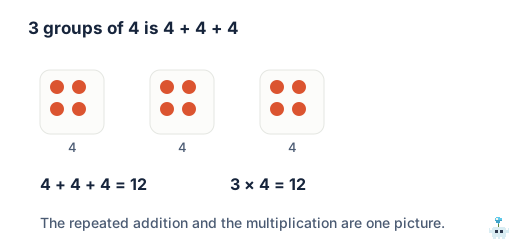
- VC2M2A04 names the structure behind the operation. Both curricula ask students to recall multiplication facts for twos and derive division facts by doubling and halving (VC2M2A03, identical wording to AC9M2A03). Victoria adds a separate descriptor asking students to apply repetition in arithmetic operations, explicitly naming multiplication as repeated addition and division as repeated subtraction. Where the national curriculum treats this connection as implicit in how you teach VC2M2A03, Victoria makes it an assessable idea in its own right, which means a Victorian Level 2 program should include a lesson that is just about the repetition, 3 groups of 4 written out as 4 + 4 + 4, separate from any fact-recall drilling.
Everything else, the shift to hundreds place value, halves and quarters through repeated halving, reading a clock to the quarter-hour, matches the national curriculum exactly at this level. For the wider comparison of how the two frameworks diverge and where they agree, see the Victorian Curriculum versus the Australian Curriculum.
The level at a glance
| Strand | Codes | What it covers |
|---|---|---|
| Number | 6 (VC2M2N01–06) | Numbers to at least 1000, three-digit place value including zero, halves and related fractions, addition and subtraction, and multiplicative modelling including money |
| Algebra | 4 (VC2M2A01–04) | Additive patterns, addition and subtraction facts to 20, multiplication and division facts for twos, and repetition in arithmetic operations named explicitly |
| Measurement | 5 (VC2M2M01–05) | Length, capacity and mass with uniform informal units, halves and quarters of shapes and events, calendar dates, reading an analog clock to the quarter-hour, and quarter and half turns |
| Space | 2 (VC2M2SP01–02) | Comparing and classifying shapes by sides and spatial terms, and locating and following directions in two-dimensional representations |
| Statistics | 2 (VC2M2ST01–02) | Acquiring categorical data through surveys and digital tools, and creating and comparing graphical representations |
No Probability strand yet, it begins at Level 3. Algebra is the only strand with more codes than the national curriculum, four against three, entirely because of VC2M2A04.
Reading the codes
Victorian Maths codes run VC2 + M + level + strand + number, so VC2M2N01 is Level 2 Number, position 1. In primary school the level number matches the year number, so Level 2 is the same cohort as Year 2. Strand letters are unchanged from Level 1: N Number, A Algebra, M Measurement, SP Space, ST Statistics, with P Probability arriving at Level 3.
Strand by strand
Number (VC2M2N01 to VC2M2N06)
VC2M2N01 extends counting and ordering to at least 1000. VC2M2N02 is this level’s new arrival, partitioning, rearranging, regrouping and renaming two- and three-digit numbers using standard and non-standard groupings, naming the zero digit’s role explicitly. It is the single most load-bearing descriptor of the level. VC2M2N03 introduces one-half as one of two equal parts, connecting halves, quarters and eighths through repeated halving.
VC2M2N04 extends addition and subtraction to one- and two-digit numbers using part-part-whole reasoning. VC2M2N05 covers multiplying and dividing by one-digit numbers using repeated addition, equal grouping, arrays and partitioning, the descriptor VC2M2A04 exists to make explicit. VC2M2N06 is the applied pair, modelling additive and multiplicative situations including money transactions.
Algebra (VC2M2A01 to VC2M2A04)
VC2M2A01 extends Level 1’s repeating patterns into additive patterns that increase or decrease by a constant amount. VC2M2A02 asks for fluent recall of addition facts to 20 and related subtraction facts. VC2M2A03 is the multiplication and division facts for twos using doubling and halving, identical to the national descriptor. VC2M2A04, covered above, is Victoria’s addition: applying repetition in arithmetic operations, multiplication as repeated addition and division as repeated subtraction, named as its own idea rather than left inside VC2M2A03.
Measurement (VC2M2M01 to VC2M2M05)
VC2M2M01 extends informal-unit measuring to length, capacity and mass together. VC2M2M02 is the fractions-in-context descriptor, halves, quarters and eighths of shapes, objects and events. VC2M2M03 extends calendar work to counting days between events. VC2M2M04 introduces reading an analog clock to the hour, half-hour and quarter-hour. VC2M2M05 names quarter, half, three-quarter and full turns, previewing angle language two levels ahead.
Space (VC2M2SP01 to VC2M2SP02)
VC2M2SP01 extends shape comparison with named spatial terms, opposite, parallel, curved and straight. VC2M2SP02 moves directions work into two-dimensional representations of a familiar space, the first step toward reading a simple map.
Statistics (VC2M2ST01 to VC2M2ST02)
VC2M2ST01 extends data collection to include experiment as a method alongside survey and observation. VC2M2ST02 asks for graphical representations created with software where appropriate, comparing representations and identifying common and distinctive features.
The three codes that decide Level 3
VC2M2N02: hundreds, tens, ones, and the zero that means nothing is there
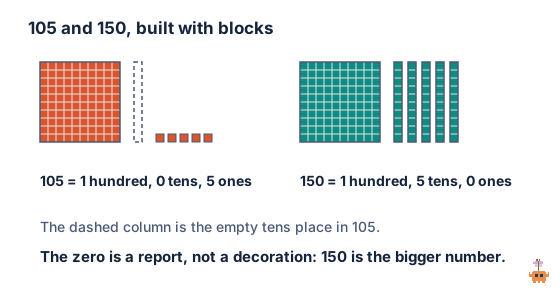
The misconception: that a zero in a number is a placeholder to make the number look right, not a digit recording that a place holds nothing. A child can write 105 correctly from dictation while reading it as “one, oh, five” with no sense that the middle zero means zero tens.
What you will see: asked to build 105 with base-ten blocks, the child reaches for a tens block out of habit, or drops the zero and writes 15. Asked which is bigger, 105 or 150, a child without secure place value may hesitate or guess.
The fix: extend the bundling routine one level further than Level 1, ones into tens, tens into hundreds, and deliberately build numbers with an empty middle place, 105, 209, 302, so the child has to physically show nothing where the tens block would go.
VC2M2A03 and VC2M2A04: multiplication as doubling and as repetition
The misconception: that multiplication facts are a memorised chant rather than a relationship that also runs backwards into division and forwards into repeated addition. Victoria’s split into two descriptors reflects two separate ways this misconception shows up.
What you will see: a child recites the twos fluently but cannot retrieve 4 × 2 out of sequence, or cannot rewrite 3 groups of 4 as 4 + 4 + 4 without being shown. The second gap is the one VC2M2A04 exists to catch, and it is easy to miss if you only test fact recall.
The fix: teach doubling as the entry point for VC2M2A03, double 1, double 2, double 3, then flip each fact into division. Separately, for VC2M2A04, have the child physically arrange counters into equal groups and write the repeated-addition sentence before ever asking for the multiplication fact, so the structure is visible before the shortcut is introduced.
VC2M2N03 and VC2M2M02: fractions as parts of a whole, not just words
The misconception: that “quarter” is a size word rather than a precise relationship to a whole. A child can point to any small piece and call it a quarter regardless of whether four of that piece would rebuild the whole.
What you will see: asked to fold a strip of paper into quarters, a child tears it into four uneven pieces instead of halving twice. Asked whether a quarter is bigger or smaller than a half, some guess bigger, reasoning that four sounds bigger than two.
The fix: insist on repeated halving, fold for halves, fold again for quarters, once more for eighths, so each fraction is generated from the last by the same action, and the pieces visibly shrink as the folds increase.
What students need to arrive with
Level 2 leans on three Level 1 codes directly: VC2M1N02 (tens and ones) for extending place value to hundreds in VC2M2N02, VC2M1A01 (skip counting by twos, fives and tens) for the multiplication facts in VC2M2A03, and VC2M1N04 (addition and subtraction within 20) for fluent recall in VC2M2A02. A child without secure tens-and-ones understanding should not start three-digit regrouping; the fix is a short return to Level 1’s place value work rather than pushing ahead into hundreds.
What this level sets up
- VC2M2N02 (hundreds, tens and ones) becomes Level 3’s numbers beyond 10 000, the same structure extended two more places.
- VC2M2A03 and VC2M2A04 (multiplication facts and repetition) become Level 3’s facts for 3, 4, 5 and 10, the same doubling and repeated-addition relationships applied to new fact families.
- VC2M2N03 and VC2M2M02 (halves, quarters and eighths) become Level 3’s unit fractions, including thirds and fifths.
- VC2M2M05 (quarter and half turns) becomes Level 4’s explicit angle work.
See Level 3 Maths for the full breakdown of where these codes lead next, including the arrival of Probability.
A term-by-term order
- Term 1: extend and consolidate. VC2M2N01 counting to 500, VC2M2SP01 and VC2M2SP02 shapes and directions, and VC2M2A02 fluent recall of facts to 20, confirming Level 1 held before adding new structure.
- Term 2: hundreds, tens and ones. VC2M2N02 as the centrepiece with three-place bundling, alongside VC2M2M01 measuring length, capacity and mass with informal units.
- Term 3: multiplication, repetition and fractions. VC2M2A03 doubling and halving alongside VC2M2A04 repeated addition and subtraction, both taught before VC2M2N03 and VC2M2M02 halves, quarters and eighths through repeated folding.
- Term 4: apply and extend. VC2M2N04 and VC2M2N05 addition, subtraction, multiplication and division problems, VC2M2N06 modelling money situations, VC2M2M03 and VC2M2M04 calendars and clock reading, VC2M2M05 turns, and VC2M2ST01 and VC2M2ST02 collecting and representing data.
Repetition (VC2M2A04) sits deliberately before fact recall gets tested in later terms, because a child who can write 4 + 4 + 4 for 3 groups of 4 has a fallback strategy for any multiplication fact they have not yet memorised.
Five checks before Level 3
- Build 105 with base-ten blocks. One hundred block, no tens blocks, five ones confirms VC2M2N02; reaching for a tens block or dropping the zero means reteach place value with a deliberately empty middle place.
- Ask for 4 × 2 out of sequence, then write 3 groups of 4 as repeated addition. Both confirm VC2M2A03 and VC2M2A04; needing to restart the twos chant or being unable to write the addition sentence means reteach doubling and repetition separately.
- Fold a paper strip into quarters and ask which is bigger, a half or a quarter. Even folds and a correct comparison confirm VC2M2M02; uneven tearing or the wrong comparison means reteach repeated halving.
- Ask the child to compare two shapes using the words parallel and curved. Using the vocabulary correctly confirms VC2M2SP01; pointing without naming means reteach the spatial terms explicitly.
- From a class survey, ask the child to create a graph and describe one feature it shows. A specific, evidence-based description confirms VC2M2ST02; a vague answer means reteach comparing representations with a two-category question first.
Capabilities and record keeping
Victoria assesses four Capabilities alongside the learning areas, and Level 2’s repetition-in-operations work in Algebra overlaps naturally with the Critical and Creative Thinking Capability’s content on identifying relationships between numbers. A single lesson connecting 3 groups of 4 to 4 + 4 + 4 can legitimately evidence both a Mathematics and a Capabilities code. We cover this in the four capabilities in the Victorian Curriculum.
Whether you are programming for a class or building a VRQA home education portfolio, record the code on the activity as you go. “Maths games” tells a reviewer nothing; “VC2M2A04, groups of 4 written as repeated addition, 9 June” answers the question before it is asked. Our guide to homeschool resources in Victoria covers what the VRQA looks for.
Sprout Lessons builds a full interactive lesson from any of these codes, pitched at Level 2 and wrapped in whatever your student is into, with the VC2 code recorded in the lesson footer. Try it free and generate a Level 2 Maths lesson in about a minute. You can also browse ready-made Year 2 Maths lessons against these codes directly.
Curriculum codes reference the Victorian Curriculum F–10 Version 2.0 © VCAA. The curriculum can be accessed directly at f10.vcaa.vic.edu.au. The VCAA does not endorse this product. Always verify against the current content descriptions and achievement standards.
FAQ
How is Year 2 Maths different in the Victorian Curriculum compared with the Australian Curriculum?
Eighteen of the 19 codes match the national Year 2 curriculum exactly. One is new: VC2M2A04 names repetition in arithmetic operations as its own descriptor, multiplication as repeated addition and division as repeated subtraction, an idea the national curriculum leaves implicit inside its multiplication-facts descriptor.
How many maths codes are there in Year 2 (Level 2) of the Victorian Curriculum?
Nineteen: six in Number (VC2M2N01 to VC2M2N06), four in Algebra (VC2M2A01 to VC2M2A04), five in Measurement (VC2M2M01 to VC2M2M05), two in Space (VC2M2SP01 and VC2M2SP02) and two in Statistics (VC2M2ST01 and VC2M2ST02). Probability starts at Level 3.
Is Year 2 the same as Level 2 in the Victorian Curriculum?
Yes, for primary Maths. Victoria uses Level rather than Year in its official terminology, and in primary school the level number matches the year number, so Level 2 is the same cohort as Year 2.
What is VC2M2A04 and why does the Australian Curriculum not have an equivalent?
VC2M2A04 asks students to apply repetition in arithmetic operations, explicitly naming multiplication as repeated addition and division as repeated subtraction. The Australian Curriculum folds this idea into its multiplication-facts descriptor rather than making it a separate, assessable code, which means Victorian planning should include a lesson purely about the repeated-addition structure, separate from fact recall.
What is the most important Year 2 maths code in the Victorian Curriculum?
VC2M2N02, partitioning two- and three-digit numbers with the zero digit’s role named explicitly. It extends Level 1’s tens-and-ones structure to hundreds, and the rest of the level, regrouping, comparing three-digit numbers, assumes it is secure.