
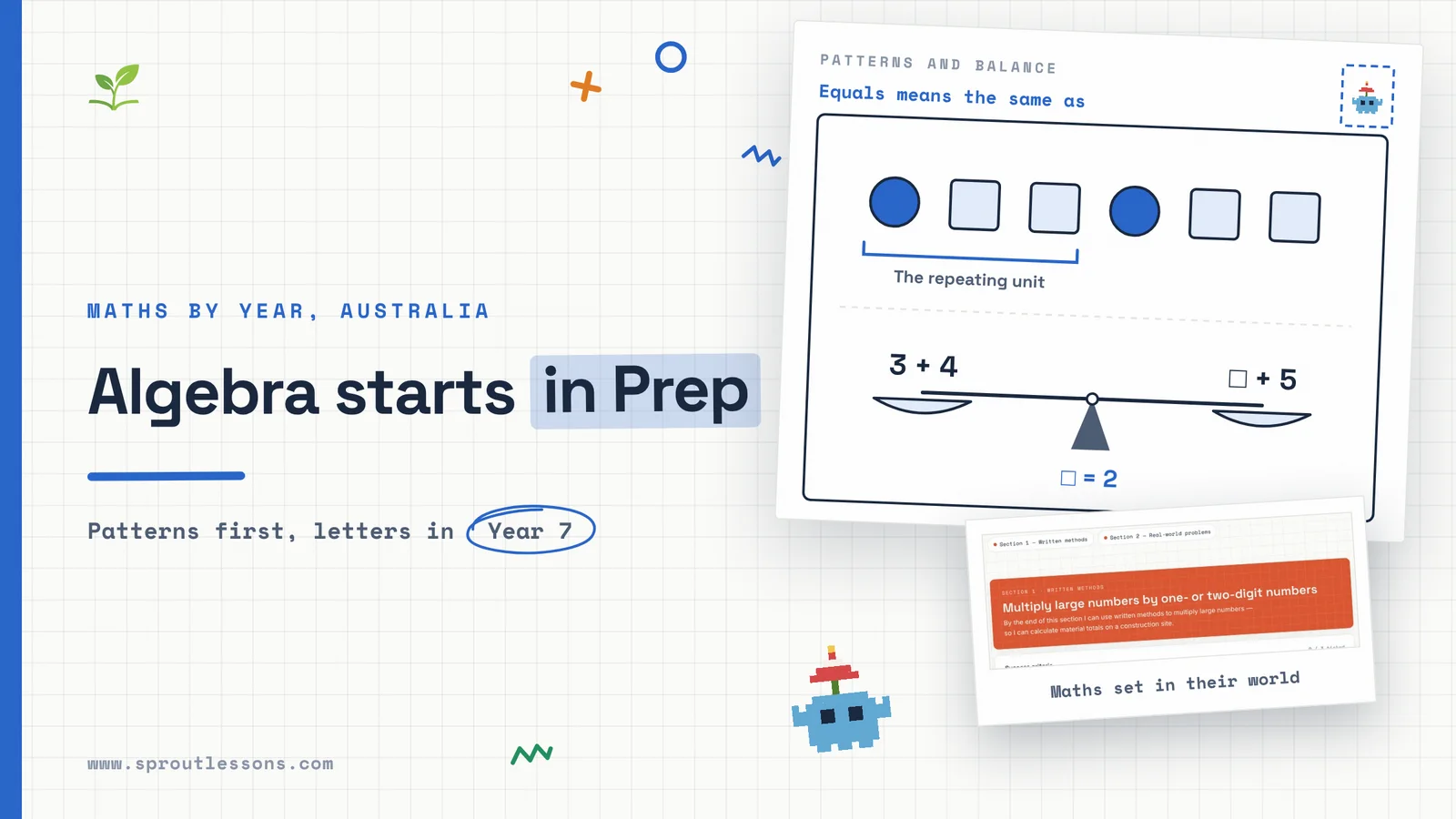
In the Australian Curriculum, algebra starts in Foundation with repeating patterns, and the letters come much later. Year 1 finds the repeating unit and skip counts, Year 2 makes patterns that grow by the same amount, Years 3 to 5 find the missing number in a number sentence such as 3 + 4 = □ + 5, and Year 6 writes the rule for a growing pattern. Letters standing for numbers arrive in Year 7. NSW has no algebra outcome at all until Stage 4, and builds the same ideas through its number outcomes instead.
So when a parent asks “when do kids learn algebra?”, the honest answer is “from Prep, but you would not recognise it.” The primary years build the two ideas algebra depends on: that the equals sign means “is the same as”, and that a pattern has a rule you can say out loud. A child who has both finds Year 7 easy. A child who has neither finds letters baffling, however good they are at sums. This page sets out what each year asks for, five mistakes that show exactly where a child is, a two-minute check with coins and pasta, and a twenty-minute routine.
What the curriculum asks for, year by year
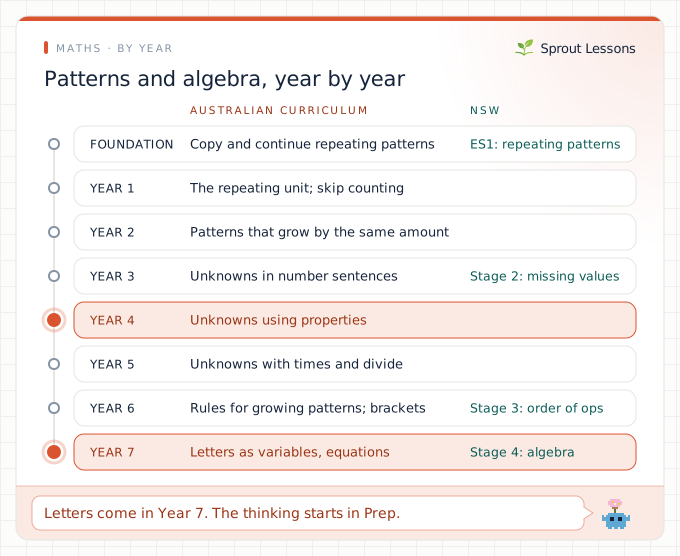
Algebra is a strand of its own in the Australian Curriculum from Foundation. Between Years 2 and 5 it also holds the number facts (addition facts to 20, then the times tables), which our pages on addition and subtraction and times tables cover. The descriptors about patterns and unknowns, quoted from ACARA:
- Foundation, AC9MFA01: “recognise, copy and continue repeating patterns represented in different ways”. Clap, clap, stamp; red, red, blue.
- Year 1, AC9M1A01 and AC9M1A02: “recognise, continue and create pattern sequences, with numbers, symbols, shapes and objects, formed by skip counting, initially by twos, fives and tens”, and “recognise, continue and create repeating patterns with numbers, symbols, shapes and objects, identifying the repeating unit”. The repeating unit is the new idea: the smallest chunk that keeps coming back.
- Year 2, AC9M2A01: “recognise, describe and create additive patterns that increase or decrease by a constant amount, using numbers, shapes and objects, and identify missing elements in the pattern”. 3, 7, 11, 15: what is missing, and what comes next?
- Year 3, AC9M3A01: “recognise and explain the connection between addition and subtraction as inverse operations, apply to partition numbers and find unknown values in number sentences”. If 8 + □ = 13, then 13 − 8 = □.
- Year 4, AC9M4A01: “find unknown values in numerical equations involving addition and subtraction, using the properties of numbers and operations”. This is where 3 + 4 = □ + 5 belongs.
- Year 5, AC9M5A02: “find unknown values in numerical equations involving multiplication and division using the properties of numbers and operations”. 6 × □ = 3 × 8.
- Year 6, AC9M6A01 and AC9M6A02: “recognise and use rules that generate visually growing patterns and number patterns involving rational numbers”, and “find unknown values in numerical equations involving brackets and combinations of arithmetic operations”. Year 6 also writes simple algorithms that generate sets of numbers (AC9M6A03).
- Year 7, AC9M7A01 to AC9M7A03: “recognise and use variables to represent everyday formulas algebraically and substitute values into formulas to determine an unknown”, “formulate algebraic expressions using constants, variables, operations and brackets”, and “solve one-variable linear equations with natural number solutions; verify the solution by substitution”. The letters, at last.
Where Victoria differs (the VCAA wording is paraphrased here, not quoted). The Victorian Curriculum follows the same path level by level, with three additions worth knowing. Foundation adds following a short sequence of instructions and creating patterns, not only copying them (VC2MFA01), which is the first step towards algorithms. Level 2 has an extra descriptor on repetition in arithmetic: multiplication as repeated addition and division as repeated subtraction (VC2M2A04), so the Level 3 and later codes do not shift but Level 2 has four. Level 7 puts the associative, commutative and distributive laws into the expressions descriptor (VC2M7A02), and Level 8 adds a descriptor of its own on using algorithms and tests to find and correct errors (VC2M8A04).
Where NSW differs (the NESA outcomes are paraphrased). The NSW Mathematics K–10 syllabus has no algebra outcome in Kindergarten to Year 6. The ideas sit inside the number outcomes instead. Repeating patterns are part of the Kindergarten outcome on forming groups (MAE-FG-01). Finding missing values in number sentences is Stage 2 (Years 3 and 4), for addition and subtraction (MA2-AR-02) and for multiplication and division (MA2-MR-02). Stage 3 (Years 5 and 6) constructs number sentences and applies the order of operations (MA3-MR-02). Algebraic expressions, equations and linear patterns open in Stage 4 (MA4-ALG-C-01, MA4-EQU-C-01, MA4-LIN-C-01). So a NSW report that never mentions algebra in primary is not missing anything.
Five mistakes that tell you where your child is
1. Copying a pattern without seeing the unit (Foundation to Year 1)
Ask a five-year-old to continue red, blue, blue, red, blue, blue, and many will carry on red, blue, red, blue. They have noticed “it changes colour” but not the chunk that repeats. Year 1 names this as the repeating unit (AC9M1A02). The fix is to make the unit physical: build the pattern with pegs or blocks, then snap it into its repeating chunks and line the chunks up. Three identical chunks in a row is the unit made visible. Then ask your child to make a pattern for you to continue, and to tell you the chunk.
2. “The equals sign means the answer comes next” (Years 1 to 4)
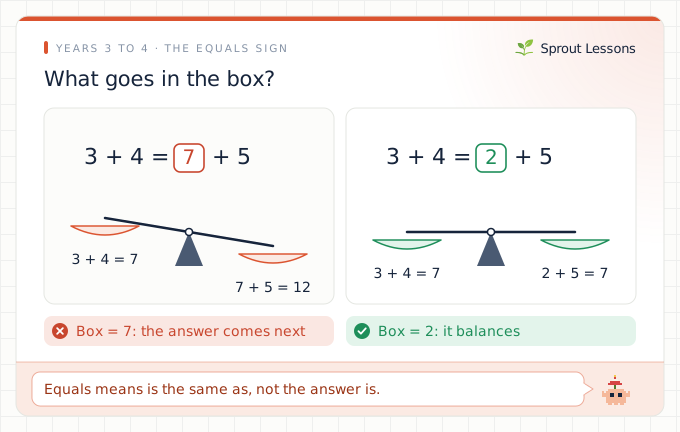
This is the most important mistake on the page. Show your child 3 + 4 = □ + 5 and ask what goes in the box. A child who writes 7 has read the equals sign as “and the answer is”. A child who writes 12 has added every number they can see. Both have spent years seeing sums written as 3 + 4 = 7, with the answer always on the right, so the habit is reasonable. It is also the single biggest thing that makes Year 7 algebra hard, because every equation they will meet treats the two sides as a balance.
The fix is a balance and a new word. Say “is the same as” every time you read an equals sign aloud. Write sums the other way round (7 = 3 + 4) and in both directions (3 + 4 = 2 + 5). If you have kitchen scales or a coat hanger with two cups, use them: three pegs and four pegs on one side, five pegs on the other, and how many more until it balances? That is AC9M3A01 and AC9M4A01 exactly, and it takes about a week of five-minute goes to shift.
3. Counting on instead of finding the rule (Years 5 and 6)
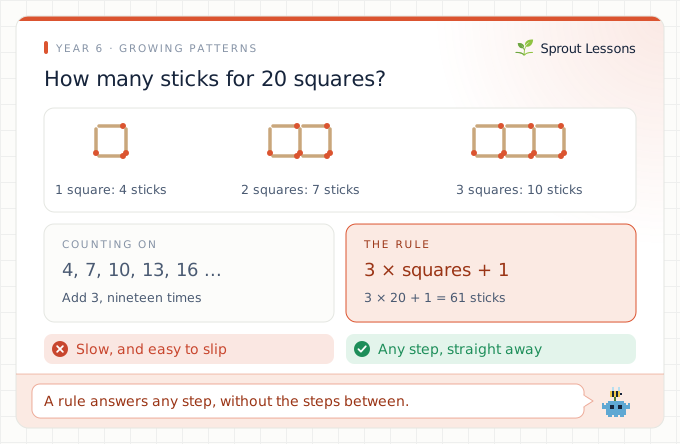
Lay matchsticks in a row of squares: one square takes 4 sticks, two take 7, three take 10. Ask how many sticks 20 squares need. Most Year 5 children add 3, then 3, then 3, nineteen times, and many slip somewhere along the way. That is a Year 2 skill (AC9M2A01) doing a Year 6 job. Year 6 asks for the rule (AC9M6A01): each square adds 3 sticks, and the very first square needs one extra to close it, so it is 3 × squares + 1, and 20 squares is 61. The fix is to ask for the 100th step as soon as your child can do the 4th. Nobody counts on to 100, so they have to look for the rule. In Year 7 the same rule becomes 3n + 1 (AC9M7A05).
4. Working left to right through every sum (Year 6, Stage 3 in NSW)
Ask what 3 + 4 × 2 is. A child who says 14 has worked left to right, which is how they read. The convention is that multiplication comes first, so it is 3 + 8, or 11; brackets change it, and (3 + 4) × 2 is 14. Year 6 meets this through equations with brackets and mixed operations (AC9M6A02), and NSW names the order of operations in Stage 3 (MA3-MR-02). The fix is to make brackets feel useful rather than fussy. Three friends each get an apple for $1 and a muesli bar for $2: ask your child to write the total as one number sentence. 3 × (1 + 2) is $9. Without the brackets, 3 × 1 + 2 is $5, and someone goes without a muesli bar. The brackets turn up because the problem needs them.
5. “3a means 3 apples” (Year 7)
In Year 7 a letter stands for a number (AC9M7A01), and two misreadings are very common. One treats the letter as a label: “3a” is three apples, so “3a + 2b” is a fruit bowl, and a child cannot see why the letters can take any value. The other glues the digits together: if a = 4, then 3a is 34. The fix for both is substitution out loud. 3a means 3 × a. If a is 4, it is 3 × 4, which is 12. If a is 10, it is 30. Swap in three or four values every time a new expression appears, and check an answer to an equation by putting it back in, which is the “verify the solution by substitution” part of AC9M7A03.
A two-minute check with coins and pasta
Stop at the first question that goes wrong. Each one maps to a year.
- Foundation: Lay out pasta, pasta, coin, pasta, pasta, coin. What comes next? Can you make me a pattern?
- Year 1: Count these 5c coins in fives. In your pasta pattern, what is the bit that repeats?
- Year 2: 4, 7, 10, □, 16. What goes in the gap? What will the next number be?
- Year 3: 9 + □ = 15. How did you work it out? (A child who says “15 take away 9” has the inverse idea.)
- Year 4: 3 + 4 = □ + 5. (The answer is 2. Watch for 7 or 12.)
- Year 5: 6 × □ = 3 × 8. Can you do it without working out 3 × 8 first? (Twice as many groups, so each group is half the size: 4.)
- Year 6: The matchstick question above: how many sticks for 20 squares, and what is the rule?
- Year 7: If n = 5, what is 2n + 3? Solve 2n + 3 = 17, then check your answer by putting it back in.
The first question that goes wrong is the place to start. A Year 6 child who stumbles on the Year 4 balance has a gap that will matter more than any number fact, and it is a quick one to close.
Want practice set in their world? Sprout writes a maths lesson on AC9M4A01 or AC9M6A01 around what your child loves, from footy scores to Minecraft builds. Try it free.
Twenty minutes a week, most of it talking
- Five minutes: make a pattern, swap. You make one, your child continues it and names the repeating unit or the rule. Then swap. From Year 2, use numbers that grow.
- Five minutes: balance sentences. Write three number sentences with the unknown in a different place each time: □ + 6 = 10, 10 = 4 + □, 4 + 6 = □ + 7. Read every equals sign aloud as “is the same as”.
- Five minutes: the 100th step. From Year 5, build three steps of a growing pattern from Lego or matchsticks and ask for the 10th, then the 100th. Ask how they know.
- Five minutes: guess my rule. You think of a rule (double it and add 1). Your child says a number, you say what comes out, until they guess the rule. This is a function machine, and it is exactly the Year 7 idea of a rule generating a table of values.
What is not the problem
- No letters in Year 5 maths. Variables are Year 7 in the Australian and Victorian curricula and Stage 4 in NSW. Boxes and blanks are the primary-school version.
- Slow times tables. They help, but a child who reads the equals sign as a balance and looks for rules has the algebra; the facts can catch up alongside.
- Not knowing the word “algebra”. Few primary reports use it. What matters is the ideas, not the name.
Where this sits
Unknowns depend on fluent facts, so this page sits next to addition and subtraction by year and times tables by year. Negative numbers, which Year 7 algebra uses constantly, are in negative numbers by year. For the whole picture of the year unknowns get serious, see what a Year 4 student should know, or the teacher-facing Year 4 maths codes and Year 7 maths codes. If you are not sure which curriculum applies, start with which curriculum your state uses.
The short version
- Foundation to Year 2: repeating patterns, the repeating unit, then patterns that grow by the same amount.
- Years 3 to 5: find the missing number in a number sentence, using the equals sign as a balance.
- Year 6: the rule for a growing pattern, and equations with brackets.
- Year 7: letters as variables, expressions and simple equations. NSW has no algebra outcome until Stage 4.
- If your child writes 7 in 3 + 4 = □ + 5, start with the balance. It matters more than any fact.
Sprout makes a lesson on the exact code your child is working on, set around what they love. Start free.
How this page was checked
The Australian Curriculum descriptors are quoted from our copy of version 9.0, which matches AC9M4A01 on the Australian Curriculum website; we read every Foundation to Year 8 Algebra descriptor. The Victorian codes are from the Victorian Curriculum F–10 version 2.0. The NSW outcomes are from the NSW Mathematics K–10 Syllabus outcomes, Early Stage 1 to Stage 4. Victorian and NSW wording is paraphrased. Checked 1 November 2026.
Australian Curriculum content descriptions are © Australian Curriculum, Assessment and Reporting Authority (ACARA) 2010 to present, licensed under CC BY 4.0, and quoted here unmodified. ACARA does not endorse any product that uses the Australian Curriculum. Victorian Curriculum codes reference the Victorian Curriculum F–10 Version 2.0 © VCAA, paraphrased; the VCAA does not endorse this product. NSW outcome codes reference the NSW syllabuses © NSW Education Standards Authority (NESA) for and on behalf of the Crown in right of the State of New South Wales, paraphrased, available at curriculum.nsw.edu.au; NESA does not endorse this product.
FAQ
When do kids learn algebra in Australia?
Letters standing for numbers arrive in Year 7 (AC9M7A01 to AC9M7A03), but the Australian Curriculum has an Algebra strand from Foundation: repeating patterns in Foundation and Year 1, patterns that grow by a constant amount in Year 2, missing numbers in number sentences in Years 3 to 5, and rules for growing patterns in Year 6. NSW has no algebra outcome until Stage 4 (Years 7 and 8).
What does 3 + 4 = ? + 5 test?
Whether a child reads the equals sign as "is the same as" or as "the answer comes next". The answer is 2, because both sides must equal 7. Children who write 7 or 12 are treating the equals sign as an instruction to calculate. Finding unknowns like this is Year 4 content (AC9M4A01) and is the most important foundation for Year 7 algebra.
What is a repeating unit in a pattern?
The smallest chunk that keeps coming back. In red, blue, blue, red, blue, blue, the repeating unit is red, blue, blue. Year 1 children are asked to identify it (AC9M1A02). Building the pattern from blocks and splitting it into identical chunks makes the unit visible.
How do I help my child find the rule for a growing pattern?
Ask for a step too far to count to, such as the 100th. A row of matchstick squares uses 4, 7, 10 sticks; counting on by 3 works for the next few, but the 100th needs the rule: 3 sticks per square plus 1, so 301. Writing rules for growing patterns is Year 6 content (AC9M6A01).
Does NSW teach algebra in primary school?
Not as a separate outcome. The NSW Mathematics K to 10 syllabus puts repeating patterns in a Kindergarten outcome, missing values in number sentences in Stage 2, and the order of operations in Stage 3, all inside its number outcomes. Algebraic expressions and equations begin in Stage 4.