
In the Australian Curriculum, children add and subtract with objects in Foundation, within 20 in Year 1, with two-digit numbers in Year 2 and with three-digit numbers, regrouping and no calculator in Year 3. Year 4 asks for efficient strategies and digital tools. No content description ever names the column method. Victoria does: its Level 4 asks for mental and written strategies. NSW names the vertical algorithm in Stage 2 (Years 3 and 4).
That one difference explains most of the “why don’t they teach it the way I learnt it” conversations parents have about Year 3 maths. If your child splits 47 + 38 into 40 + 30 and 7 + 8, draws jumps on a number line, or has never written a little carried 1 above a column, the school is on track. The column method is still taught, but later, and in most Australian schools it arrives after the mental strategies rather than instead of them. This page sets out what each year asks for, five mistakes that tell you exactly where your child is, a two-minute check and a twenty-minute routine.
What the curriculum asks for, year by year
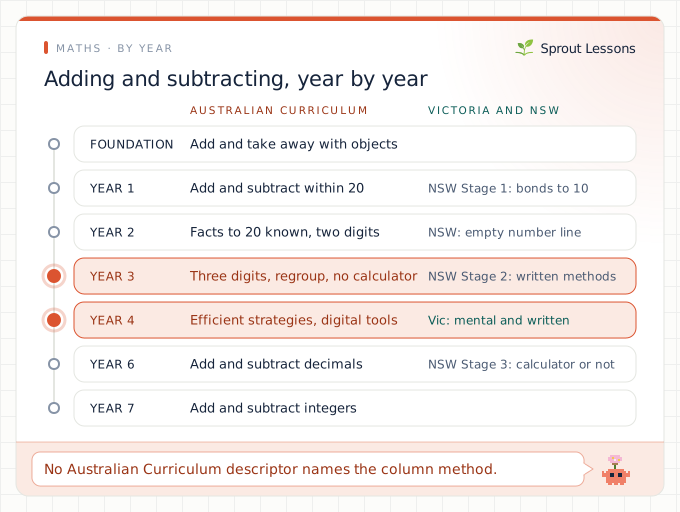
The Australian Curriculum descriptors, quoted from ACARA:
- Foundation, AC9MFN05: “represent practical situations involving addition, subtraction and quantification with physical and virtual materials and use counting or subitising strategies”. Counting, with things to hold.
- Year 1, AC9M1N04: “add and subtract numbers within 20, using physical and virtual materials, part-part-whole knowledge to 10 and a variety of calculation strategies”. Part-part-whole means knowing that 7 is 5 and 2, or 4 and 3, and using that instead of counting.
- Year 2, AC9M2A02 and AC9M2N04: “recall and demonstrate proficiency with addition facts to 20; extend and apply facts to develop related subtraction facts”, and “add and subtract one- and two-digit numbers, representing problems using number sentences, and solve using part-part-whole reasoning and a variety of calculation strategies”. Facts to 20 are meant to be known by the end of Year 2, not worked out.
- Year 3, AC9M3N03 and AC9M3A02: “add and subtract two- and three-digit numbers using place value to partition, rearrange and regroup numbers to assist in calculations without a calculator”, and “extend and apply knowledge of addition and subtraction facts to 20 to develop efficient mental strategies for computation with larger numbers without a calculator”. Regrouping is the idea underneath carrying and borrowing; the descriptor asks for the idea, not the layout. AC9M3A01 adds that addition and subtraction are inverse operations, used to find unknown values in number sentences.
- Year 4, AC9M4N06: “develop efficient strategies and use appropriate digital tools for solving problems involving addition and subtraction, and multiplication and division where there is no remainder”. This is the last descriptor about adding and subtracting whole numbers, and it allows a calculator where it is the sensible tool.
- Year 6, AC9M6N04: “apply knowledge of place value to add and subtract decimals, using digital tools where appropriate; use estimation and rounding to check the reasonableness of answers”.
- Year 7, AC9M7N07: “compare, order and solve problems involving addition and subtraction of integers”, which is where negative numbers join in.
We searched every Foundation to Year 10 maths descriptor for “written” and “algorithm”. “Written” never appears in an addition or subtraction descriptor. “Algorithm” does appear from Year 3 (AC9M3N07), but there it means a sequence of steps and decisions for investigating number patterns, the computing sense of the word, not the column method.
Where Victoria differs (the VCAA wording is paraphrased here, not quoted). Foundation to Level 3 match the Australian Curriculum (VC2MFN05, VC2M1N04, VC2M2N04, VC2M3N04, VC2M3A02). At Level 4, Victoria changes two words that matter: VC2M4N06 asks for efficient mental and written strategies alongside digital tools, and VC2M4A02 asks for multiplication facts to be used in mental and written strategies for larger numbers. The phrase carries on into multiplying and dividing at Level 5 (VC2M5N06, VC2M5N07) and the four operations with fractions and decimals at Level 7 (VC2M7N06). So in a Victorian school, a written method for adding and subtracting is curriculum content from Year 4, and it is reasonable to ask the teacher which one the school uses.
Where NSW differs (the NESA wording is paraphrased). The NSW Mathematics K–10 Syllabus is the most explicit of the three. Stage 1 (Years 1 and 2) builds number bonds to 10 and then 20, bridges to 10, and records jumps on an empty number line. The Stage 2 outcome MA2-AR-01 (Years 3 and 4) names mental and written strategies for two- and three-digit numbers, and its content asks children to model addition and subtraction with and without regrouping, to use an algorithm with understanding for three-digit numbers, to recognise how hundreds are exchanged in a subtraction algorithm, and to recognise when a mental strategy beats a vertical algorithm. Stage 3 (MA3-AR-01, Years 5 and 6) adds working out when a calculator is the efficient choice, and adding and subtracting decimals to three places.
Five mistakes that tell you where your child is
1. Counting all (Foundation and Year 1)
For 5 + 3, the child counts out five fingers, then three more, then counts all eight from one. The answer is right, so it is easy to miss. The next step is counting on: hold 5 in your head and count “six, seven, eight”. Then, in Year 1, part-part-whole: 5 + 3 is one less than 5 + 4, or it is 8 because 5 and 3 make 8 every time. If your Year 1 child counts all on every sum, practise counting on from the bigger number before anything else, because a child who still counts from one in Year 2 cannot keep up with two-digit numbers.
2. 3 + □ = 8 answered with 11 (Years 1 to 4)
The child sees a plus sign and two numbers and adds them. To them the equals sign means “now write the answer”, not “is the same as”. AC9M3A01 and AC9M4A01 both ask for unknown values in number sentences, and NSW teaches the equals sign as “is the same as” in Stage 1, so it turns up on worksheets well before most parents expect it. The fix is to read the sentence aloud with “is the same as”: three and how many is the same as eight? A balance or two piles of blocks makes the point faster than any explanation.
3. 52 − 27 = 35 (Years 3 and 4)
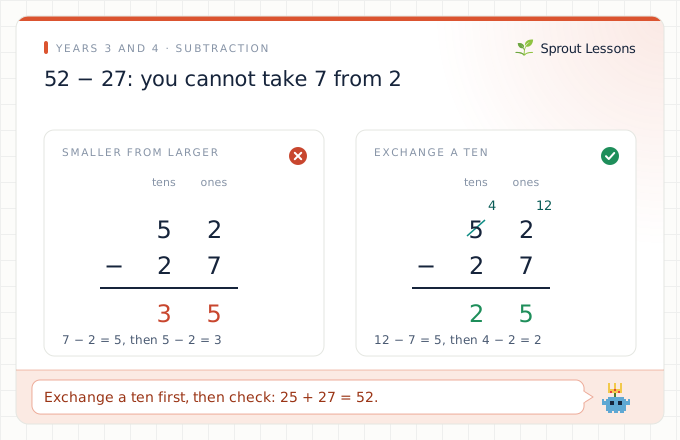
In the ones column the child cannot take 7 from 2, so they quietly take 2 from 7 instead. Then 5 − 2 in the tens, and the answer is 35. It is the single most common written subtraction mistake, and it comes from a rule that worked for every subtraction they did before regrouping arrived: take the small number from the big one. The fix is not a new rule but the old picture. Make 52 with tens and ones (bundled sticks, or money: five $10 notes and two $1 coins), try to take away 27, and let your child discover they have to swap a ten for ten ones. Then check by adding back: 25 + 27 = 52. A child who checks this way catches the mistake on their own.
4. 38 + 45 = 73 (Years 3 and 4)
8 + 5 is 13, the child writes the 3 and forgets the ten, or keeps the ten in their head and loses it. The answer is 83. A child who splits the numbers (30 + 40 = 70, 8 + 5 = 13, 70 + 13 = 83) rarely makes this mistake, which is one reason schools teach splitting first. If your child uses the column method and drops tens, ask them to estimate before they start: about 40 + about 45 is about 85, so 73 is too small. It is the same habit our rounding by year page describes.
5. 1,000 − 998 done in columns (Year 4 and up)
A child who has just mastered the column method uses it for everything, and 1,000 − 998 in columns means three exchanges across three zeros. Under that load the smaller-from- larger rule from mistake 3 often comes back, column by column, and the answer comes out as 1,998, bigger than the number they started with. The answer is 2, and a child who counts up from 998 gets it in a second. The NSW syllabus names this skill directly (knowing when a mental strategy beats a vertical algorithm), and it is what “efficient strategies” means in AC9M4N06. Knowing which method to use is the Year 4 skill, not knowing one method well.
A two-minute check
Do these in order and stop when one goes wrong. Each one maps to a year.
- Year 1: 6 + 3. Watch how: counting all, counting on, or just knowing? (9. Counting on from 6 is the Year 1 target; just knowing is the Year 2 one.)
- Year 2: 14 − 6, without fingers. (8. A child who says “6 and 8 is 14” is using the related fact, which is exactly AC9M2A02.)
- Year 2 to 3: 4 + □ = 11. (7, not 15.)
- Year 3: 47 + 38 in their head, then explain. (85. Listen for 40 + 30 and 7 + 8, or 47 + 40 − 2.)
- Year 3 to 4: 52 − 27 on paper, any method. (25.)
- Year 4: 1,000 − 998. Which method did they pick? (2, by counting up.)
- Year 6: 6.4 + 2.35. (8.75. If they write 2.99, they lined the digits up on the right instead of at the decimal point.)
The first one that goes wrong is where to start. A Year 4 child who gets 5 right but uses columns for 6 is not behind; they have one method and need a second.
Want practice set in their own world? Sprout writes a maths lesson on AC9M3N03 or VC2M4N06 around what your child loves, from footy scores to Minecraft. Try it free.
Twenty minutes, three methods
The aim is a child who can choose, so practise more than one way to do the same sum.
- Five minutes: facts to 20. Pick one family, such as the facts that make 13 (9 + 4, 8 + 5, 7 + 6), and say them both ways: 13 − 5 is 8 because 8 + 5 is 13. Facts are the raw material for every method below.
- Five minutes: split it. Three two-digit sums done by splitting into tens and ones, said aloud. 56 + 27 is 70 and 13, which is 83.
- Five minutes: jump it. Draw an empty number line for one subtraction, such as 82 − 47. Jump back 40 to 42, then 7 more to 35. Then do it the other way, counting up from 47 to 82, and see that both give 35.
- Five minutes: choose. Write four sums: 300 − 299, 45 + 46, 734 − 258, 199 + 199. For each, your child says which method they would use and why, then does it. There is no single right choice, but counting up for the first and columns for the third are good ones.
What is not the problem
- No column method in Year 3. The Australian Curriculum never names one, and Victoria names written strategies from Year 4. Splitting and number lines in Year 3 are the curriculum, not a detour.
- A method that is not yours. Schools differ in which written method they teach and when. If you show your child your way, show it as another way, and ask them to explain theirs first.
- Fingers in Foundation and Year 1. Counting with fingers is how counting on starts. It becomes worth working on when facts to 20 are still counted at the end of Year 2.
- A calculator in Year 4. AC9M4N06 names digital tools on purpose. What the curriculum wants is a child who knows roughly what the calculator should say.
Where this sits
Regrouping is place value in action, so if mistakes 3 and 4 will not shift, start with our place value by year page. Facts to 20 lead straight into times tables by year, and decimals have their own page in decimals by year. For the whole picture of a year level, see what a Year 3 student should know, and for every maths code in that year, the teacher-facing Year 3 maths codes page. If you are not sure which curriculum your school follows, start with which curriculum your state uses.
The short version
- Foundation: objects and counting. Year 1: within 20. Year 2: facts to 20 known, two-digit numbers.
- Year 3: three-digit numbers, regrouping, mental strategies, no calculator.
- Year 4: efficient strategies and digital tools. The Australian Curriculum never names the column method.
- Victoria names mental and written strategies from Level 4. NSW names the vertical algorithm in Stage 2.
- 52 − 27 = 35 is smaller-from-larger. Check by adding back.
- The Year 4 skill is choosing a method, not mastering one.
Sprout makes a lesson on the exact code your child is working on, with examples in their own interests. Start free.
How this page was checked
The Australian Curriculum descriptors are quoted from our copy of version 9.0, which matches AC9M3N03 on the Australian Curriculum website; we searched every Foundation to Year 10 maths descriptor for addition, subtraction, written, algorithm and regrouping. The Victorian codes are from the Victorian Curriculum F–10 version 2.0. The NSW findings come from the Combining and separating quantities and Additive relations pages of the NSW Mathematics K–10 syllabus content for Stage 1 to Stage 3 (six pages), read on 25 October 2026. Victorian and NSW wording is paraphrased. Checked 25 October 2026.
Australian Curriculum content descriptions are © Australian Curriculum, Assessment and Reporting Authority (ACARA) 2010 to present, licensed under CC BY 4.0, and quoted here unmodified. ACARA does not endorse any product that uses the Australian Curriculum. Victorian Curriculum codes reference the Victorian Curriculum F–10 Version 2.0 © VCAA, paraphrased; the VCAA does not endorse this product. NSW outcome codes reference the NSW syllabuses © NSW Education Standards Authority (NESA) for and on behalf of the Crown in right of the State of New South Wales, paraphrased, available at curriculum.nsw.edu.au; NESA does not endorse this product.
FAQ
When do kids learn column addition and subtraction in Australia?
It depends on the state. The Australian Curriculum never names a written method: Year 3 adds and subtracts three-digit numbers by partitioning and regrouping without a calculator (AC9M3N03), and Year 4 asks for efficient strategies and digital tools (AC9M4N06). Victoria asks for mental and written strategies from Level 4 (VC2M4N06), and the NSW syllabus names the vertical algorithm in Stage 2, which is Years 3 and 4.
Why does my child's school teach splitting instead of carrying and borrowing?
Because splitting numbers into tens and ones is the idea the column method rests on. AC9M3N03 asks children to partition, rearrange and regroup numbers, which is carrying and borrowing explained, and mental strategies come first so that a child can check a written answer. The column method is still taught, usually from Year 4.
Why does my child get 52 minus 27 equals 35?
They are taking the smaller digit from the larger in each column: 7 minus 2 in the ones instead of 2 minus 7. The answer is 25. The fix is to make 52 with tens and ones, discover that a ten has to be exchanged for ten ones, and check by adding back: 25 plus 27 is 52.
What addition facts should a Year 2 child know?
All the addition facts to 20, and the subtraction facts that go with them. AC9M2A02 asks for Year 2 students to recall and demonstrate proficiency with addition facts to 20 and to use them to develop related subtraction facts, so 14 minus 6 is 8 because 6 and 8 make 14.
Can Year 4 students use a calculator for addition?
Where it is the sensible tool, yes. AC9M4N06 names appropriate digital tools alongside efficient strategies, and NSW Stage 3 asks children to decide when a calculator is the efficient choice. What the curriculum still expects is a child who can estimate roughly what the answer should be.