
In the Australian Curriculum, rounding is first named in Year 4, where children round to check whether an answer is reasonable. Year 3 estimates without rounding, Years 5 and 6 use rounding to check calculations with decimals, and rounding decimals to a given number of places is Year 7. Victoria adds rounding change to the nearest 5 cents in Year 4. NSW starts much earlier: finding the nearest ten and the nearest hundred is Stage 1 content, in Years 1 and 2.
So if your Year 2 child in Sydney is bringing home “round to the nearest 10” sheets while a cousin in Melbourne has never heard the word, both schools are on track. And if your Year 4 child can round perfectly but never thinks to do it, that is the gap the curriculum cares about most, because in Australia rounding is taught as a checking tool, not as a topic of its own. This page sets out what each year asks for, the five mistakes worth knowing (including the 5-cent rounding at the shops that only makes sense here), a two-minute check and a twenty-minute routine.
What the curriculum asks for, year by year
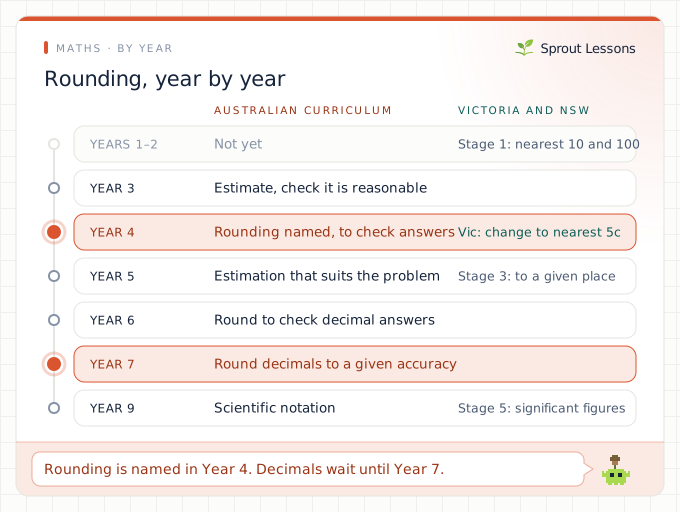
The Australian Curriculum descriptors, quoted from ACARA:
- Year 3, AC9M3N05: “estimate the quantity of objects in collections and make estimates when solving problems to determine the reasonableness of calculations”. Estimating, but no rounding yet.
- Year 4, AC9M4N07: “choose and use estimation and rounding to check and explain the reasonableness of calculations including the results of financial transactions”. This is the first content description in Foundation to Year 10 that names rounding, and it names it as a way to check, not as an end in itself.
- Year 5, AC9M5N08: “check and explain the reasonableness of solutions to problems including financial contexts using estimation strategies appropriate to the context”. The skill here is choosing how roughly to round for the job in front of you.
- Year 6, AC9M6N04 and AC9M6N06: adding and subtracting decimals, and multiplying and dividing decimals by powers of 10, each “using estimation and rounding to check the reasonableness of answers”. AC9M6N08 adds approximating answers to problems with rational numbers and percentages.
- Year 7, AC9M7N05: “round decimals to a given accuracy appropriate to the context and use appropriate rounding and estimation to check the reasonableness of solutions”. Rounding to one or two decimal places lives here.
- Year 9, AC9M9M02: very small and very large measurements in scientific notation. No Foundation to Year 10 content description in the Australian Curriculum names significant figures.
Where Victoria differs (the VCAA wording is paraphrased here, not quoted). The rounding and estimation descriptors match the Australian Curriculum level by level (VC2M3N06, VC2M4N07, VC2M5N08, VC2M6N04, VC2M6N06 and VC2M7N04). The addition is VC2M4N08: solving problems with purchases and working out change to the nearest 5 cents, with and without digital tools. That is rounding in its most practical form, and it is mistake 4 below.
Where NSW differs (the NESA wording is paraphrased). The NSW Mathematics K–10 Syllabus puts rounding in its number content well before Year 4. In Stage 1 (Years 1 and 2), children use number lines and charts to find the nearest ten to a number, estimate collections to the nearest ten and later the nearest hundred, and identify the nearest hundred to a number. Stage 2 (Years 3 and 4) identifies the nearest thousand, ten thousand or hundred thousand. Stage 3 (Years 5 and 6) rounds numbers to a specified place value, rounds when estimating answers to calculations, approximates the size of decimals and rounds time answers to the nearest minute or hour. Rounding to significant figures appears in a Stage 5 outcome (MA5-MAG-C-01), which the Australian Curriculum has no equivalent for.
Five mistakes that tell you where your child is
1. 47 becomes 40 (Year 4, or Stage 1 in NSW)
The child has learnt that rounding makes the ones digit a zero and simply drops the 7. It is the most common first mistake, and the fix is to stop talking about digits and talk about distance. On a number line from 40 to 50, is 47 closer to 40 or to 50? Most children can see the answer before they can say the rule. Then mark 45 as the halfway point: anything past it goes up. The digit rule (“5 or more, round up”) is a shortcut for that picture, and children who learn it without the picture are the ones who make mistake 2.
2. 3,449 becomes 3,500 (Year 4 to Year 6)
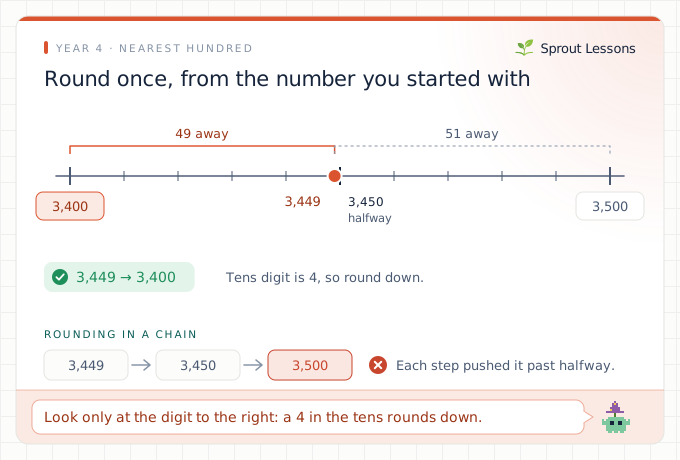
Round 3,449 to the nearest hundred and a careful child often writes 3,500. They rounded in a chain: the 9 made 3,449 into 3,450, and the 5 made that into 3,500. Each step follows the rule, and the answer is still wrong, because 3,449 is closer to 3,400. The fix is a rule and a picture together: round once, from the number you started with, looking only at the digit one place to the right of the one you are rounding to. For the nearest hundred, that is the tens digit, a 4, so it rounds down.
3. Rounding that never gets used (Year 5 and Year 6)
A Year 6 child adds 4.75 and 3.6, lines the digits up on the right instead of at the decimal point, and writes 5.11. They know how to round. They just did not do it, and a two-second estimate (about 5 plus about 4 is about 9) would have caught it. This is the skill the curriculum keeps naming, from “reasonableness” in Year 3 to “check the reasonableness of answers” in AC9M6N04, and it is the one that school worksheets on rounding rarely practise. The fix is a habit: estimate before calculating, write the estimate down, and compare at the end. The right answer here is 8.35, close to 9, so it passes.
4. $7.97 becomes $8.00 at the shop (Year 4, Victoria)
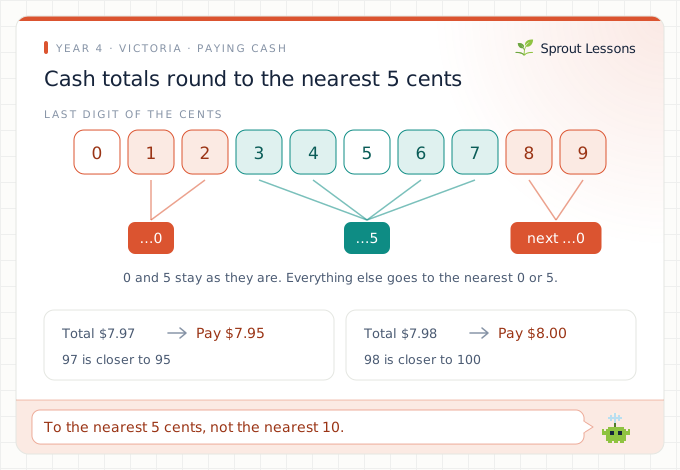
Australia has no 1 or 2 cent coins, so a cash total is rounded to the nearest 5 cents, and Victoria makes that a named Year 4 skill (VC2M4N08). Children who have just learnt to round to the nearest 10 apply it here and get it wrong half the time: $7.97 is paid as $7.95, not $8.00, because 97 is closer to 95 than to 100. The picture is the same number line with more stops on it. Next time you pay cash, let your child work out what the total will become before the shop assistant says it. Our money by year page has more on what each year expects with coins and change.
5. 2.96 to one decimal place becomes 2.10 (Year 7)
Rounding 2.96 to one decimal place, the 9 in the tenths place has to go up, and a child who treats the digits as separate counters writes 2.10, as though nine plus one made a “10” in that one column. The answer is 3.0, and the zero matters: it says the number was rounded to one decimal place, which “3” alone does not. AC9M7N05 asks for rounding “to a given accuracy”, and writing the trailing zero is part of showing that accuracy. The fix is the number line again, this time from 2.9 to 3.0, and the question from mistake 1: which is it closer to?
A two-minute rounding check
Do these in order and stop when one goes wrong. Each one maps to a year.
- Stage 1 in NSW, Year 4 elsewhere: Is 47 closer to 40 or 50? Round 63 to the nearest ten. (50; 60.)
- Year 4: Round 3,449 to the nearest hundred, then explain how you know. (3,400, because the tens digit is 4.)
- Year 4 in Victoria: A cash total is $12.38. What do you pay? ($12.40.)
- Year 5 and 6: Without working it out, is 4.75 + 3.6 nearer to 5, 8 or 11? (8: it is 8.35.)
- Year 7: Round 2.96 to one decimal place. (3.0.)
The first number that goes wrong is the place to start. A Year 5 child who manages 1 and 2 but hesitates on 4 has the rule and not the habit, which is the more useful thing to work on.
Want practice set in their own world? Sprout writes a maths lesson on AC9M4N07 or VC2M4N08 around what your child loves, from footy scores to Lego. Try it free.
Twenty minutes, mostly estimating
Rounding sheets practise the rule. The curriculum wants the habit, which is easier to build in everyday sums.
- Five minutes: the number line. Draw a line from 40 to 50 and mark 45. Call out numbers and have your child point to where each one sits, then say which end it is closer to. Move to 3,400 to 3,500 when that is easy.
- Five minutes: estimate first. Give three sums from their homework. Before working each one out, they write a rounded estimate in the margin. After, they circle any answer that is far from its estimate.
- Five minutes: the shopping docket. Take a supermarket docket and have your child round each price to the nearest dollar and add them up. Compare with the real total. How close did they get, and which way, and why?
- Five minutes: cash rounding (Year 4 and up). Write five totals ending in different cents ($3.41, $3.43, $3.46, $3.48, $3.45) and have your child say what each one becomes in cash.
What is not the problem
- No rounding before Year 4 outside NSW. The Australian and Victorian curricula estimate in Year 3 and name rounding in Year 4. In NSW, the nearest ten and hundred are Stage 1 content.
- Rounding 5 up. A number exactly halfway, such as 45, is the same distance from 40 and 50, so rounding it up is a convention rather than a fact. Schools use “5 or more, round up”, and so should you, but a child who asks why is asking a good question.
- Estimates that are not exact. An estimate is meant to be rough. What matters is whether it is close enough to catch a wrong answer.
Where this sits
Rounding sits on top of place value: a child who cannot say which digit is the hundreds digit cannot round to the nearest hundred, so if mistake 2 will not shift, start with our place value by year page. For decimals, see decimals by year. For the whole picture of a year level, see what a Year 4 student should know, and for every maths code in that year, the teacher-facing Year 4 maths codes page. If you are not sure which curriculum applies, start with which curriculum your state uses.
The short version
- Year 3: estimating without rounding. Year 4: rounding first named, as a way to check.
- Years 5 and 6: estimation strategies, and rounding to check answers with decimals.
- Year 7: rounding decimals to a given accuracy. Significant figures only in NSW Stage 5.
- Victoria adds cash rounding to the nearest 5 cents in Year 4.
- NSW starts in Stage 1 with the nearest ten and the nearest hundred.
- Round once, from the number you started with, and estimate before you calculate.
Sprout makes a lesson on the exact code your child is working on, with examples in their own interests. Start free.
How this page was checked
The Australian Curriculum descriptors are quoted from our copy of version 9.0, which matches AC9M4N07 on the Australian Curriculum website; we searched every Foundation to Year 10 maths descriptor for rounding, estimation, approximation and significant figures. The Victorian codes are from the Victorian Curriculum F–10 version 2.0. The NSW findings come from every NSW Mathematics K–10 content page in Stage 1 to Stage 3 (58 pages), read on 24 October 2026; Stage 4 and 5 are covered at outcome level only. Victorian and NSW wording is paraphrased. Checked 24 October 2026.
Australian Curriculum content descriptions are © Australian Curriculum, Assessment and Reporting Authority (ACARA) 2010 to present, licensed under CC BY 4.0, and quoted here unmodified. ACARA does not endorse any product that uses the Australian Curriculum. Victorian Curriculum codes reference the Victorian Curriculum F–10 Version 2.0 © VCAA, paraphrased; the VCAA does not endorse this product. NSW outcome codes reference the NSW syllabuses © NSW Education Standards Authority (NESA) for and on behalf of the Crown in right of the State of New South Wales, paraphrased, available at curriculum.nsw.edu.au; NESA does not endorse this product.
FAQ
What year do kids learn rounding in Australia?
Year 4. AC9M4N07 is the first content description in the Australian Curriculum to name rounding, as a way to check whether an answer is reasonable; Year 3 estimates without it. Victoria matches this at Level 4 (VC2M4N07). In NSW, finding the nearest ten and the nearest hundred is Stage 1 content, in Years 1 and 2.
When do kids learn to round decimals?
Year 7. AC9M7N05 asks students to round decimals to a given accuracy appropriate to the context. Before that, Year 6 uses estimation and rounding to check answers when adding, subtracting, multiplying and dividing decimals (AC9M6N04, AC9M6N06). NSW Stage 3 approximates the size of decimals and rounds to a specified place value.
How does rounding to the nearest 5 cents work?
Australia has no 1 or 2 cent coins, so a cash total is rounded to the nearest 5 cents. Totals ending in 1 or 2 cents round down to 0, 3 and 4 round up to 5, 6 and 7 round down to 5, and 8 and 9 round up to the next 10. So $7.97 is paid as $7.95 and $7.98 as $8.00. Victoria teaches this in Year 4 (VC2M4N08).
Why does my child round 3,449 to 3,500?
Because they rounded in a chain: 3,449 to 3,450, then 3,450 to 3,500. Each step follows the rule but the answer is wrong, because 3,449 is closer to 3,400. Round once, from the number you started with, looking only at the digit one place to the right of the one you are rounding to.
Does Australia teach significant figures?
Not in a Foundation to Year 10 content description of the Australian Curriculum, which stops at rounding decimals to a given accuracy (Year 7) and scientific notation (Year 9). NSW names rounding to significant figures in a Stage 5 outcome (MA5-MAG-C-01).